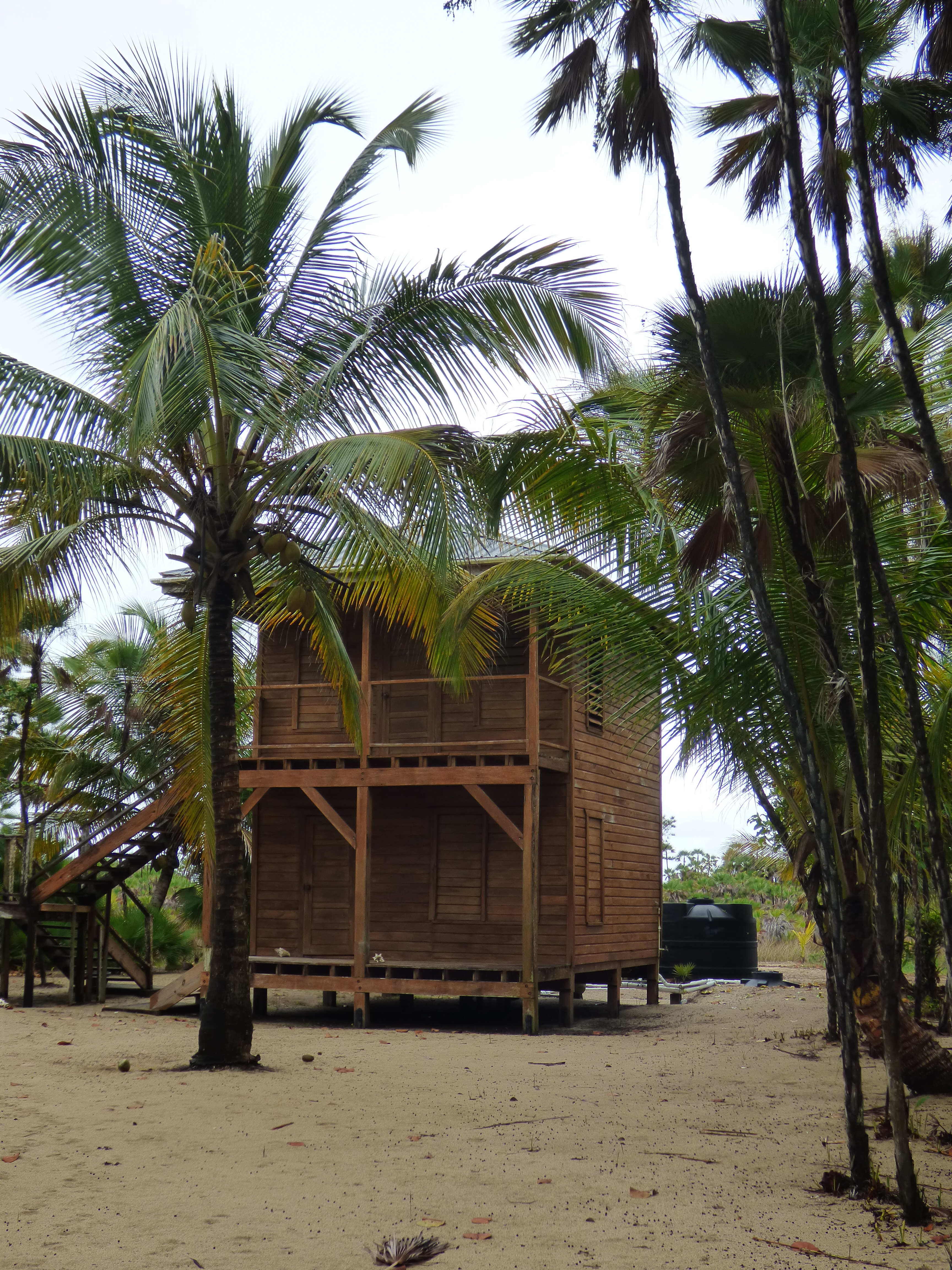
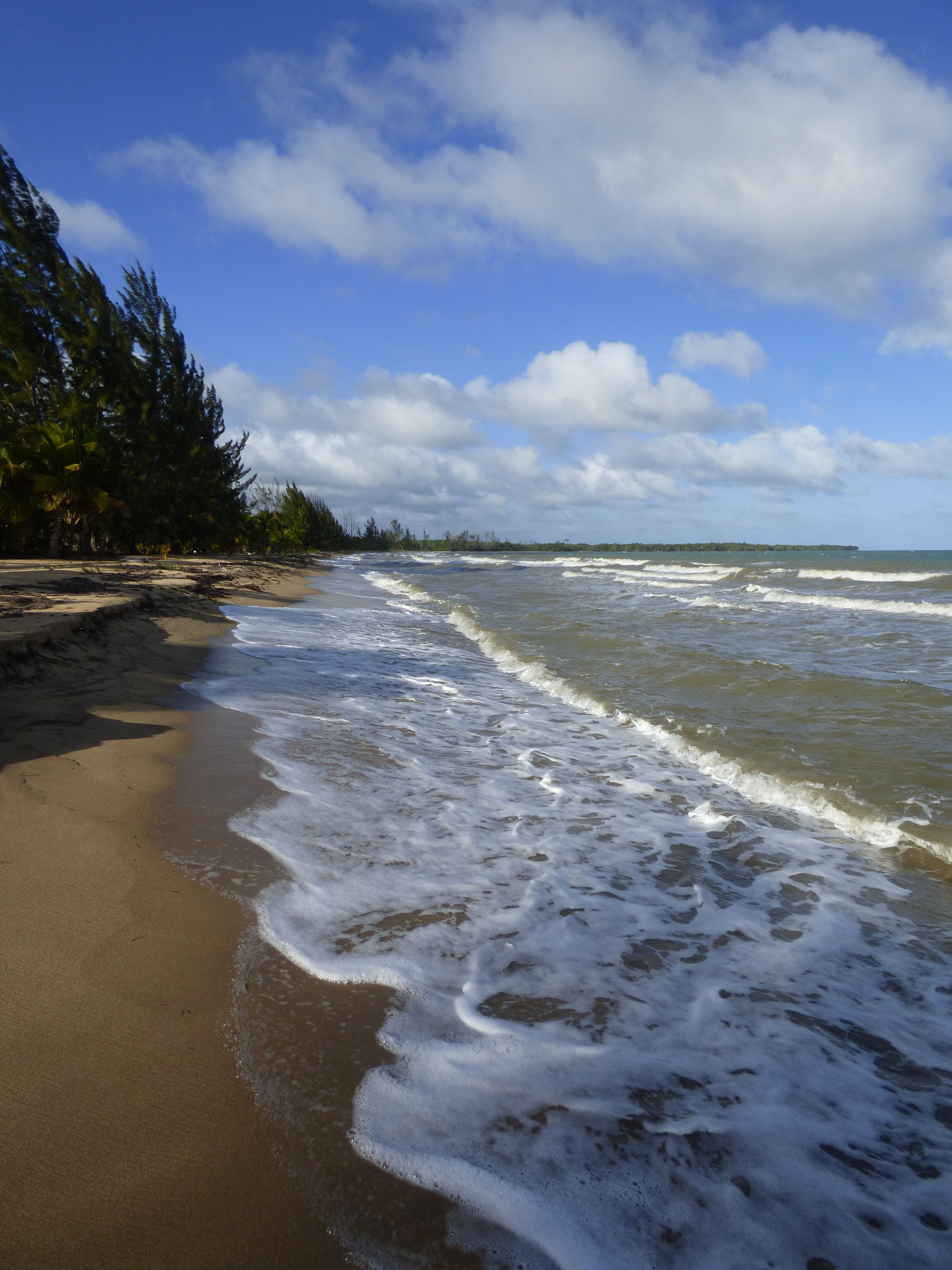
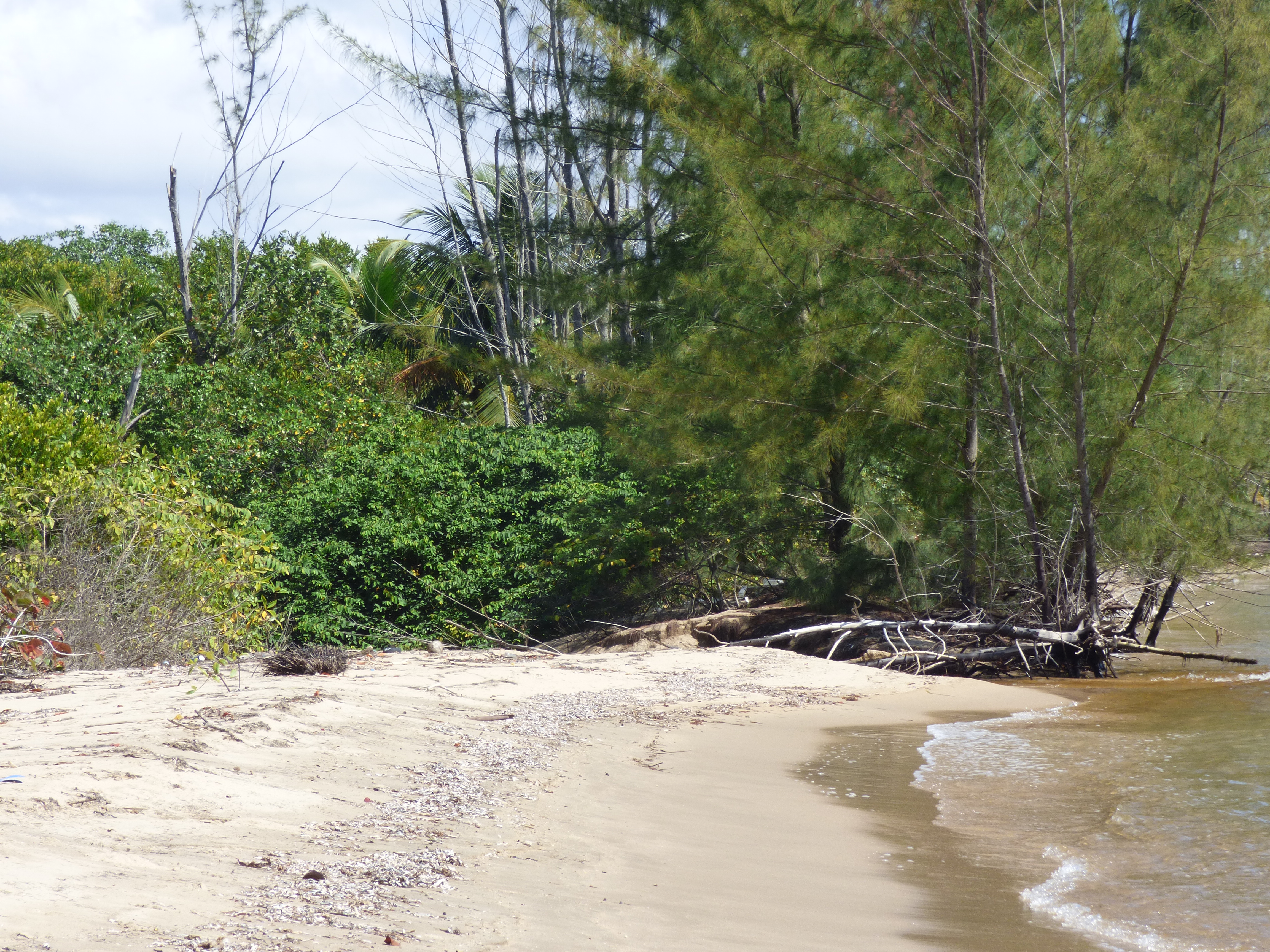
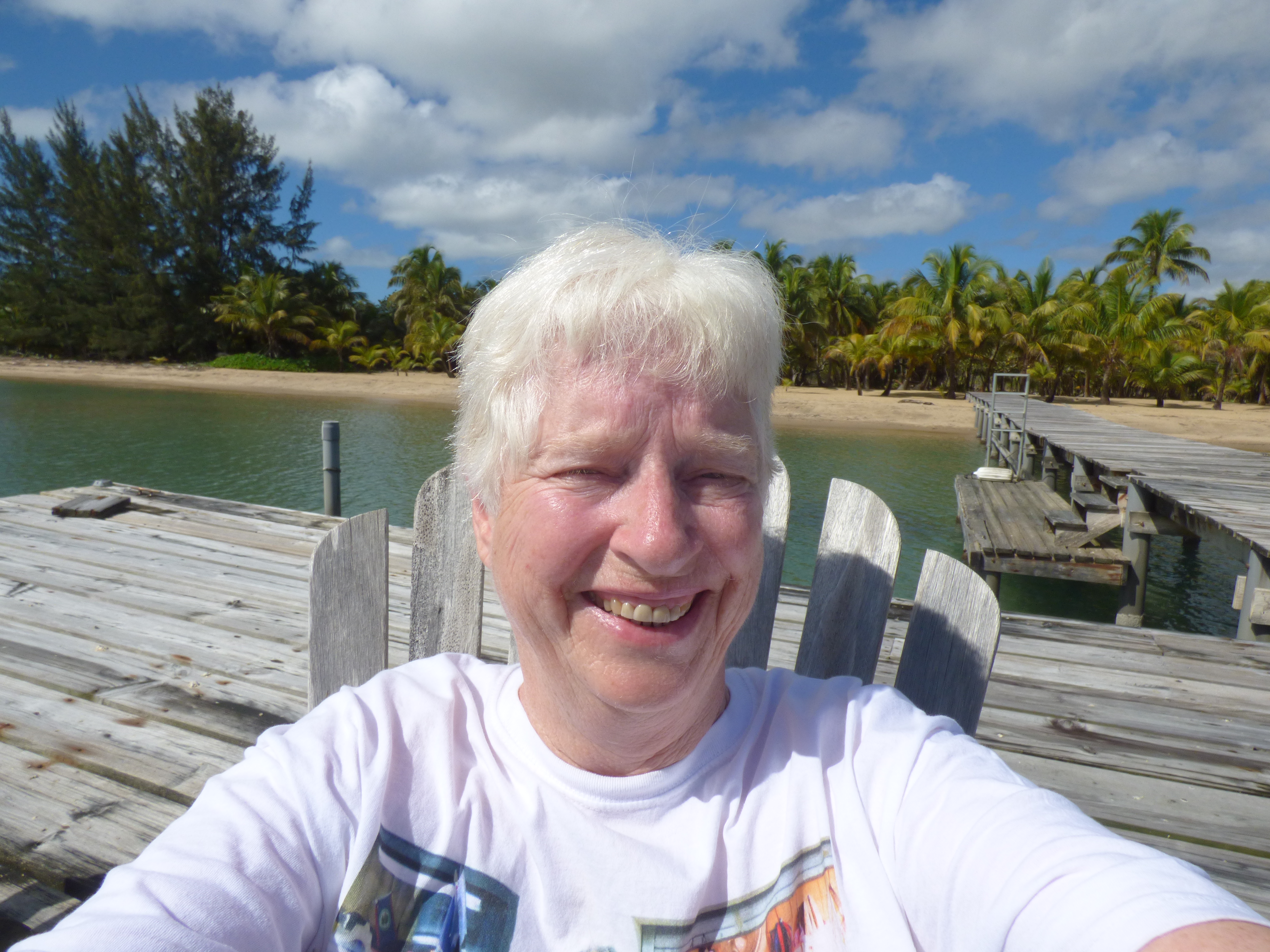
As you can see from my posts, Sabal Beach was my “happy place”. For 10 years (bar two covid years) I made my pilgrimage to Sabal Beach. Miles of white sand, a sea of Caribbean colours, a cabana that offered comfort and, most of all, all the privacy anyone could want.
After 5 years of only visiting Sabal Beach for varying times, I began to split my time between Placencia and Sabal Beach and spent longer in Belize. The quiet mornings at Sabal Beach with gentle breezes filtering through the louvres are a memory to savour. Long walks alone on a deserted, white sand beach were relaxing and healing especially for someone who regularly travelled the world through the stress of airports, new cities, new colleagues, different work. There was no corner store, no resupply available.
Prepping for a trip to Sabal Beach was always challenging … what did I want to eat? how much food did I need for however long I was staying? What substitutions could I make when what I might want to eat was unavailable in Placencia? And, of course, there was the bill!
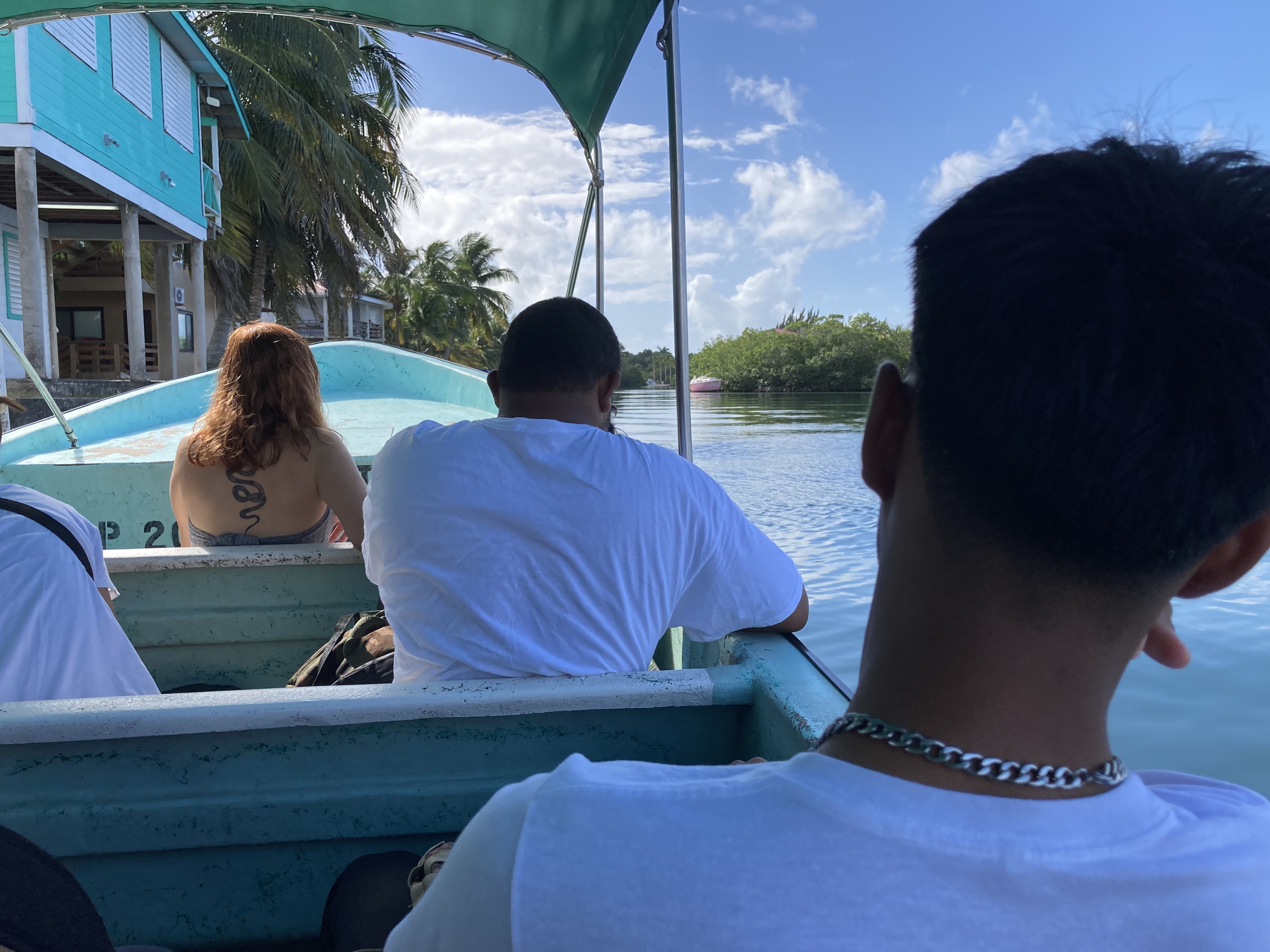
Getting on Jason’s boat (he is now running Adventours Belize) I could feel, as we left the dock, my stress level go down and relaxation set in. Jason is a wonderful boat captain – no matter the sea conditions I always felt fully safe in his care. He also had a keen eye for passing wildlife and a willingness to share his knowledge of the local fauna.
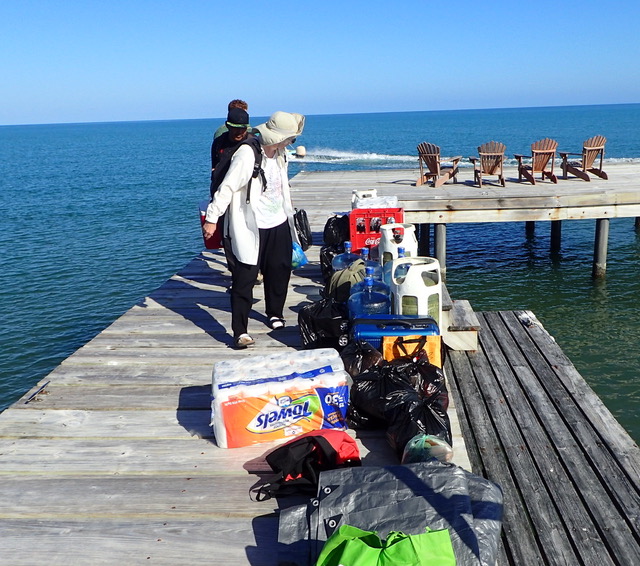
Often, the owners also used the boat pick up run to bring in supplies … water, toilet paper, food for the caretaker, gas cylinders. Arriving at the dock I was greeted by a big smile from the caretaker, Sly. Similing although he knew that all that stuff – suitcases, my purchases and the owner’s supplies – had to be got to the cabana or main house by him and his wheelbarrow. One year the sea was so high Jason could not get the boat to the dock safely and beached it requiring Sly (and I) to unload it in waist deep water! What a landing adventure.
Then, peace, quiet, the beach and the sand. The bird life and the aquatic life. My feet in the surf, keeping a careful lookout for crabs, star fish, and manta rays with their evil glares.
The owners originally lived on the property but moved into Placencia in 2018 or 2019. Although I missed their company and they were not intrusive at all … an evening beer on the dock as the sun set was all I usually saw of them … it was time they moved on.
I continued to go down to Sabal Beach until 2024 when the owners sold it. It is now very different under new owners and I simply cannot afford to go back. With cabanas having been built just to the north, the atmosphere had changed last time I was there and I knew the future would look quite different. That is progress and, as a boss of mine once said “the only thing that is guaranteed is change and it will happen”.
How true! I miss the Sabal Beach that I knew – but the memories of my “Happy Place” will remain with me always as I now, regularly, come down to stay in Placencia for a good part of the winter to avoid the ice and snow.
I wrote the following in mid February when I was at Sabal Beach and am now posting it very, very, much later!
I arrived here at Sabal Beach on Monday and the sea was high as Willsey brought us in Jason’s boat but we were able to land at the dock rather than beach the boat (an altogether wetter unloading). Sly, the caretaker, schlepped all my stuff up to the cabana in his wheelbarrow and lugged it up the stairs bless his heart. He looks after me well!
Emilio and Juan Pablo came with us and Emilio made some repairs – including an adjustment to the inline water heater that has made the hot water work as well as it ever has – and were soon done and Willsey took them back on the boat. As soon as they left, the wind picked up and there was a tropical downpour. The wind then veered to an onshore wind from east-northeast and it blew that way until Friday morning, producing waves that smashed into the dock and sprayed spume over it. I am beginning to understand a friend who lives near the Tantramar Marsh in Sackville, NB where the Tantramar Breezes blow briskly. A steady wind can grind on the nerves. We were lucky in Sackville that we had applied wrap-around insulation to our house, top to bottom, held firm with tuck tape before we put the new siding on. As soon as that went around the house, the house felt still and quiet and the winds, broken by the many mature trees around our neighbourhood, did not bother us.
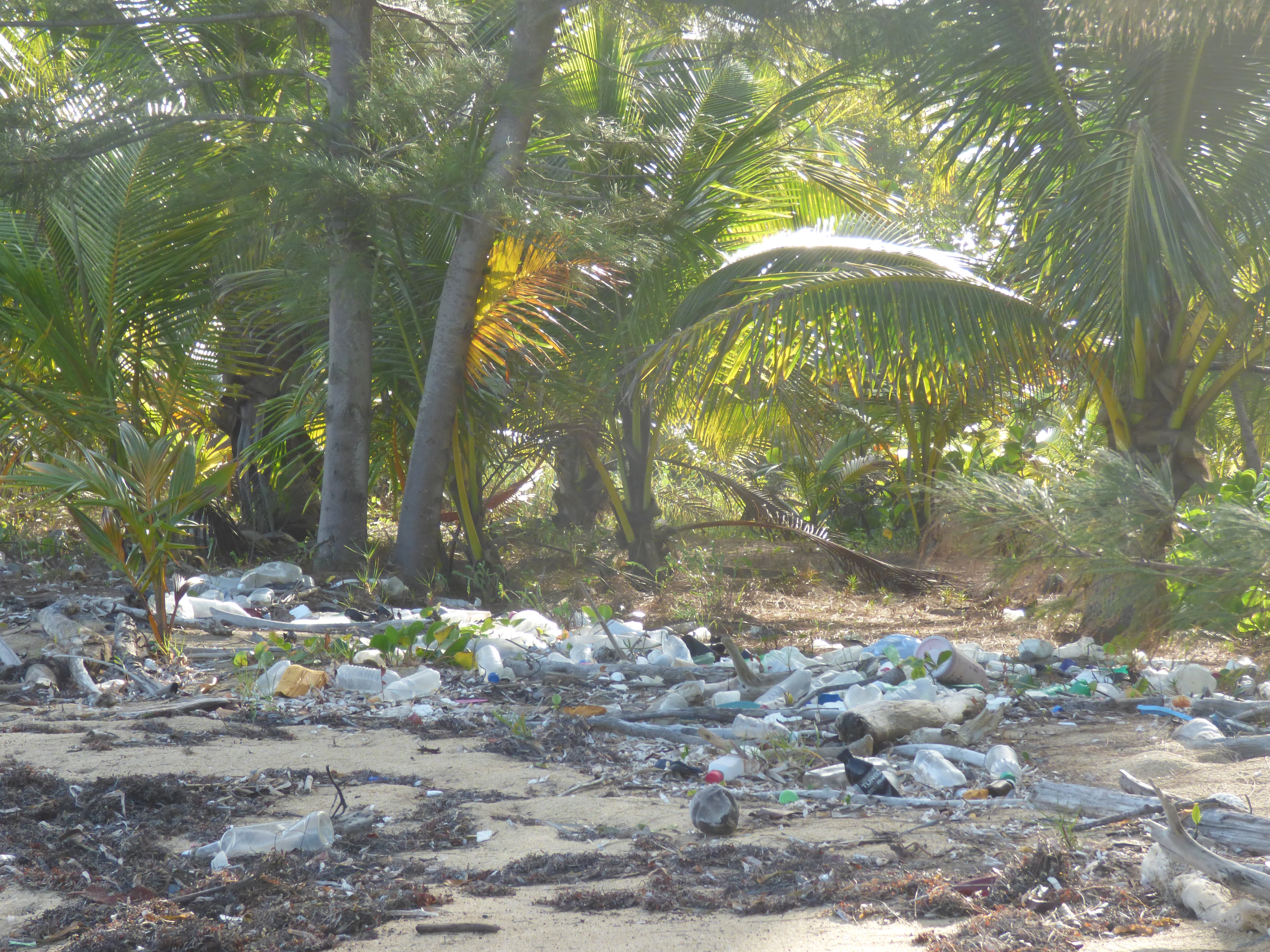
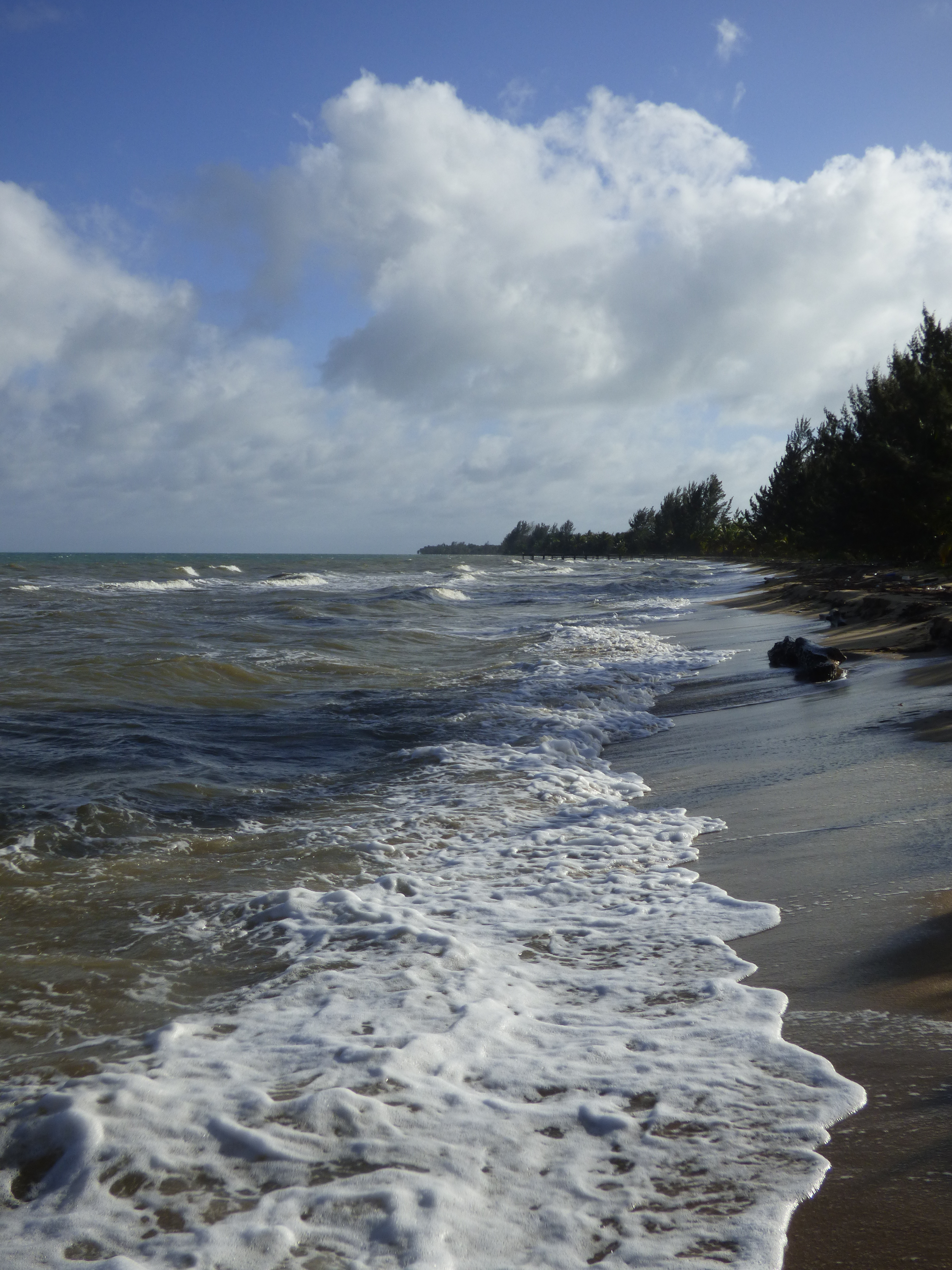
Braving the winds, I have walked along the shore every day, my feet splashing in the waves, and seen the changes brought by the tides since my last visit a year ago. There are inroads in the shore in some places, built up ledges of sand in others. Not to mention all the flotsam that is heaved up on shore: plastic water/soda bottles, plastic motor oil bottles, the occasional soccer ball, plastic flip flops – usually one of a pair. All these things could fly off one of the passing cruise ships (Norwegian Cruise Lines have dredged and built out a huge island, including zip line and dock for the ship about half way between here and Placencia). Other things – 100 ml deodorant containers, disposable razors, used condoms and tampon applicators – are the type of things you throw in your bathroom garbage in your cabin on cruise ship or yacht or sailboat which indicates to me that someone has dumped garbage, somewhere in the ocean to the east of here. Areas where no one occupies the land, these things stay there until the cows come home and clutter the shore. Where someone cares for the shore, it all has to be bagged up, carted out by boat and paid for at the landfill drop off.
Friday night the wind wound down and became a light, westerly off-shore breeze – very cooling as it comes from the mountains you can see in the westerly distance. Lovely for sleeping and pleasant during the day, these are the salad days winds that are soothing. Add to that an overcast sky and the occasional black cloud that seems to avoid Sabal Beach itself and the day stays cool as well and the humidity stays down as it doesn’t when the sun beats on the wet sand. Today, Sunday, the waves are down and I took a morning walk to see if there were manta rays spreading their malevolent looks in the shallows but no luck. The shore sure has changed in the almost week I have been here – one large piece of driftwood has created its own crumbling shoreline behind it after being scoured by the waves. One piece of flotsam, which appeared to be a hard plastic vegetable creel, was well buried in sand yesterday and has floated off with the tide sometime between yesterday and today!
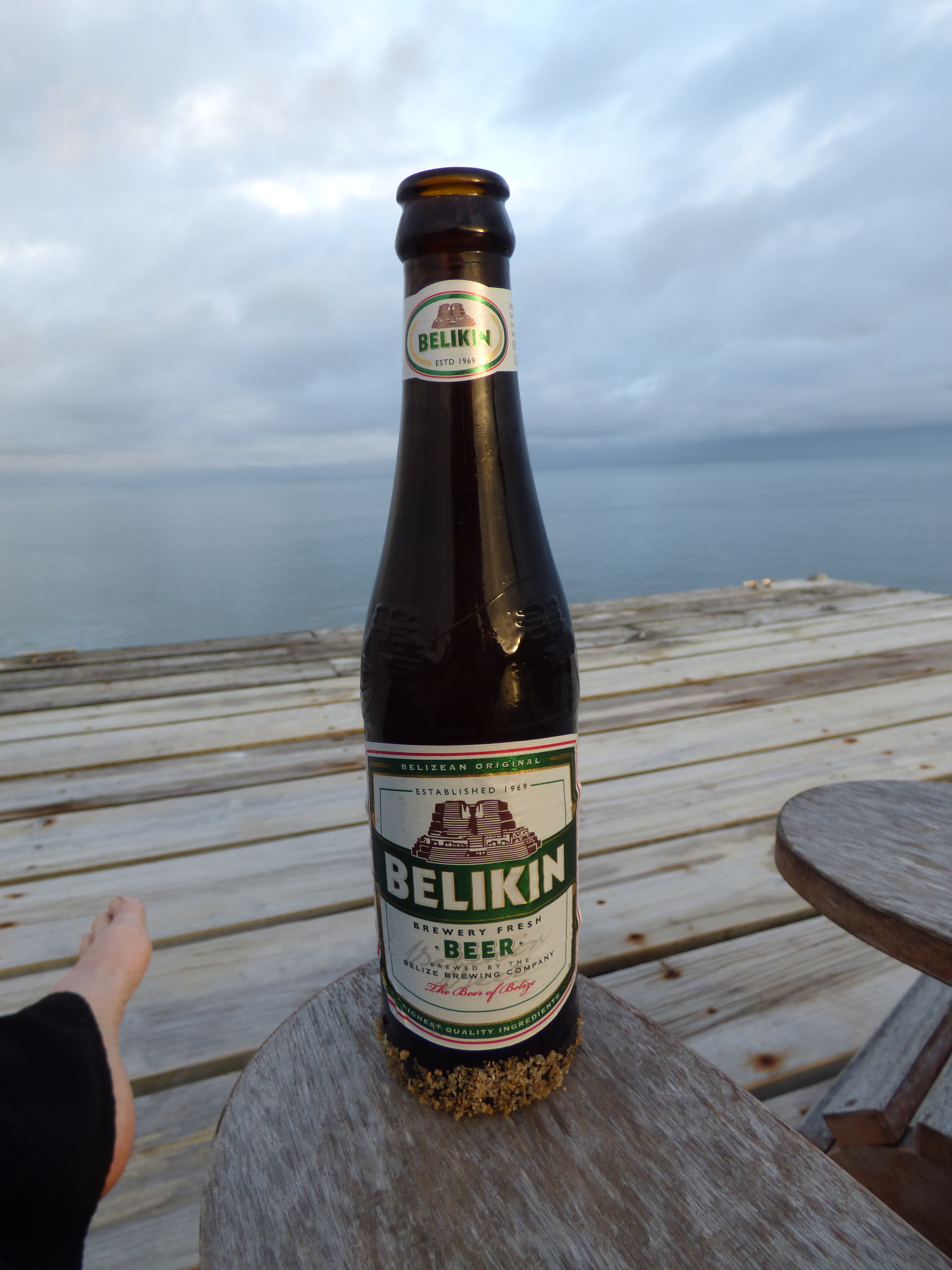
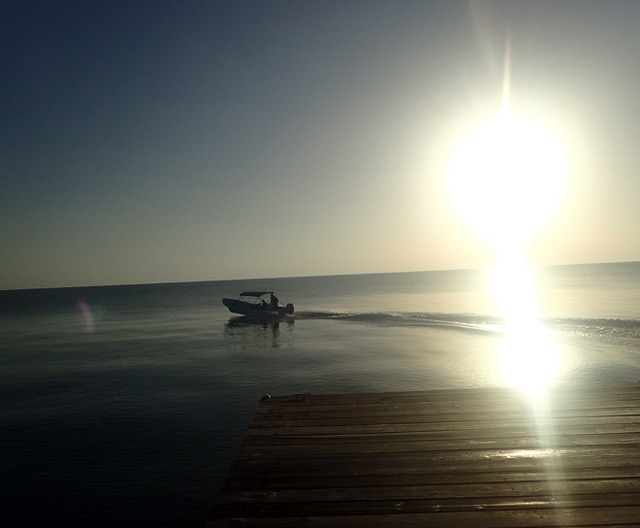
If it stays nice with as little wind as today so far, I look forward to a quiet Belikin Beer on the dock watching what might be a spectacular sunset tonight with enough cloud in the sky to give a colourful display.
Not this year’s photo but the usual arrival at Sabal Beach is with supplies brought down (gas and drinking water), my suitcase and all the food bought for the duration of my stay.
Except for two weeks at Christmas, I have spent my time, since the beginning of November, at a rental in Placencia, Belize. It is a lovely, cozy, 1 bedroom house on the canal. I have a rowboat to paddle across the canal should I choose to bail it out and get into town. It has not been as relaxing as last year due to a 7 day a week generator at the house construction across the canal and, since Christmas, either a noisy power washer/generator or table saw going, again, 7 days a week at the house to the south of me. The construction starts most mornings at 8:00 am and stops for a two hour lunch and resumes until 4:30 or 5:00. The repair work/maintenance at the house south of me has started on occasion at 7:15 am but usually ends around lunch time – unless he doesn’t start until lunch time then works to supper time. About twice a week, there is a late afternoon, loud party at the small resort 2 properties to the north that shakes my floor with the base amplifier. Luckily, I have been waking at 6:00 am to enjoy an hour or two of quiet song from the birds in the palms of the front yard before the construction noise sends them on their way.
Needless to say, I have been longing for Sabal Beach – a very isolated, off-grid property near Punta Negra, a 45 minute boat ride (no roads) south of Placencia. On 06 Feb I made it here for 9 days and wrote this sitting typing with a view of the Caribbean through the gently rustling palms and the breeze that blows through the cabana.
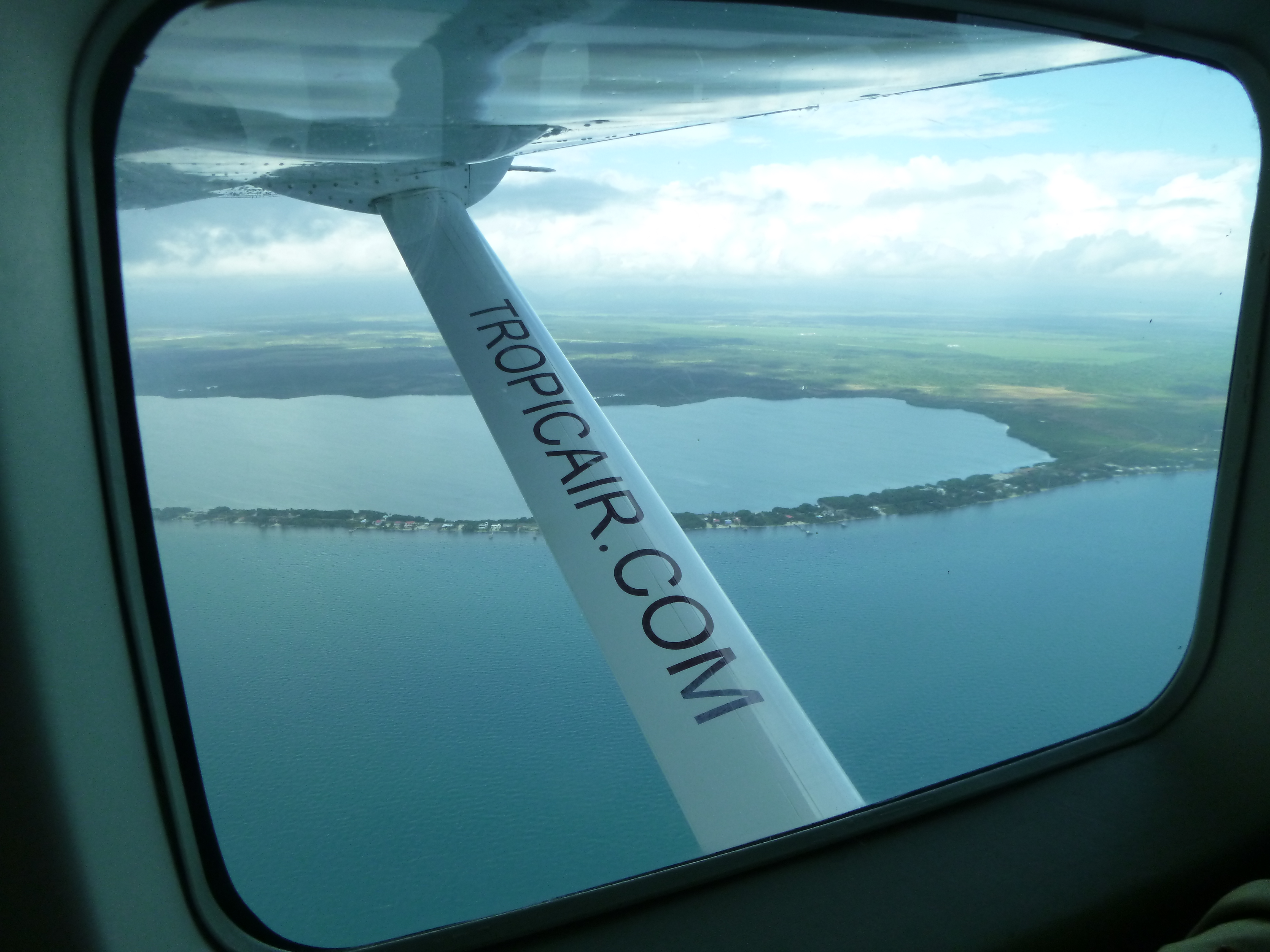
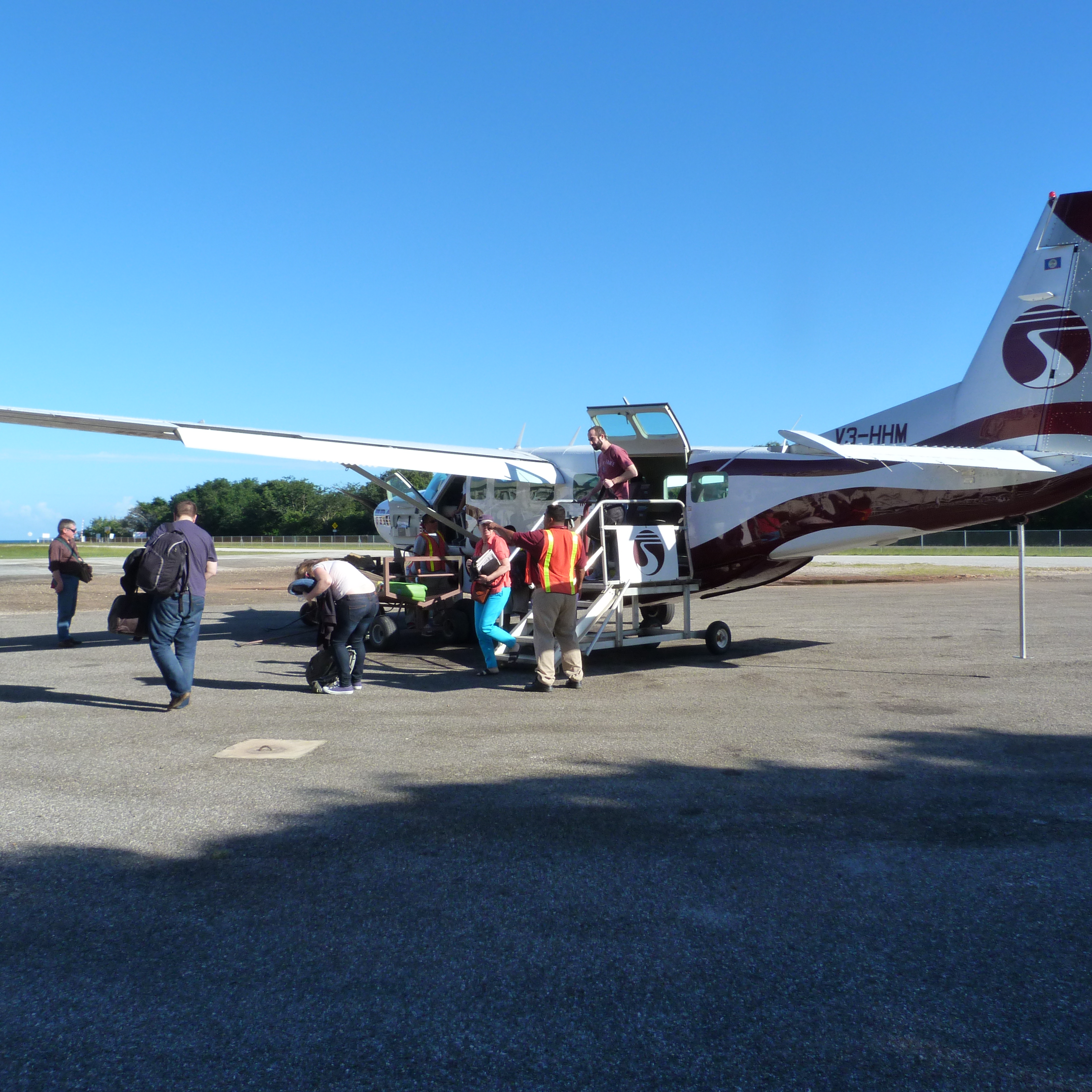
I first came here in January 2014 when Sahib and I headed here from frozen New Brunswick for two weeks. In those days we were living in New Brunswick and United Airlines was flying from Moncton to Newark and there was an onward flight from Newark direct to Belize City where we were introduced to Tropic Air – the little airline that is amazing. They run 16 seater prop planes flying Visual Flight Rules (daytime only, last flight has to arrive before dark) on domestic routes and have since added a couple of Central American destinations as well as Merida in Mexico. How they juggle their schedule and provide amazing customer service is interesting to behold. Your flight is late? We’ll put you on our next flight to your destination. Your flight is early? We’ll put you on an earlier flight than you booked. In those days, our flight was booked by David, one of the owners of this property, and had to be paid for on check-in in Belize City. Now, it is online booking but the customer service remains the same: up to two suitcases are part of the fare and any hand baggage has to fit, and be held on, your lap. If you are really lucky, you will be asked to take the 16th seat in the copilot’s chair where there is a notice to leave the controls strictly alone! The view from there is fabulous. Often, the flight stops en route to Placencia at Dandriga and it is a fast turnaround so that the whole flight only takes about 25 minutes. Getting to Belize City has been by many different routes and airlines. United from Moncton onwards, then Air Canada via Toronto with an overnight in Houston at a close-to-the-airport Super 8 Motel, West Jet from Toronto (direct) and now Air Canada direct from Toronto – but always, Tropic Air!
Our first time here, David had his taxi friend, Walter, meet us at the airport, take us shopping and meet Jason’s boat at the dock for the ride here. I still call Walter when I arrive in Belize City and tell him I am on the way. He picks me up and I go shopping – usually at Top Value Supermarket and then a vegetable stand – before I go wherever I am staying. Up until Covid, it was always down to Sabal Beach that I was heading. I have missed a couple of years – notably in 2015 when I was in Pakistan working, 2018 when I broke my knee just before Christmas and was still recovering and 2021 due to Covid. In November 2021 I rented a place in Placencia that David arranged when many Covid rules were still in place: you had to have a Covid test on arrival and stay in a Gold Standard lodging where Covid cleanliness standards were being met (not to mention the Covid test before heading back to Canada). I enjoyed that trip – my first travel since January 2020 but really missed Sabal Beach but it was a turning point and change for me as I was able to attend meetings by Zoom while I was there and it got me looking for places in Placencia where I could do the same and, when Covid rules relaxed, could get some Sabal Beach time in.
Sahib found it a bit too warm, as he had Mexico in 2011, and that there was not much to explore beyond the 7 miles of sandy beach one has to oneself. Since that initial trip, I have come by myself and can feel the tension slip away and relaxation start to slip in as I leave the dock in Placencia. Last February and now this year, I was pretty relaxed as I left Placencia and my little rental there so I am really, really a puddle of relaxation here at Sabal Beach.
As always, I am able to look at the little things here at Sabal and enjoy them. I found a tiny, one inch, tree frog in the shower last night and was able to send him on his way outside. The first bird I saw yesterday was a beautiful Baltimore Oriole and I am looking at a yellow warbler in the palm out front as I type. Huge hawks flew over last night and there were two pelicans bobbing in the water as I headed back from my yesterday’s walk as it started spitting rain, making it back before the deluge hit. Other fauna I find here I am relaxed enough to handle but in 2016 I got attacked by four nasty pit bulls who took a chunk out of my thigh before I retreated to the salt water and made it back to the cabana. Luckily, the salt water must have killed any germs and, because I lived in Sackville, the local hospital was able to give me my rabies shots when I got back, covered by the provincial health plan, instead of sending me to the public health offices in Moncton where I would both have had to pay for the shots and travel back and forth for them. Win-win. The brown widow spider I found one year climbing the cabana I was able to send on its way using a broom handle. Not so nice, being this far from a grocery store, was finding winged bugs in my recently purchased, unopened cereal this morning (Post’s Great Grains with Strawberries, in case anyone is wondering) that I had purchased to add to my morning yoghurt and muesli. I tossed it, unopened but heaven knows what their factory is like! I think I have enough muesli to last.
The sunset on the day I had arrived was, as some are, spectacular:
Soon, it will be time to head out for an afternoon walk up the deserted beach ….
Yes, I do know the dance we all used to do, especially around the campfire at summer camp. That is not what I am talking about today!
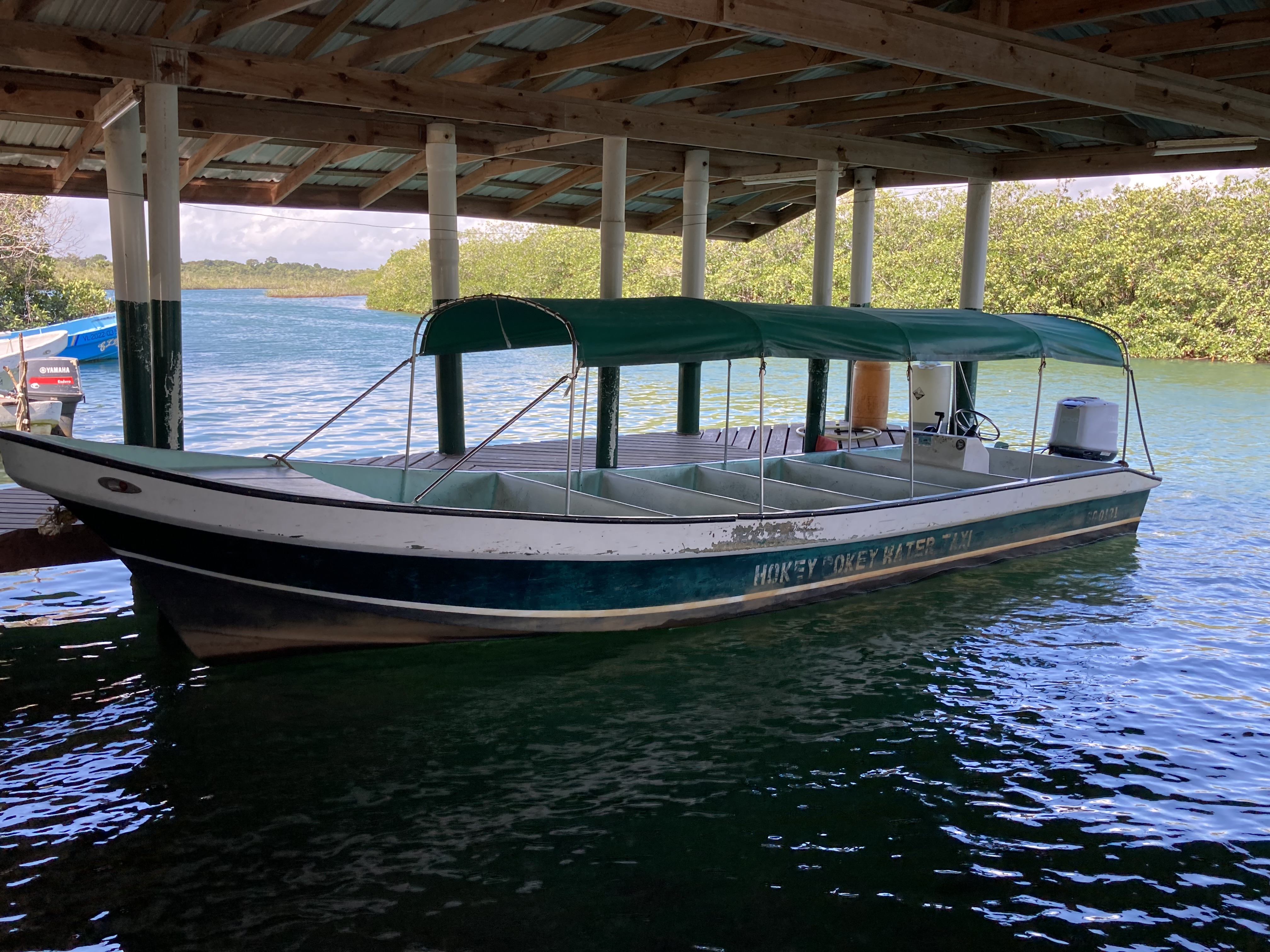
Here, the Hokey Pokey is the water taxi between Placencia, Belize where I am staying and Independence, Belize where one of the Immigration offices is located. Belize only grants 30 day entry – unlike Canada that grants 6 months on arrival. The first time I got a Visa Extension here in Belize I was at Sabal Beach and hired Jason and his boat and went down to Punta Gorda on a rainy day with high seas! It took about an hour to get the Visa Extension although it was a really expensive proposition given Jason’s cost as well as the $100 USD I had to fork over. The second time I rented a car and drove to the Dandriga Immigration office where I got the Visa Extension in 15 minutes but picked up a $50 BZ ($25 USD) traffic ticket, paid for the rental car and, once again, forked over the $100 USD. Very expensive …
When I got home from that trip and talked to Edwin, the caretaker here, he asked why I did not take the Hokey Pokey to Independence because it would be so much less expensive. I had looked at going to Independence rather than Dandriga but it is 75 km to drive which Google Maps says, optimistically, should take and hour and fifteen minutes but they do not factor in the number of “sleeping policemen” on route – I’ll bet it would take a lot longer!
So, this time I decided to try the Hokey Pokey Water Taxi service. I got up early and called Walter, my usual taxi guy but he was off to Belize City and trying Eddin, his #2, I found out he was also out of town. So, I sent a message to Edwin to see if he knew another taxi driver and got no response (turns out that he was out of town for his “day job” as I heard after I was back!). So, that being the case, I got ready and left here about 8:45, untied the boat (thankfully, no need to bail after yesterday’s few skiffs of rain), tied up on the dock on the other side of the canal and set off on foot to walk the mile and a half to the UNO dock where the Hokey Pokey is based on this side. Arriving at 9:15 I bought a ticket on the 10:00 am taxi for a mere $7.25 Belize and sat down to wait. Much like Tropic Air, the Hokey Pokey goes when full and we headed off about 9:40!
Heading out from Placencia.
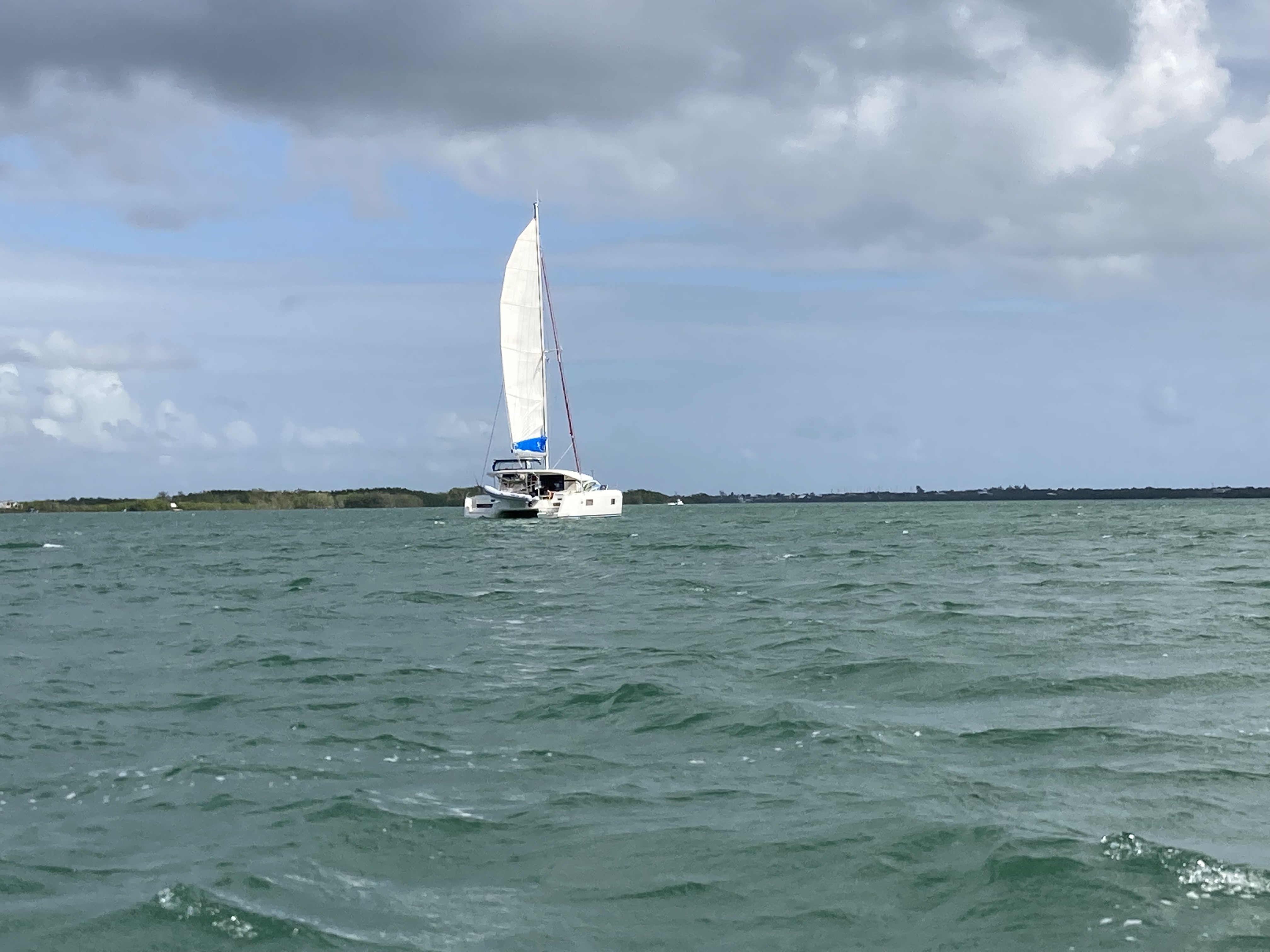
Catamaran seen from the Hokey Pokey.
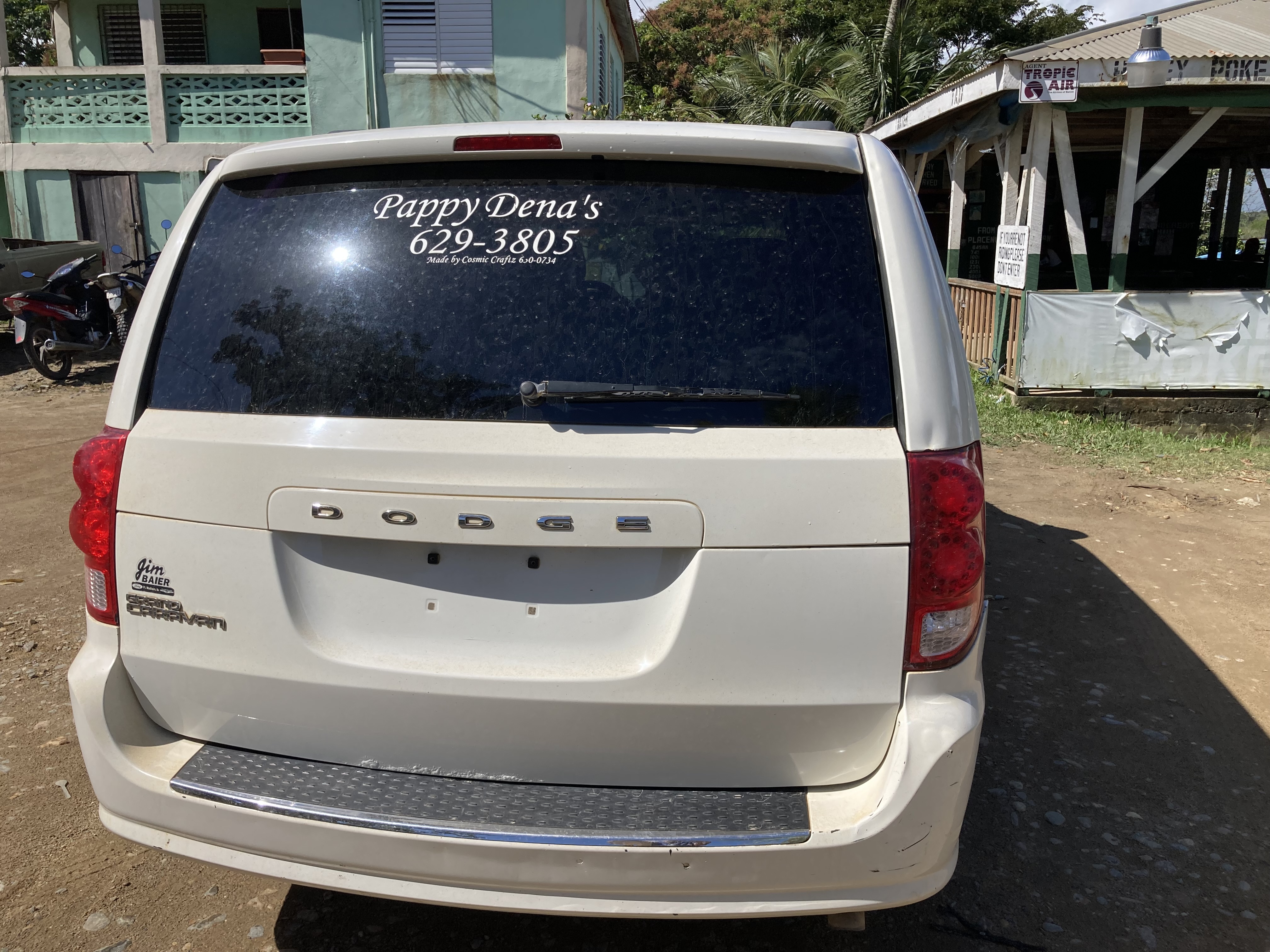
10 minutes later, we pulled into the Hokey Pokey HQ dock at Mango Creek, Independence. As one might expect, there were car taxis more than willing to take the offloading passengers and Pappy Dena seemed a good bet! An interesting character – he is thin as rail, tall and with dreadlocks to his waist!
In addition to me, he had two other passengers but they were quickly dropped off and we headed to the Immigration Office. As a good ploy (much appreciated) he had copies of the application form I had to fill in and while he drove, I wrote. He dropped me off at the Immigration office and said he would be back for me shortly. Unbeknownst to me, the rules have changed and one now must have one or more of the following: proof of sufficient funds, rental agreement and/or copy of your return ticket(s). Needless to say, I had none of the above altho’ I tried to see if I could access my back account (nope) or Air Canada booking (nope) on my cell phone but I did say I had a booking on 26 Feb, sufficient funds and had a rental agreement to 01 March. Guess I looked honest enough and did not come up in any database and they could see the previous entries/exits from Belize in my passport as well as the two previous Visa Extensions. 10 minutes later she was back with my passport including the new Visa extension and, like any good immigration officer, reminded me that the new rules were in effect (certainly weren’t on their website when I looked on Sunday) and I promised to be good in the future!
By this time Pappy was back and we headed back to the Hokey Pokey dock. The cost? Well, there was the $100 USD to fork over but Pappy? Well, he charged me $20 BZ ($10 USD) for all the pleasant service. I gather he regularly meets the hokey pokey looking for folk like me – wise move!
Having arrived about 10:25 am there was a significant wait until the next taxi was due to leave at 12:00 – still costing 7.25 BZ. So I asked where the toilet was and was given a key to the Jil of the Jack + Jil out back. Scored 8 on the Capper Toilet Scale – lacking only something to dry one’s hands after washing. As I came out I realized that boys will be boys everywhere in the world – one of the staff was watering the weeds beside the Jack + Jil!
So, I took a look around the dock, took a couple pictures and settled down to wait.
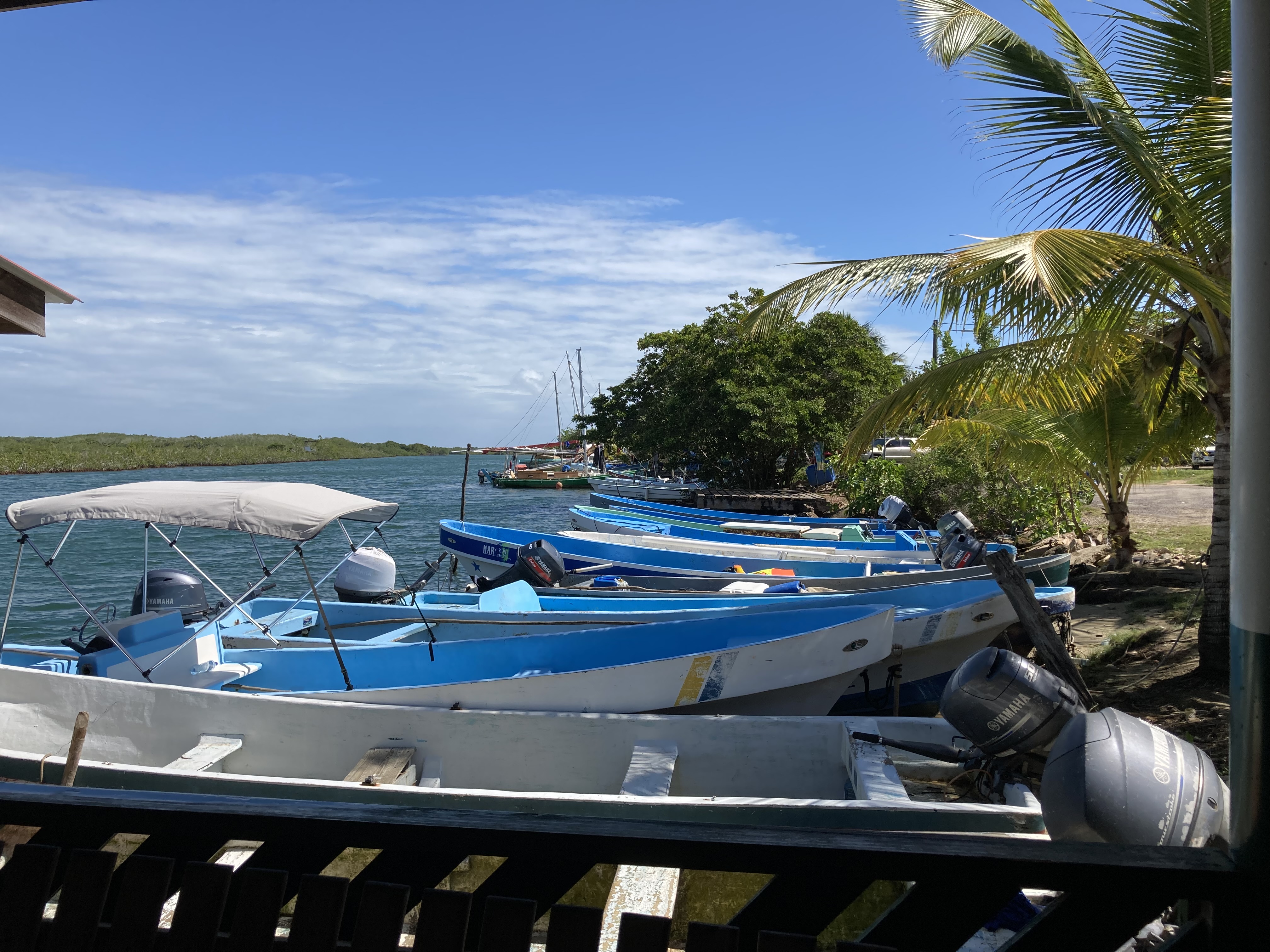
View from the dock in Mango Creek.
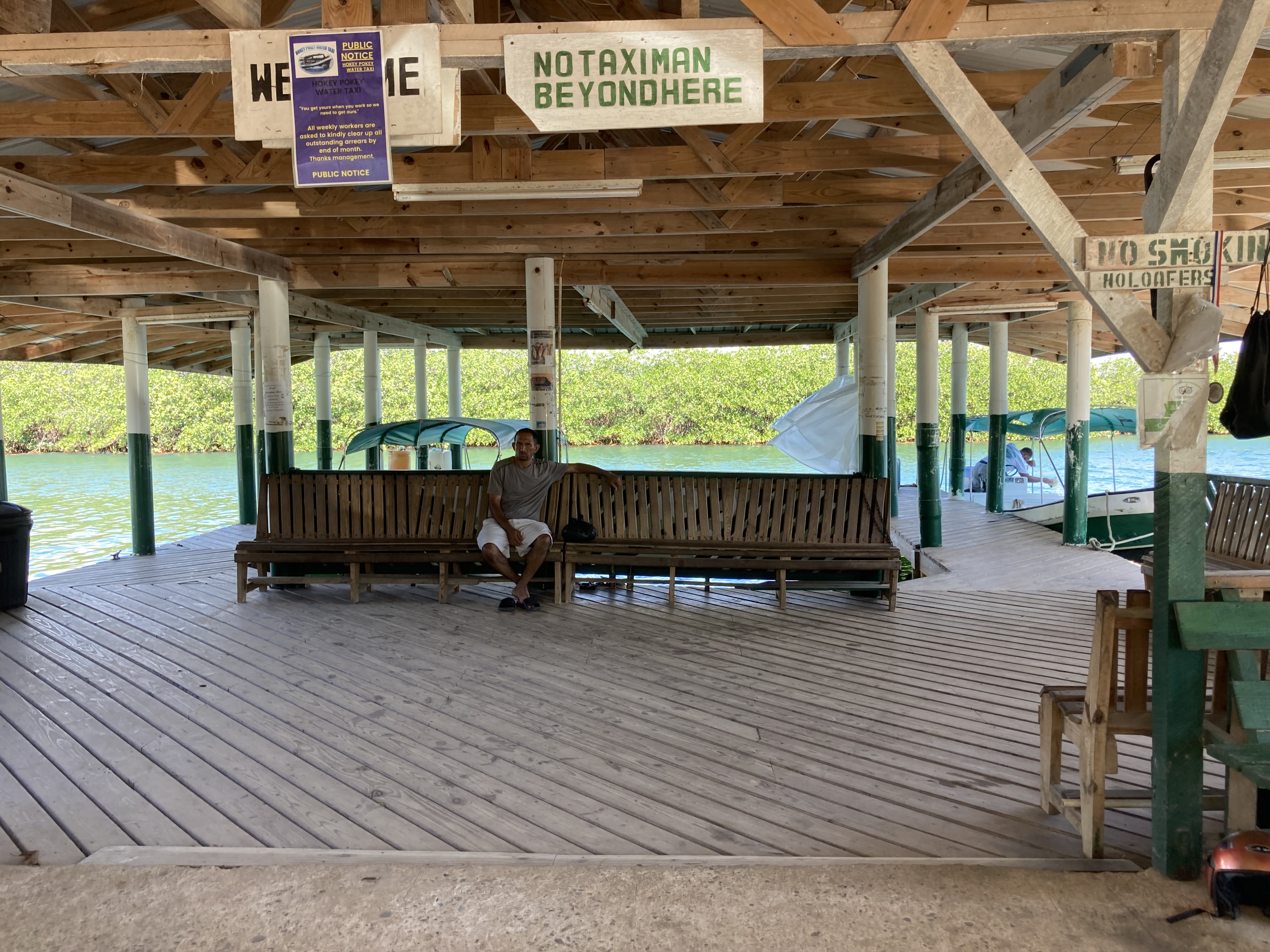
Clearly, car taxi drivers not welcome to harass Hokey Pokey passengers and all were waiting well behind the line!
See – it really is called the Hokey Pokey Water Taxi!
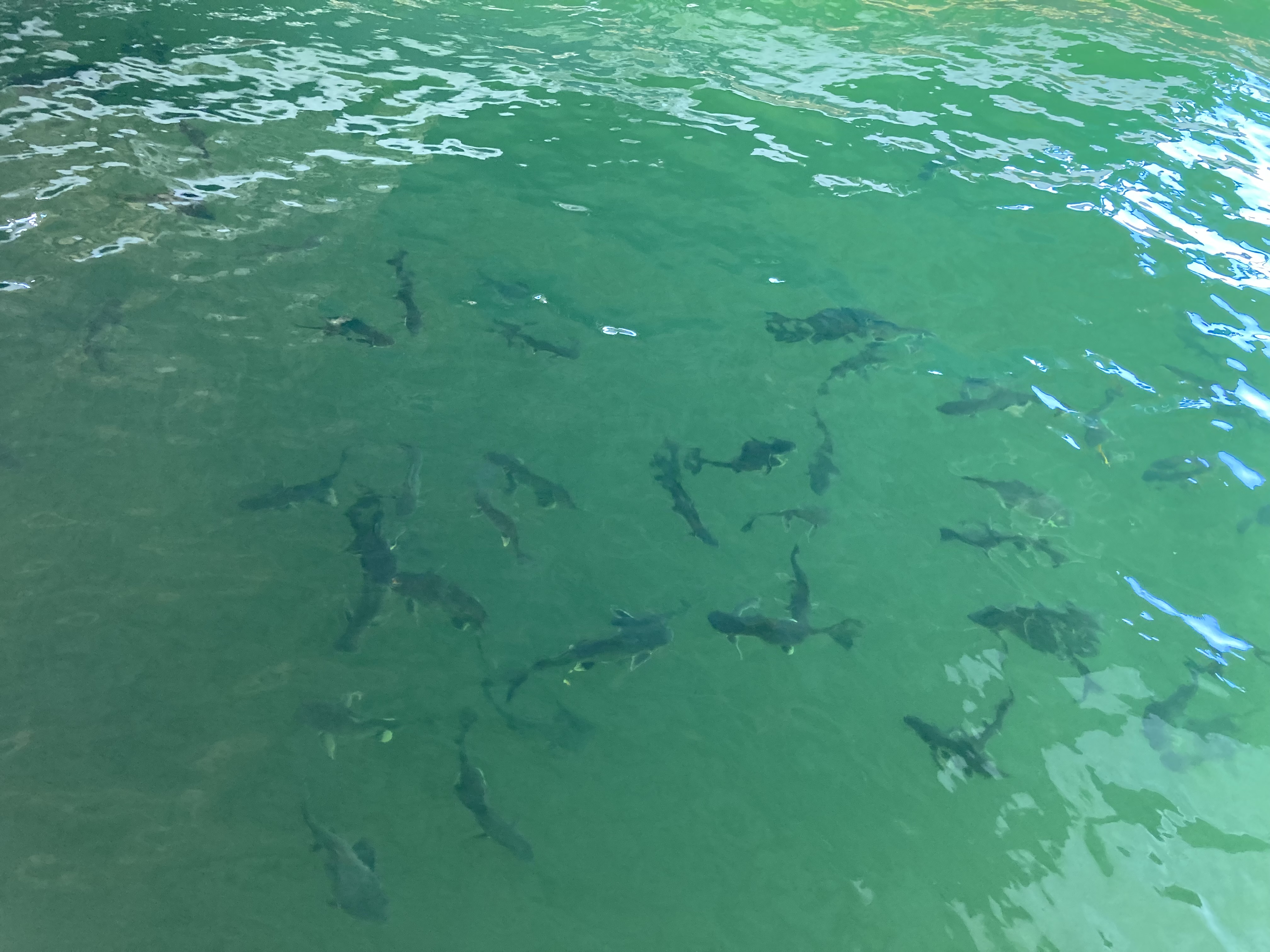
Between the two docks was this school of fish – looked like catfish about a foot long. I remember when I was in Osijek, Croatia, inviting a contact out to dinner that he recommended a restaurant in a curve on the Drava River where they had the “best smuć” as the local fish was called. Judging from the bones (and how very many of them there were) it was catfish by another name!
As before, the hokey pokey left when full – about 11:45 and 10 minutes later we arrived back in Placencia! Knowing my taxi drivers were out of town, I headed back to my rental on foot. Stopping at the grocery store where they had raisins and Welch’s Grape juice and Cranberry Juice (a treat I reward myself with when walking back from town on a hot day) and lucked out at one of the vegetable stands and got a red and a yellow pepper – and really lucked out acquiring three punnets of fresh raspberries.
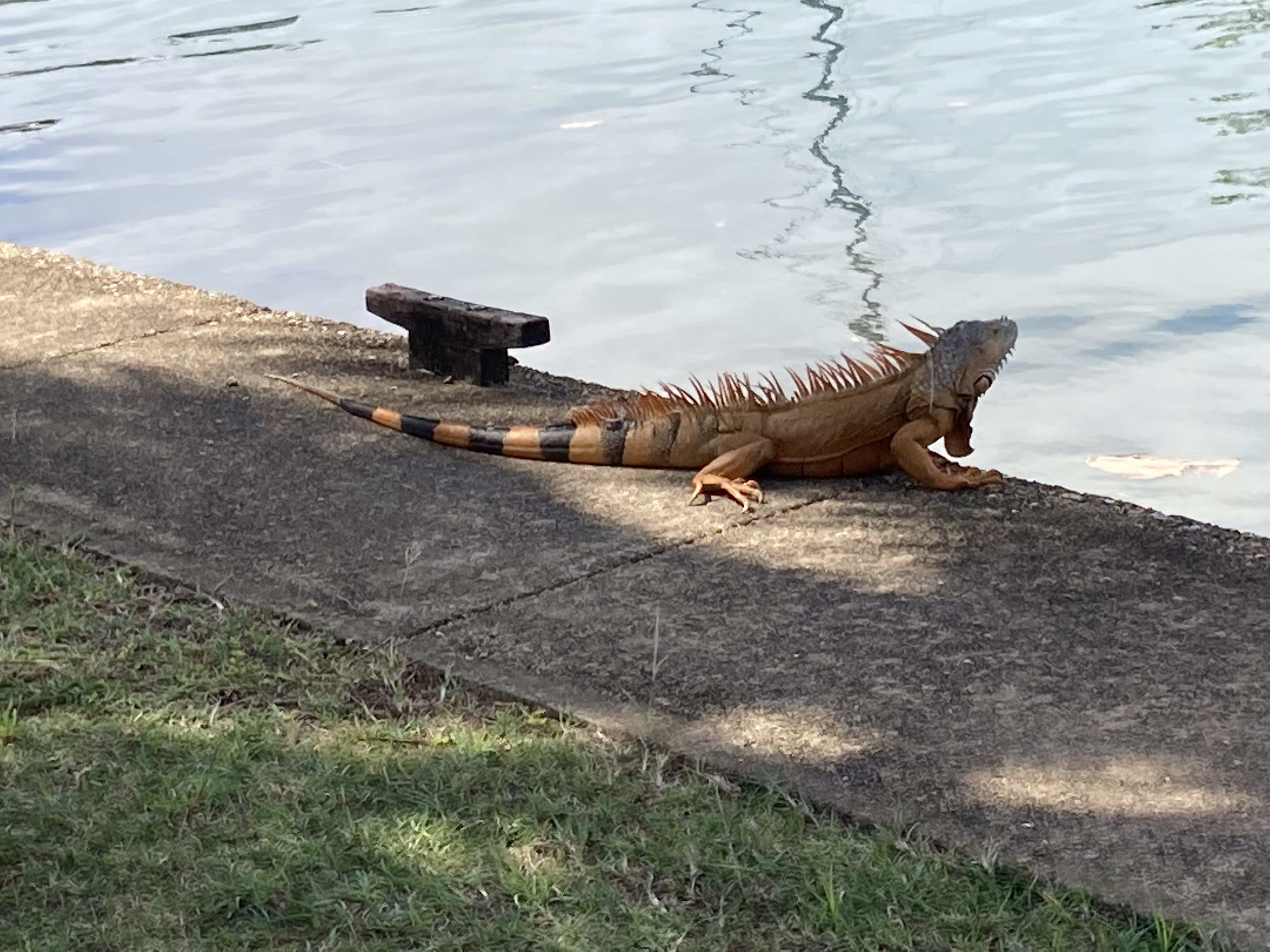
As I got close to back to my dock, I saw this fella – about 2 feet nose to tail – out sunning himself beside the canal.
Then to the dock, paddle across the canal and back to the rental where I enjoyed my Grape juice as I put the rest of my groceries away!
All in all, not including the $100 USD that is standard cost for the Visa Extension, a very much, much less expensive day!
Just a short post today – prompted by a couple of power outages for various reasons here in Belize lately that have made me really aware of how heavily dependent on electricity our modern world really is! The power cuts since November have been for a variety of reasons: Hurricane Iris and other weather phenomenon, a fire in central Placencia, a cut cable … ah, well ….
The first really big blackout I remember was that of 1965 when most of the northeast US and much of Ontario was blacked out due to a power failure at the Adam Beck Power Station in Niagara Falls ON. I was at a Girl Guides meeting at the Copetown United Church. The Guide leader got out the candles, we got on the phone to our parents and they picked us up. In those days, the telephone lines worked – no cordless phones or cell phones – these were landlines!
Initially, when we lived in New Delhi there was occasional “loadshedding” as it was called there but the increasing modernization we saw over three years resulted in regularly scheduled “loadshedding” and the schedule was published in both the Times of India and the Hindustan Times. Unfortunately, I am not sure that a) those doing the loadshedding were able to read the schedule and b) there weren’t those that were VIP’s or VVIP’s who ensured their neighbourhoods were unaffected. Our neighbourhood got loadshedding so often that it was 3 or 4 times a night. That sounds innocuous, one should sleep through those times, right? Well, no. At the peak summer months of loadshedding there was also the peak summer months of heat and pre-monsoon high humidity. Opening windows was not an option since New Delhi air quality was not good in those days (it has improved immensely even if still problematic at times), especially at night when there were often wood or charcoal fires fouling the air. We also did not have central air conditioning. Each room had its own split a/c which produced cool air in summer and could heat in the cool of winter. We also had a generator – a big, noisy thing that required a manual start (by the chowkadar – who often slept through the event), regularly ran out of diesel fuel and would run only one a/c. However, each room had a ceiling fan that could be manually turned on. On the other hand, our incoming electricity came on three input lines and when measured they provided anywhere from 180 – 320 amps rather than the 220 they should have been. Not long after we moved in, they installed a stabilizer unit for each of the incoming lines that worked on a weighted balance system, kathunka, kathunka, and provided a reasonably steady 210-230 amps – needless to say, our computer was plugged into a constant voltage transformer and a surge bar!
When loadshedding occurred I usually was alerted by the sound of the generator going on and got up and went around to the bedrooms to start the fans in each one that had gone off with the power supply. Toddling back to bed, I might get an hour or two’s sleep before the generator going off again not only turned off the fans but alerted me that someone had to go around and push the little green button on the box going to each air conditioner to restart that air conditioner. That was to keep them all from turning on at once and blowing the fuse box! Luckily, years later when we moved to Chandigarh, somebody had hooked up the fans so that they, if left on before the power went off came back on with the generator as well as a rolling start system to the air conditioners so they started one at a time. For the most part, I was the one who appreciated the new system as the old one had exhausted me in New Delhi: I often say that Sahib could sleep through an atomic bomb going outside his bedroom window so you know who did most of the turn on/turn off duty.
I don’t recall many power outages in either Austria or Jordan – if they existed, they were minimal! Although there was one power outage that we rejoiced in while in Austria: the ice storm of January 1998 that knocked out power as well as closed roads, schools, and places of employment in Eastern Ontario for days at a time – including my headquarters in Ottawa that was not heard from for several days!
However, while we were in Jordan, my youngest and I went to Ireland for a month while Sahib visited his father in Canada in 2003. Our original plan was for the three of us to drive to visit my brother in Tarsus, Turkey – we had our visas for Syria and Turkey and were all set to go when our plans changed. Not being keen to do all the driving through Syria and Turkey, let alone with a 17 year old daughter, I called my mother and asked her if her passport was valid and would she like to join said daughter and I in Ireland on Tuesday! She immediately made plans and joined us for two weeks. The day of her departure from Dublin airport was timed perfectly so that she would be on her way and an hour later we would pick up middle daughter, joining us for the second two weeks, on arrival. As we took Mom to the counter, we found her departing plane – no explanation – was going to be a couple hours late but middle daughter’s was on time and we had reservations for a weekend some distance from Dublin. Mom said she did not mind a bit and to be on our way, so we did. Little did we know until later that her flight was delayed by more than 12 hours due to the power grid failure (especially at Toronto Pearson Airport) that blacked out a good part of north east US and Ontario.
I think the longest I have ever experienced being without power was during the New Brunswick Ice Storm of 2017 in January of 2017 when we were without power for 34 hours in Sackville NB. Our house was a 2 story, with attic, high ceilinged house. We were heated by gas but without a pilot light, our heat went out. Luckily, our gas stove could be hand lit so we got out all of our flashlights, closed the kitchen-living room door and hung blankets from the two open doorways to the breakfast nook and “back room” as well as the (large) open pass through to the back room and got some warmth. Having lots of quilts handmade by my mother otherwise kept us warm and we hunkered down.
I must admit, we have become more and more wired up and power outages, loadshedding, rolling blackouts remind us that this is so. Our cordless phones don’t work, our internet is down and cell phone coverage is iffy. We do have a solar powered radio that lasts for short bursts and is useful at such times. Otherwise, flashlights and candles are always to hand and our house if full of books …
The elixir of the gods, the day-starter, that amazing cup of Joe! Anyone who knows me at all well knows I love my coffee. I used to drink it from rising in the morning to late evening. No more. Now I can only do three cups of coffee in the morning to get me going or I don’t sleep at night. Makes the morning Joe so much more important.
When I was growing up, coffee in our house was instant – and not for children. My parents and grandparents used to buy Nescafe in the fancy square glass jars with glass lids and a plastic stopper. I still have a number of them at home and use them to keep spices and bulk supplies. They are all 50 + years old and still going strong. Sadly, nowadays one has to buy most things in throwaway containers.
I thought everyone drank instant coffee (which I did not like) until I was an exchange student in the Netherlands after Grade 11 and was introduced to Melita Coffee – the v-shaped filter with a paper liner, a carafe and coffee grounds. My first intro to a coffee that tasted good. When I left home I found myself a Melita set – it came in a green and red box – and I used it for many years, in fact I still have a set at home although I do not use it now as we have a coffee maker and have had for years. The Melita filter cup, filters and coffee have gone on many camping trips with us, though we have now replaced it with a Stanley filter.
When I travelled through Paris as a teenage exchange student, I was very disappointed by the cafe au lait – weak and little coffee taste. An experience repeated when Sahib and I spent a week of our honeymoon in Paris in 1982. Where was the famous “French coffee” I had heard about? I did not find out until assigned to our Paris (France, not Ontario!) offices in 1994 – espresso is where it is at and, boy, is that an eye-opener!
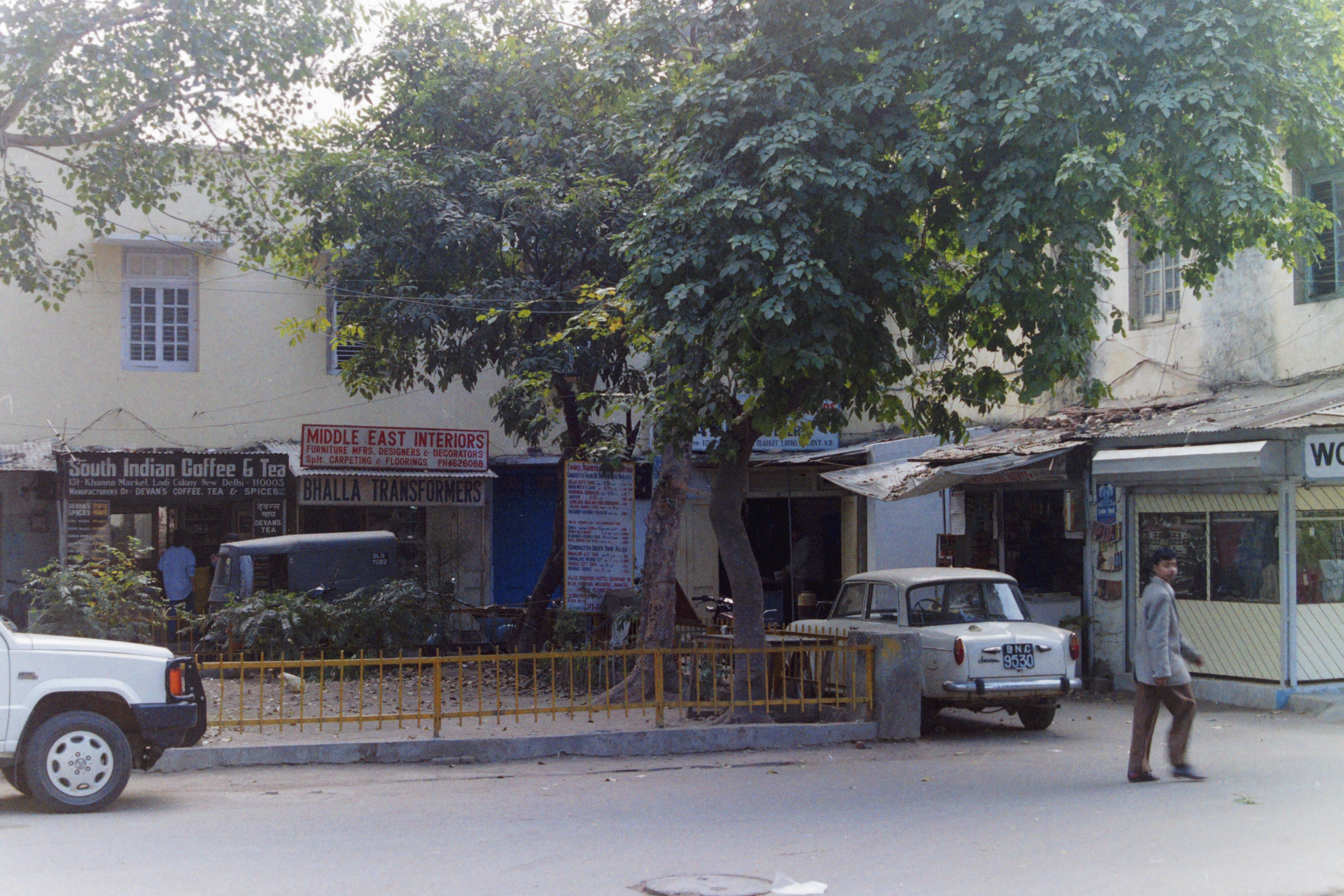
Imagine my surprise when we arrived in India and found all of the hotels supplied little packets of Nescafe instant! This, in the country of South Indian coffee. Travesty! It wasn’t long before we found the South Indian Coffee and Tea company in New Khanna market. Going in was a delight – the smell of freshly roasted coffee, It became where we bought our coffee in New Delhi – and loaded up cartons as we left India to take to Austria!
South Indian Coffee and Tea Co, New Khanna Markeet, New Delhi, ca 1994 – not to mention the wool shop at the right of frame and all of its temptations!
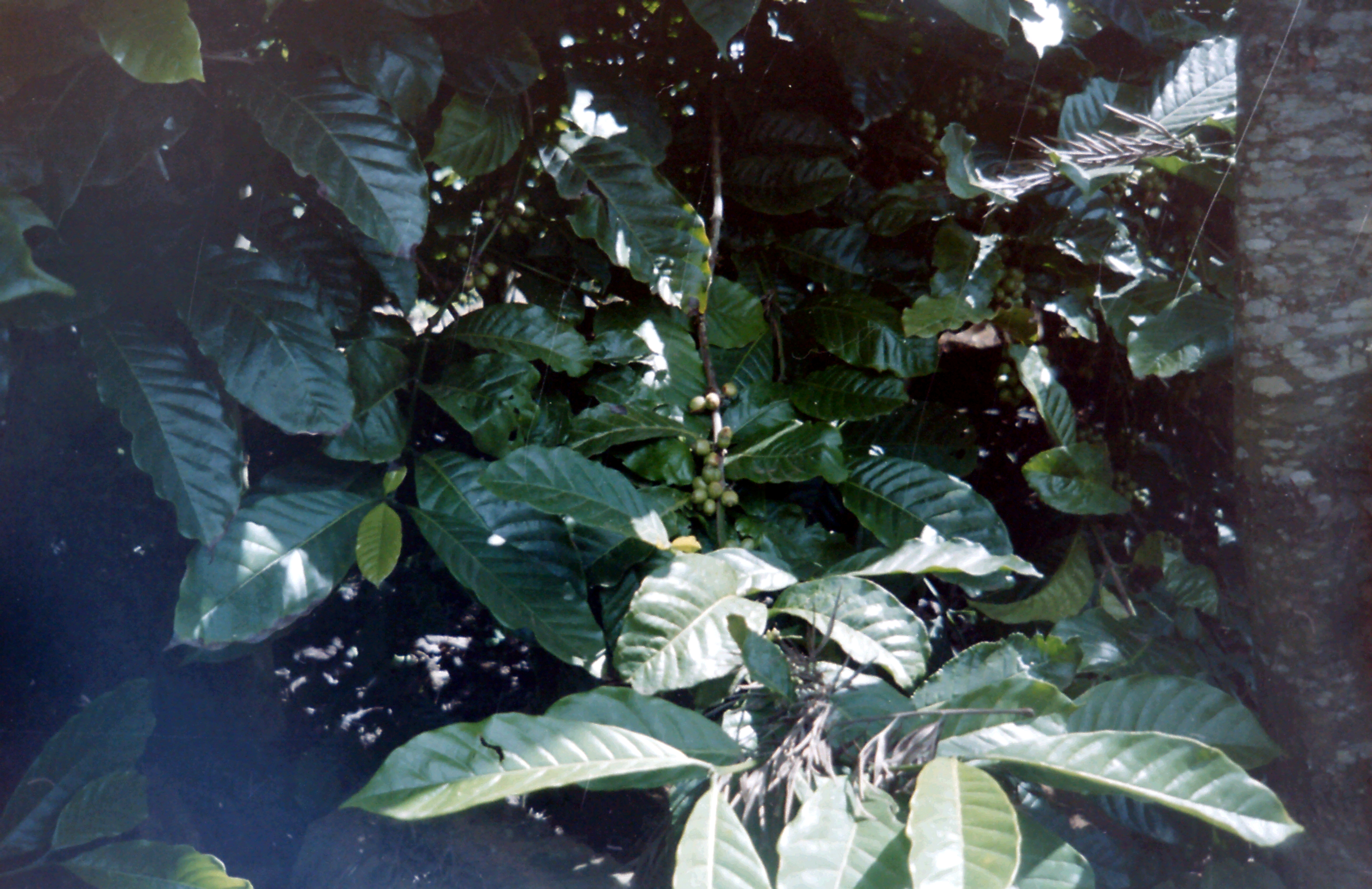
Not being content to stay in Delhi, we headed, at March Break 1995, to South India to Yerchaud, Tamil Nadu, where Sahib’s grandmother was raised after being born in Madras (now Chennai) and toured a coffee plantation and saw coffee growing and toured the processing museum. As we left the hills to Salem, TN, on the plains, we stopped at a coffee roastery and bought some coffee to take back to Delhi with us – and very good it was!
Coffee growing near Yerchaud, Tamil Nadu.
Imagine my surprise when I travelled back to India in 2016 and was delighted to find South Indian coffee widely available – but disappointed to find that the company itself had been bought by Devan’s and the coffee was nowhere nearly as good.
Austria was a coffee wasteland where herbal teas were preferred – I enjoyed some of them but was glad I had my stash of South Indian coffee.
On we went to Jordan where we found, around the corner from us in Amman, a coffee roastery with the familiar rich scent of freshly roasted coffee we had found at the South Indian Coffee and Tea company in Delhi. The owner would occasionally get South Indian coffee but mostly he had Kenyan, Columbian and Yemeni. The Yemeni coffee was not very good but the Kenyan was outstanding and I drank plenty of it.
From Jordan, we headed back to India and were able to get down to Delhi regularly to New Khanna market for our coffee.
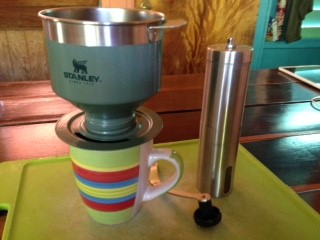
For travelling as much and for as long as I did, a knowing friend gave me, about 8 years ago, a Melita style filter, made of stainless steel, with a layer of stainless steel mesh that worked very well for quite a long time but the area between the layers of mesh seems to have been gummed up by coffee oils and now runs as slow as molasses. Hence, the new Stanley filter that comes apart into three parts with a single layer of very fine mesh that can be thoroughly cleaned has replaced it. The knowing friend also gave me, after one trip where I admitted I bought coffee beans rather than ground but without a way to grind them had brought them home, a lovely hand cranked coffee grinder that works a real treat!
Stanley coffee filter and hand cranked coffee grinder – small enough to easily fit in my luggage!
And then, there are some strange brews of coffee. During a trip to the Philippines, to visit the gifter of the melita style coffee filter and beans grinder, I was able to visit a place where they roasted and ground Kopi Luwak. Yup, that is the coffee that is made after travelling through the digestive tract of a civet cat. Some things you just have to try but it was an experience not to be repeated! It simply tasted like very stale coffee that had been left in the air and lacked any of its essential oils.
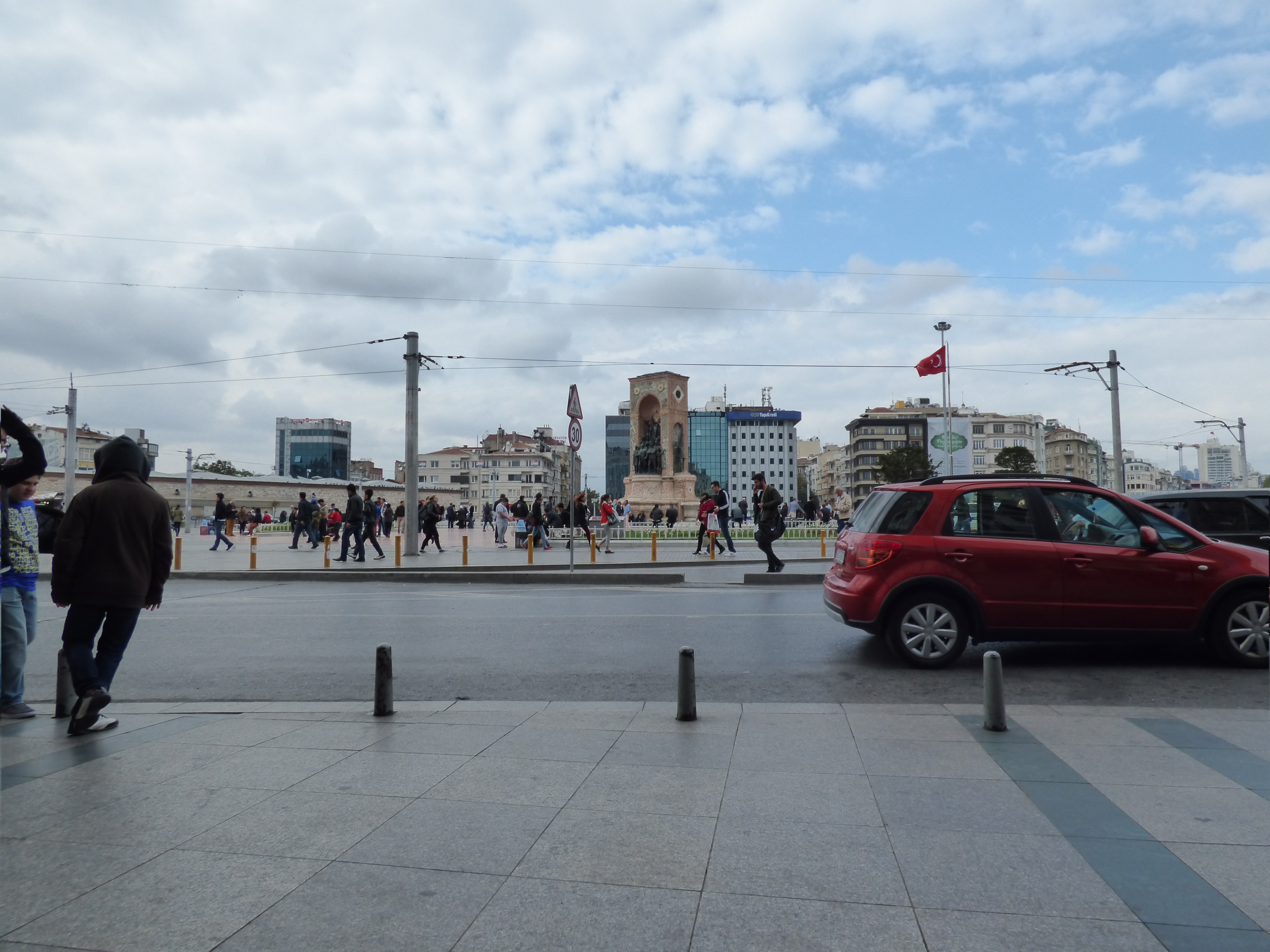
Needless to say, my joy in making my own coffee means I rarely see the inside of a Timmies or Starbucks or Second Cup. However, I have had occasion to visit one or the other of them – they make a good place to meet up, if nothing else. While I was having a base with my gifter while travelling (sometimes with her, sometimes alone) we had to meet up in Istanbul and chose the Starbucks at Taksim Square as very visible spot to do so!
The view from a sidewalk table at the Starbucks in Taksim Square, Istanbul, Turkey.
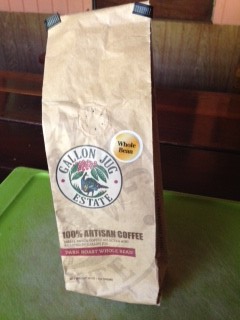
And now, here in Belize, about 14 months ago, I found a really good coffee – Gallon Jug Estate coffee, artisanal dark roast, available in beans or pre-ground. A pleasurable eye-opener in the morning, if a tad expensive (but isn’t all coffee expensive now?).
And that is my story and I am sticking to it … with a cup of morning Joe!
We had so much fun off roading with Pajjie in Jordan that we had hopes of doing the same in India when we arrived for two years in Chandigarh. Sadly, that was not to be given how hard it was to take leave time. Sahib did get off with friends P and S camping in Himachal Pradesh, we both made several weekend trips by road to Delhi, we did a road trip to Amritsar and the Golden Temple as well as one to Kasauli and Sahib also got off with his sisters during their visit.
In that hope, we ended up buying a well aged Maruti Gypsy with 4 wheel drive but no hi/low or wheel lock which, no surprise, ended up being called Gypsy. The only long trip we took with Gypsy was to Himachal Pradesh, following some of the route Sahib with our friends P and S and then going beyond to the base of Rotang La – a mountain pass with an elevation of 3,980 m (13,058 ft)) which is on the eastern end of the Pir Panjal Range of the Himalayas around 51 km (32 mi) from Manali in Himachal Pradesh connecting the Kullu Valley with the Lahaul and Spiti Valleys.
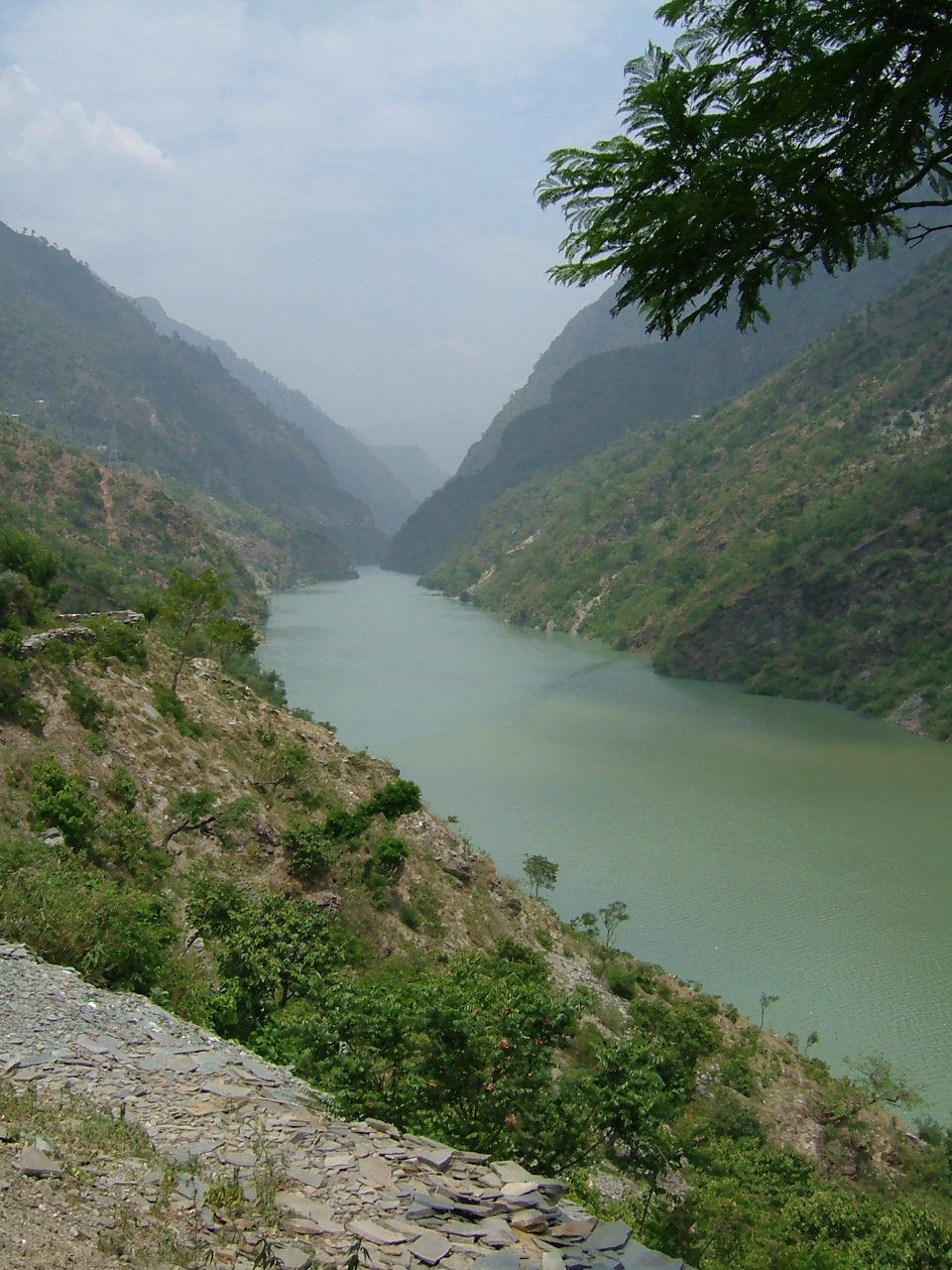
The Kullu Valley follows the Beas River into the mountains.
So, having a week’s leave, we headed off up the Kullu Valley. The first day we pretty well followed the Beas River and were heading to a town where Sahib and P and S had stayed. Unfortunately, we got thoroughly lost (despite having a pretty good set of maps). As dusk was falling we saw an empty meadow in deserted countryside across from a lonely gas station so we stopped and asked if it were possible to camp in the meadow. I am not sure they fully understood what we were asking but they said yes (okay, it was the Indian head wobble but we chose to identify it as permission!) so just as dusk was falling, we set up our tent, our small folding picnic table and our little propane burner with grill big enough to hold our pot and made supper before heading to bed for a very good night’s sleep. In the morning, we woke to the sounds of cows and, peering out of our tent, found them quite happily munching on what turned out to be marijuana plants in the meadow!
What we came to call the Happy Cow Meadow!
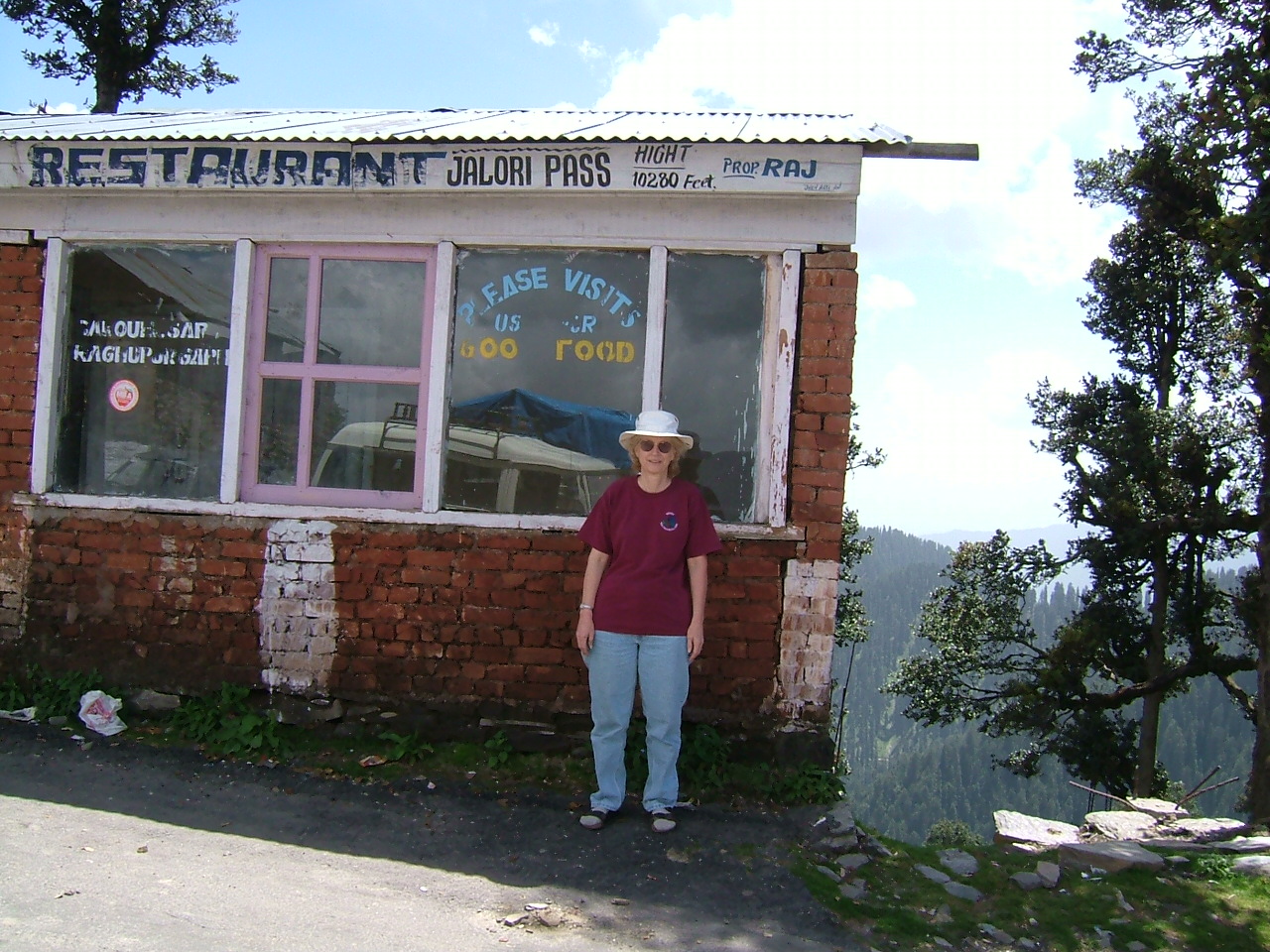
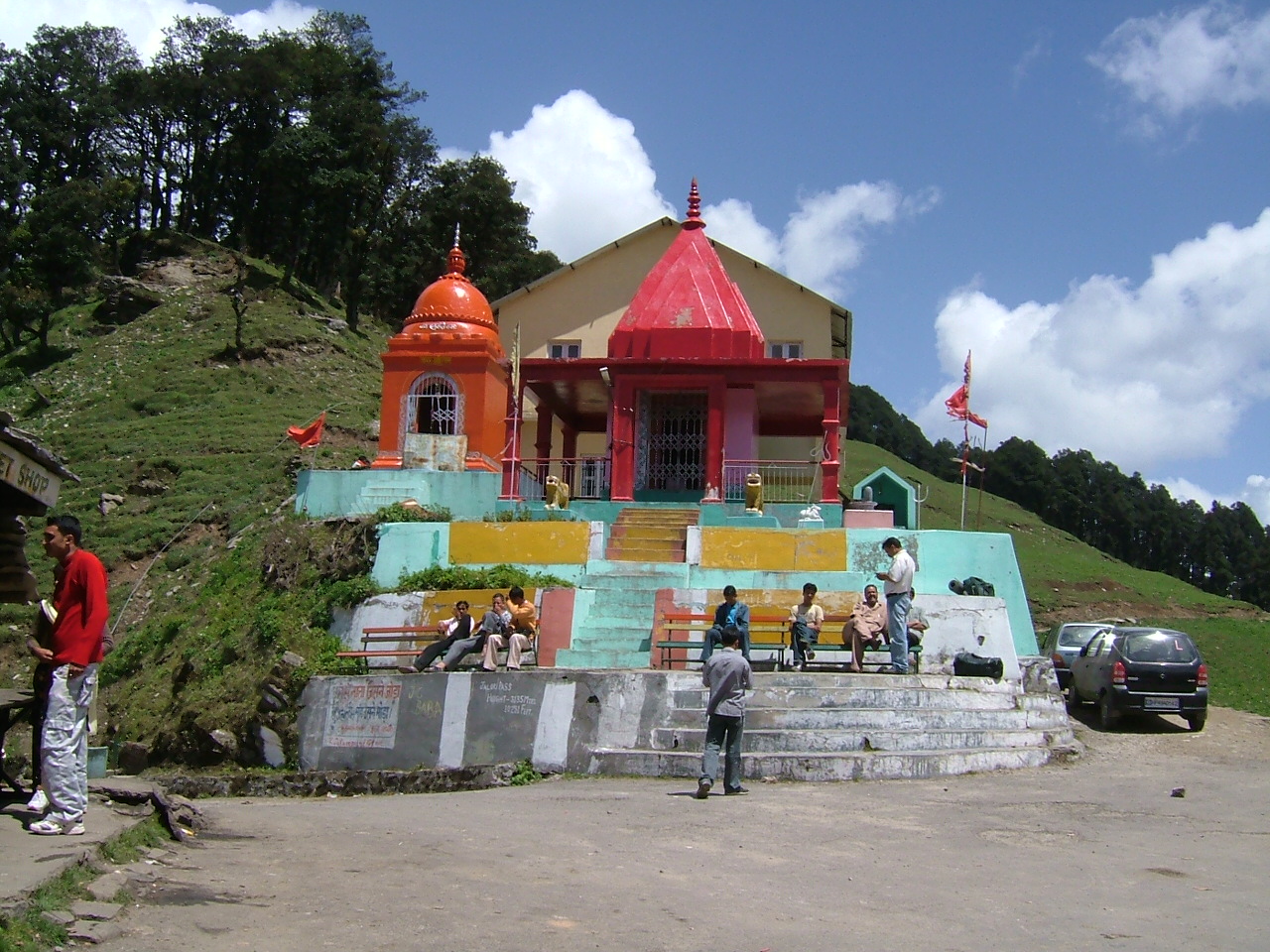
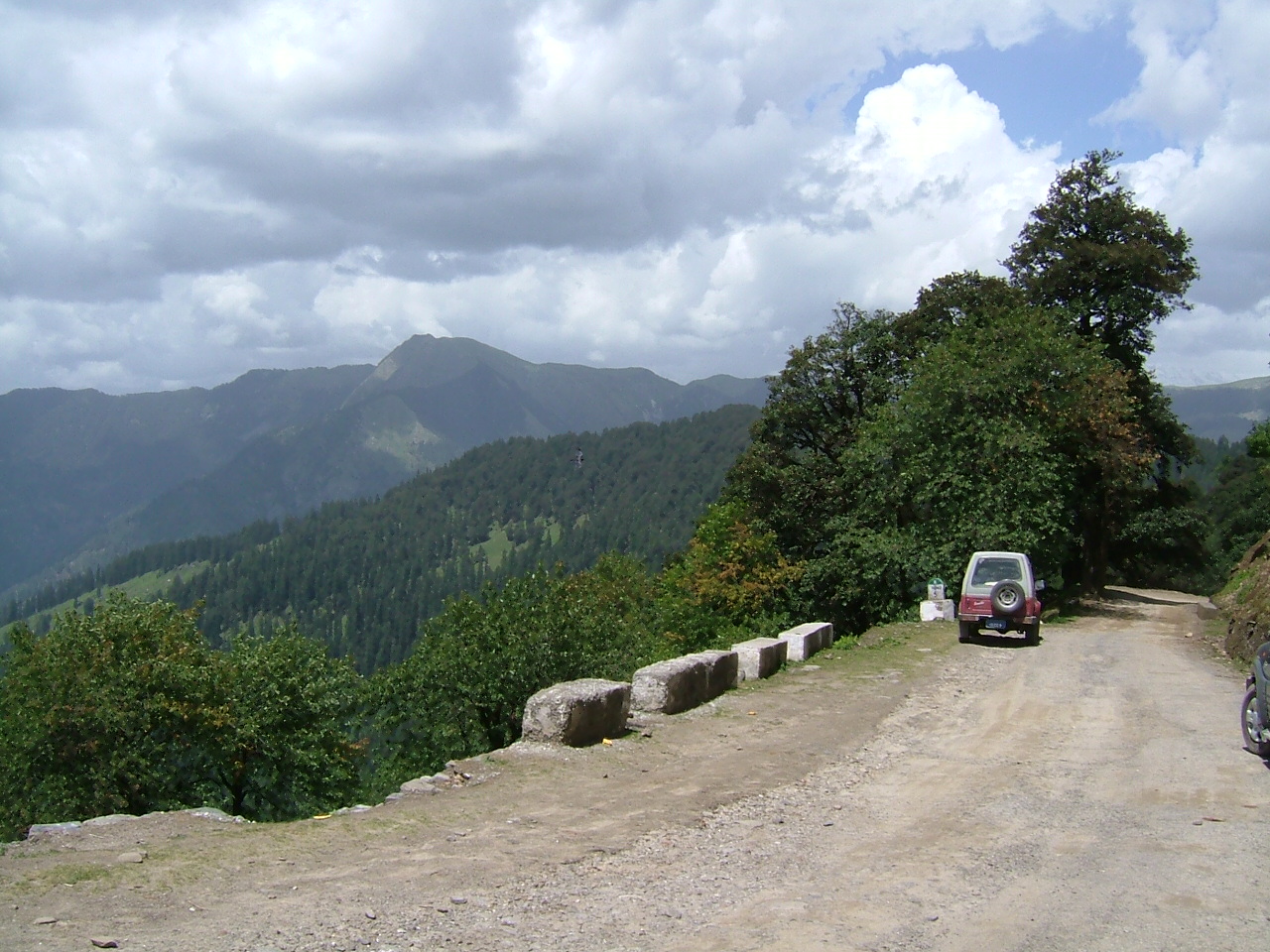
The following day, we carried on, found ourselves on the map and headed for the Jalori Pass. At 10,282 feet above sea level it is the first mountain pass heading north from New Delhi 600 km to the south. It was a narrow road, winding and steep. Gypsy was not thrilled with it – we had not had her carburetor set for high elevations and did not know how to do it ourselves. For the last kilometer of elevation we had to stop every few hundred metres, turn her off and wait while her radiator stopped boiling! However, we eventually made it to the top!
A closed restaurant at the top of the Jalori Pass.
The temple at the top of the Jalori Pass. Online searches show that the temple has been expanded and redecorated in the intervening years.
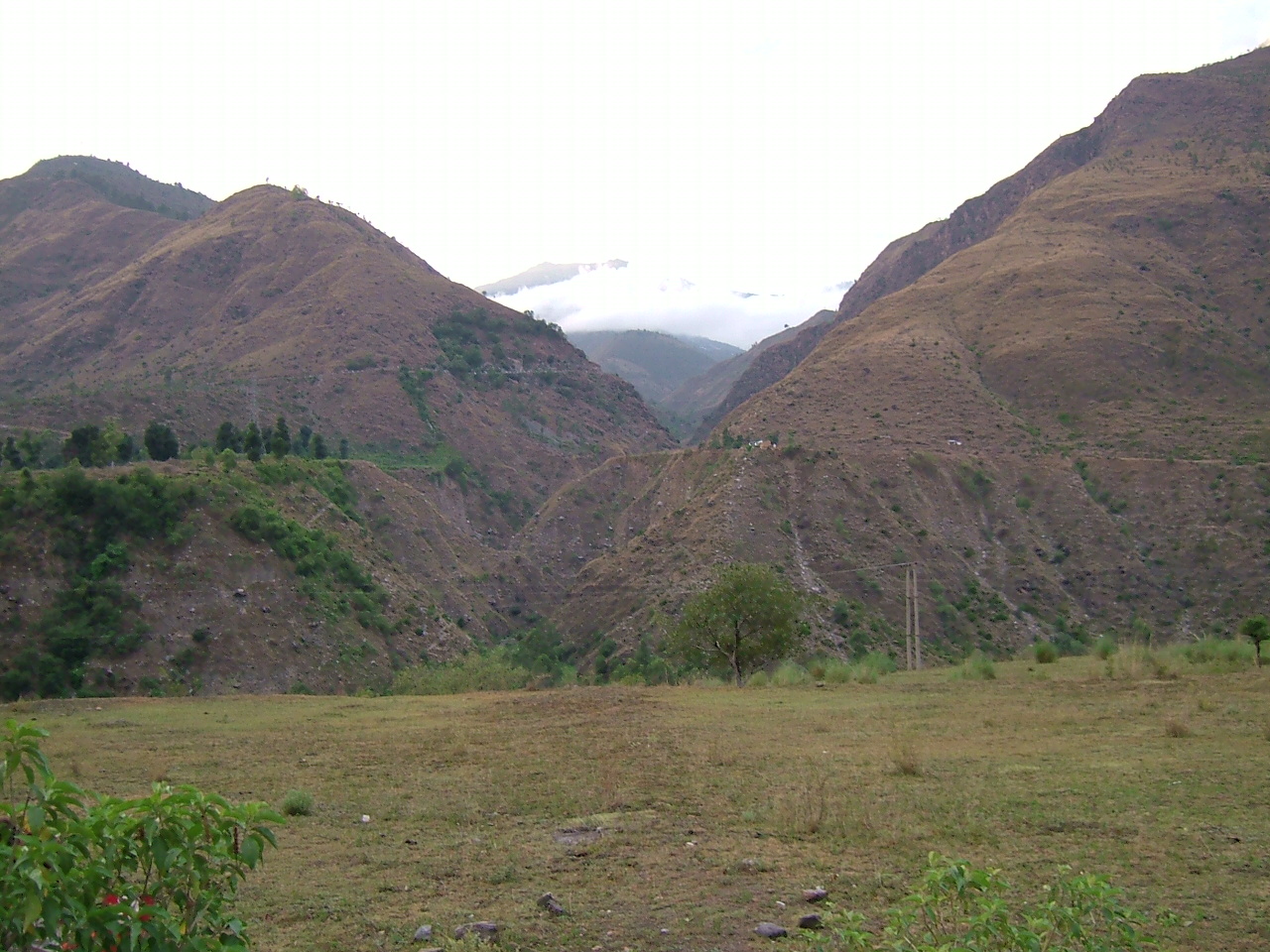
We stopped on the other side of the Jalori Pass to admire the view of the mountains while Gypsy patiently waited at the side of the road.
Onward we went to a place I can only call Jerry Beebi – a tiny village where, believe it or not, there was a formal “campground” of carefully laid out squares on which to pitch a tent and a (western) toilet block with a shower! Sadly, we neglected to take a picture of either Gypsy or the tent!
Above are the staff quarters for the attendants of the camp. Very new and well cared for. Our campsite had a small stream running behind it that gave us music to sleep the nights away (we were there for a couple of nights).
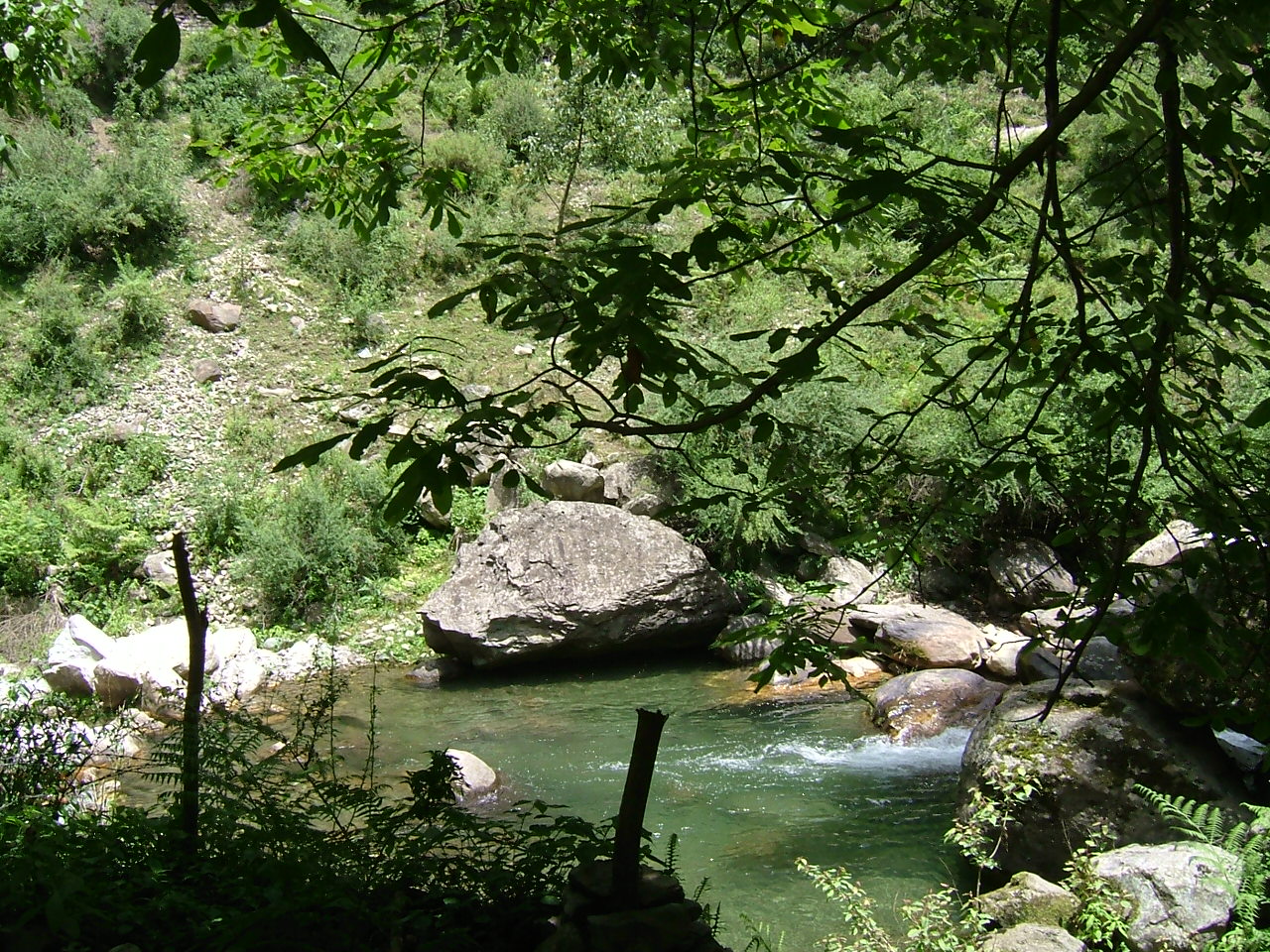
The stream behind our tent.
One afternoon we left the campground to go for a walk on the road that passed by. We were soon overtaken by a group of Indian girls – speaking English – and darned if there wasn’t a Canadian accent in the group. Turns out that they were nursing students from various hospitals – including one in Winnipeg – doing volunteer work at an outpost clinic of the Lady Willingdon Hospital in Manali. We walked on with them and they asked if we wanted to see the clinic and told us that there was a New Zealander doctor there with his family so the next afternoon they came down and got us and we hiked up to the clinic. It sure brought back memories for me: when I was in the air force, the hospital at the training base was straight out of the 1920’s – as was this clinic. It had an ancient x-ray machine, an examination room, a four bed ward and a lab that could do very basic blood and urine tests. The New Zealand doctor was actually an Iranian immigrant to NZ but his wife was a Kiwi and they had two (or maybe, three?) small children with them. He told us he found his work very rewarding and was enjoying the slower pace! We made a donation to the hospital and kept in touch with the doctor while we were in Chandigarh. Some months later, he called us up and said he and some Lady Willingdon staff were going to Delhi for a conference and could they stop to see us. We invited them for dinner and the night – putting the three girls upstairs and the two men downstairs in the den. After breakfast, they thanked us profusely for the hospitality as none of the Indian staff had expected such hospitality (I am not sure that they had ever stayed in a Westerner’s house) before we drove them to the train station. We also helped them fill in forms for a grant from the high commission’s charitable fund – they did not get it but were grateful for the opportunity to apply. Sadly, again, no photos of the clinic.
The next day we travelled back down to follow the Beas River. On our way, hunger hit and we stopped at the side of the road in a very small village crossroads and found someone with a tandoori oven making naan bread. Oh, it was heavenly hot and fresh out of the oven and cost about 5 rupees per naan! We also found someone selling the biggest, nicest garlic we have ever seen – we bought several pounds to take home. Going through the small towns and villages was hair raising given narrow roads and lots of pedestrians.
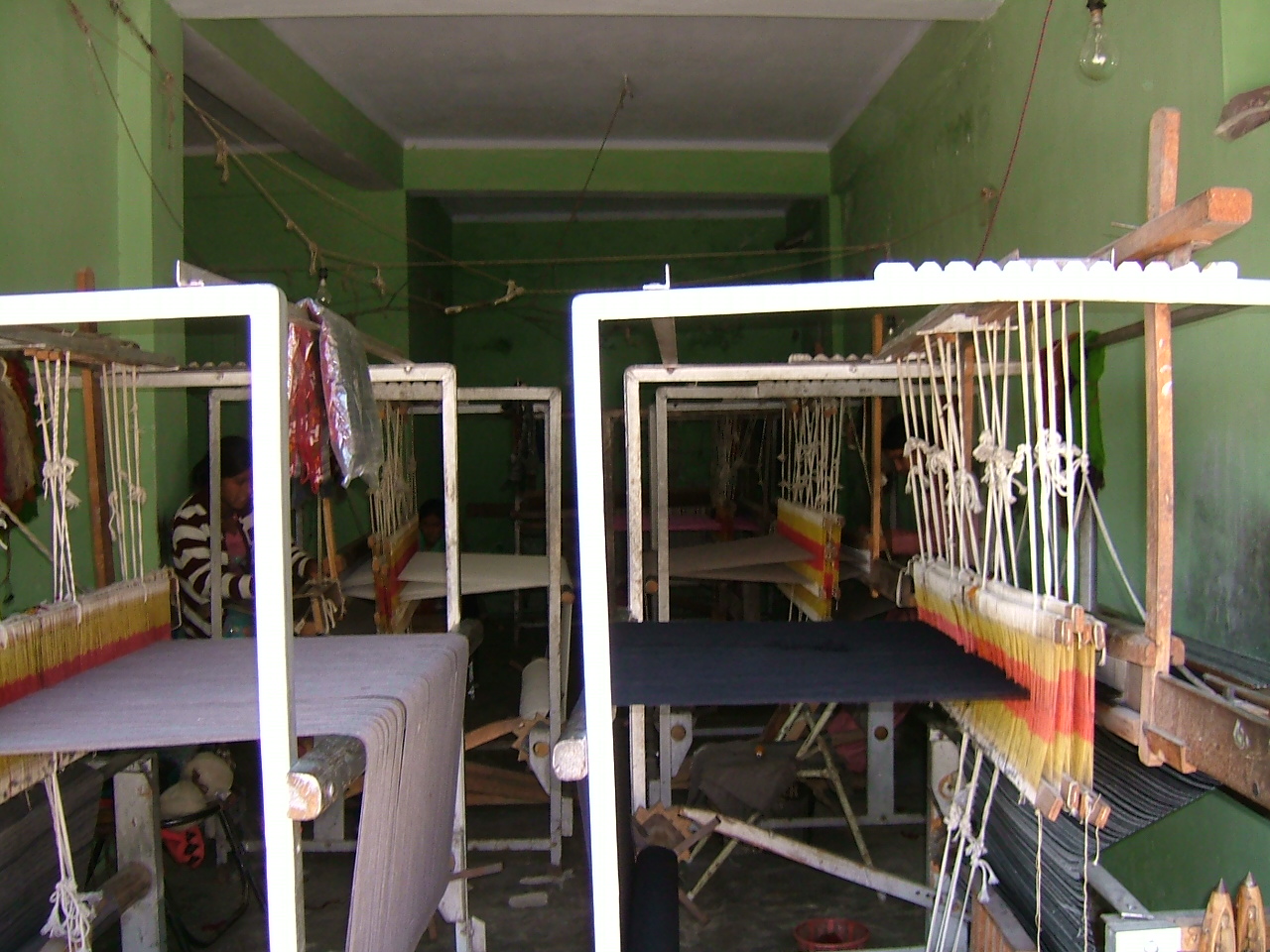
Regularly, going through towns, we came across the workshops of those making the famous Kullu shawls and bought one each.
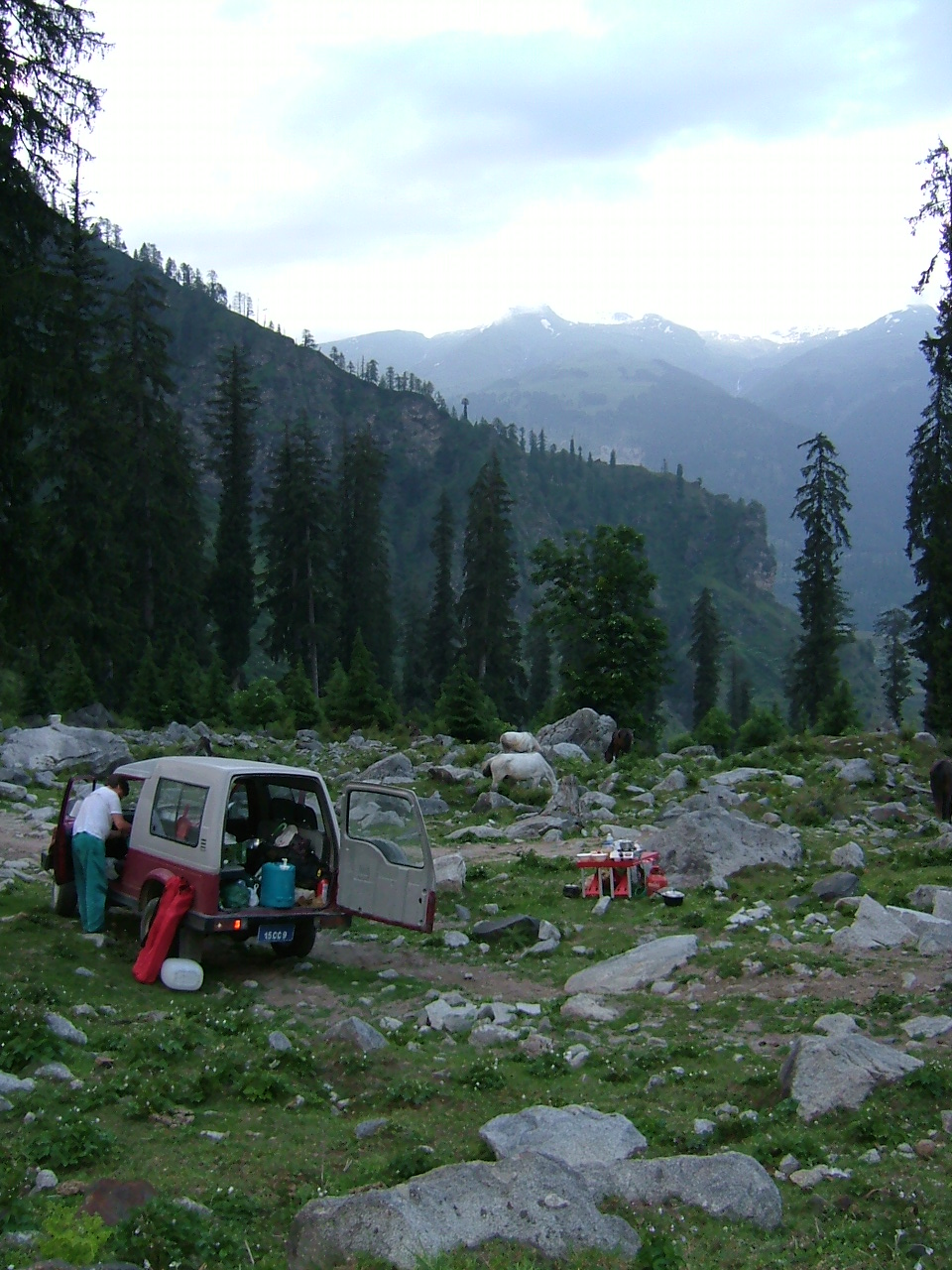
Onward we went to Manali – a real tourist hotspot being up in the hills and much cooler in June than the plains. It was crowded with tourists and, honestly, did not appeal to us. We were hoping to get a hotel room but did not really like what we saw so headed toward Rotang La in the hopes that Gypsy would take us up and over but, unfortunately, she was not keen on the altitude as we approached the pass. Seeing a large wooded and meadowed area, we approached the guard on the gate to see if we could camp on the meadow below a rocky field. Turns out, it was the Border Security Force’s training base and we were welcome to do so as long as we parked the car at the top and walked our stuff down. We actually kept our food in Gypsy (not knowing what animals were around) and only took the tent, sleeping bag and mattresses down – cooking and dining al fresco beside Gypsy!
Gypsy at the end of the road with our folding picnic table (which we bought in the Netherlands on a camping holiday from Vienna and which we still have) to the right with our dishes and cooking utensils on it.
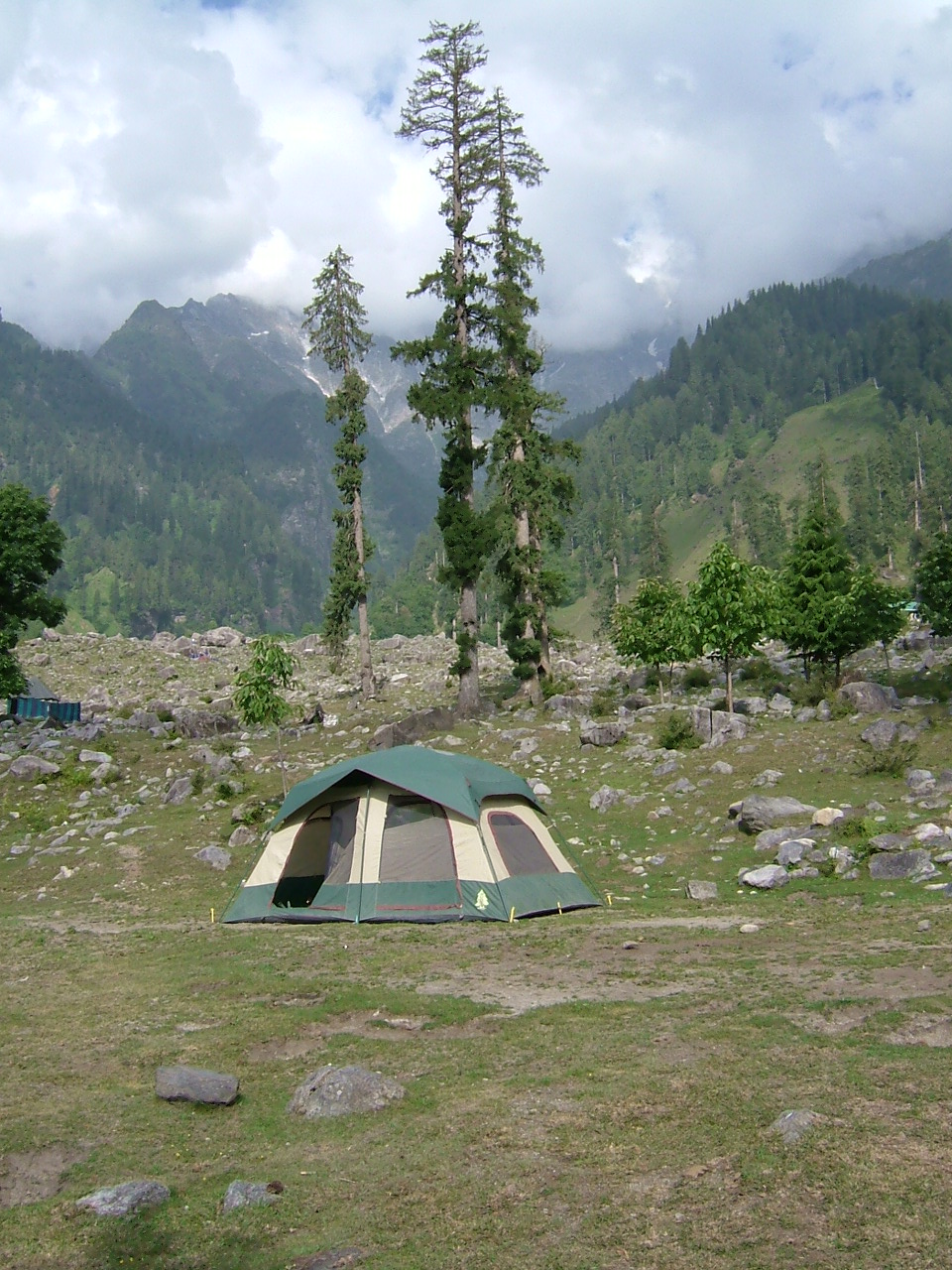
Ahhh, all set up. The first night we were on our own but the second night, two other sets of campers arrived – Europeans but did not speak English or French and they kept to themselves so we did not get to know them at all.
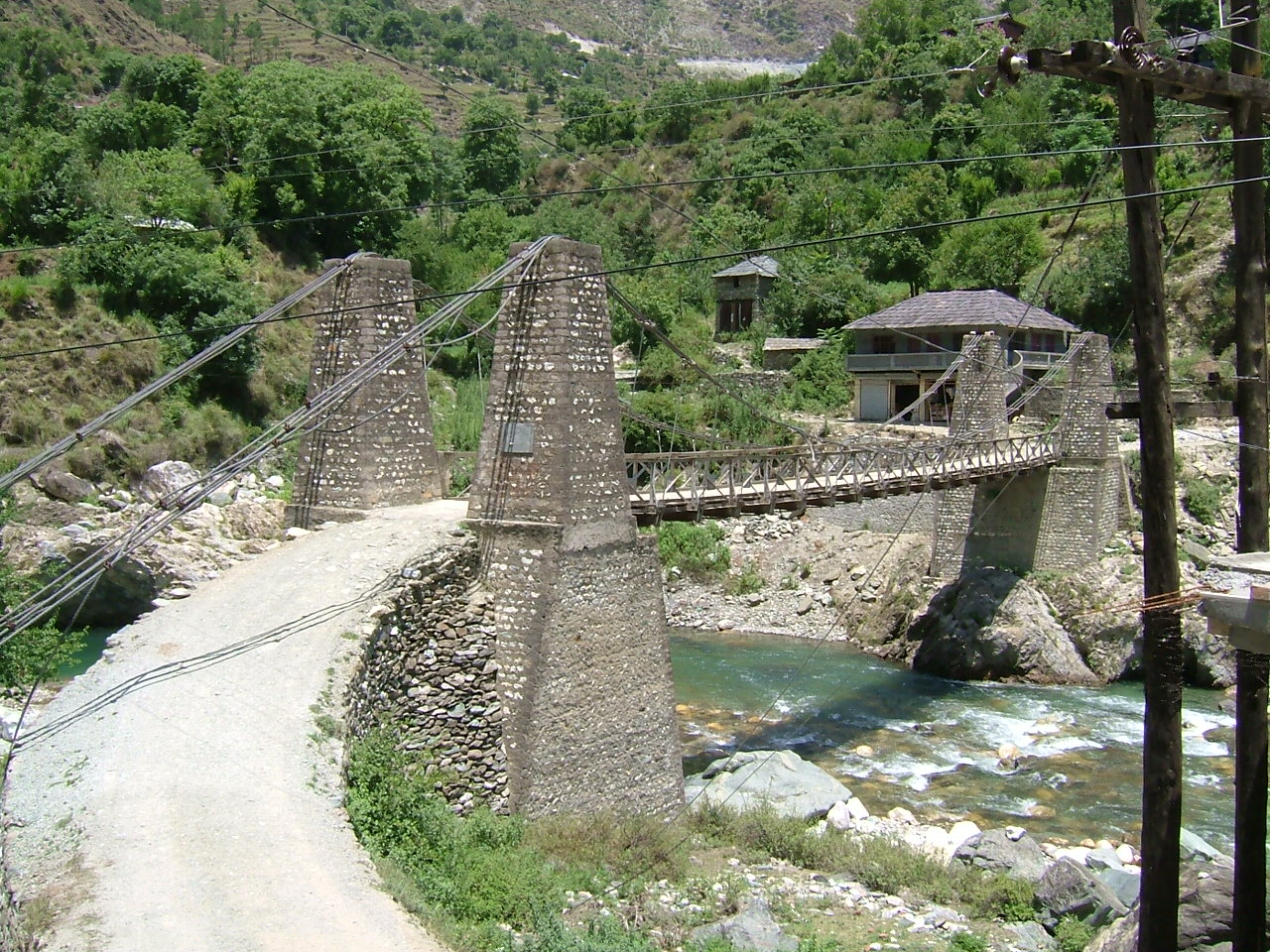
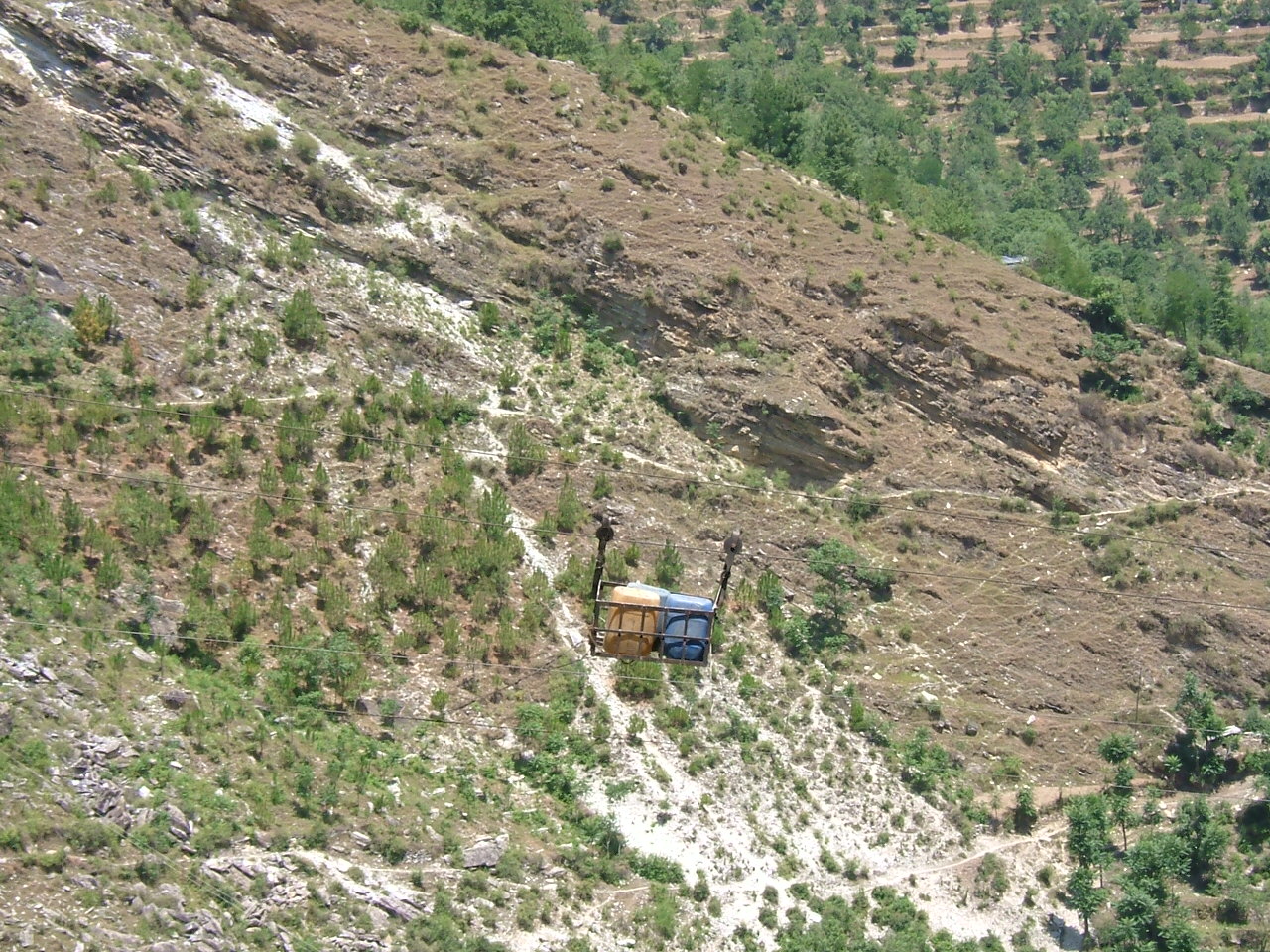
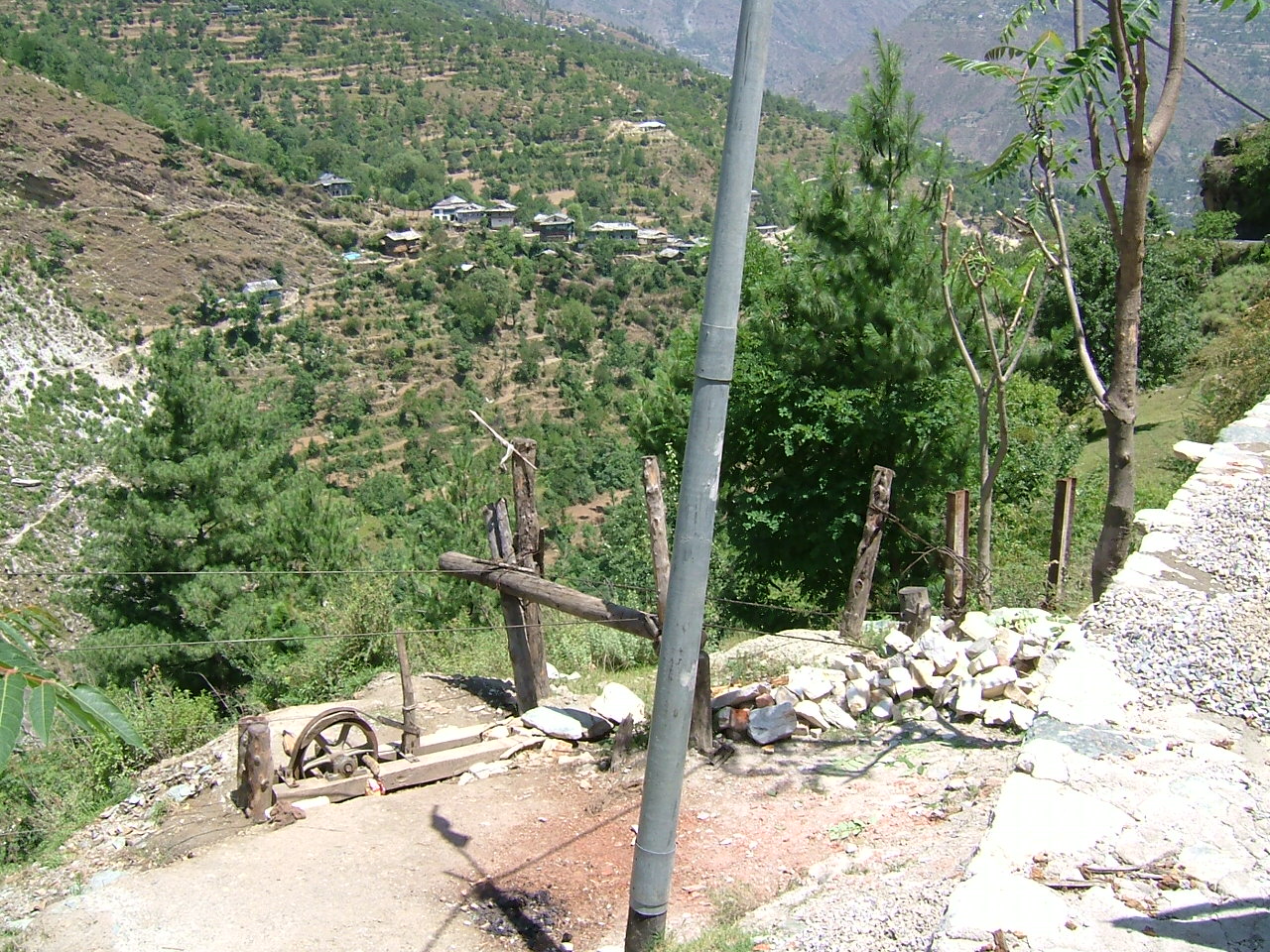
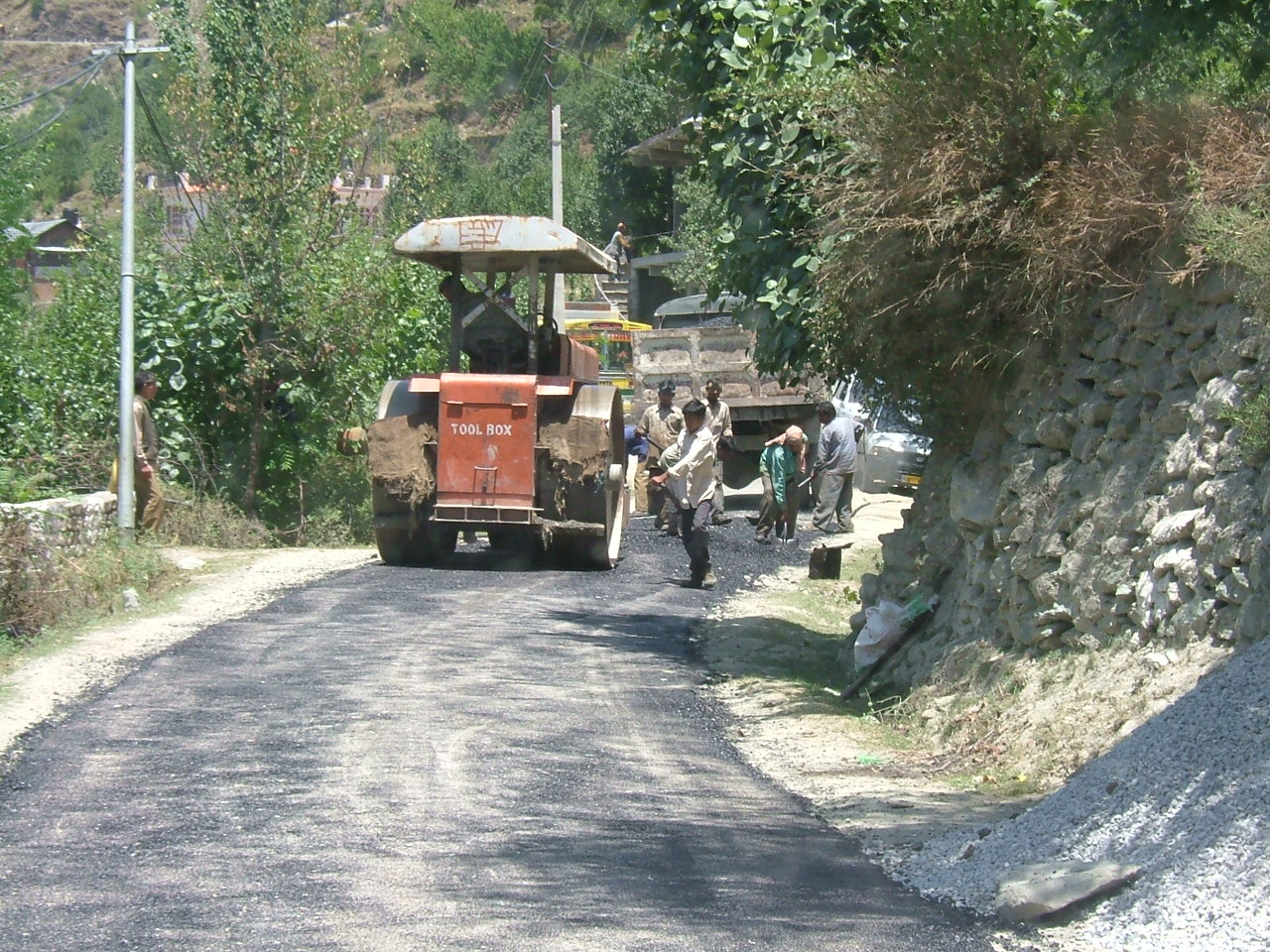
Travelling through the Himalaya foothills (I hate to call them mountains!) we saw ingenious ways of getting people or items from one place to another –
A colonial era bridge.
What looked like gas cans crossing the valley on pulleys.
Yup – the mechanism running the pulley!
Not to mention road menders at work!
We had a wonderful week exploring a little known part of India with Gypsy and were glad to have had it.
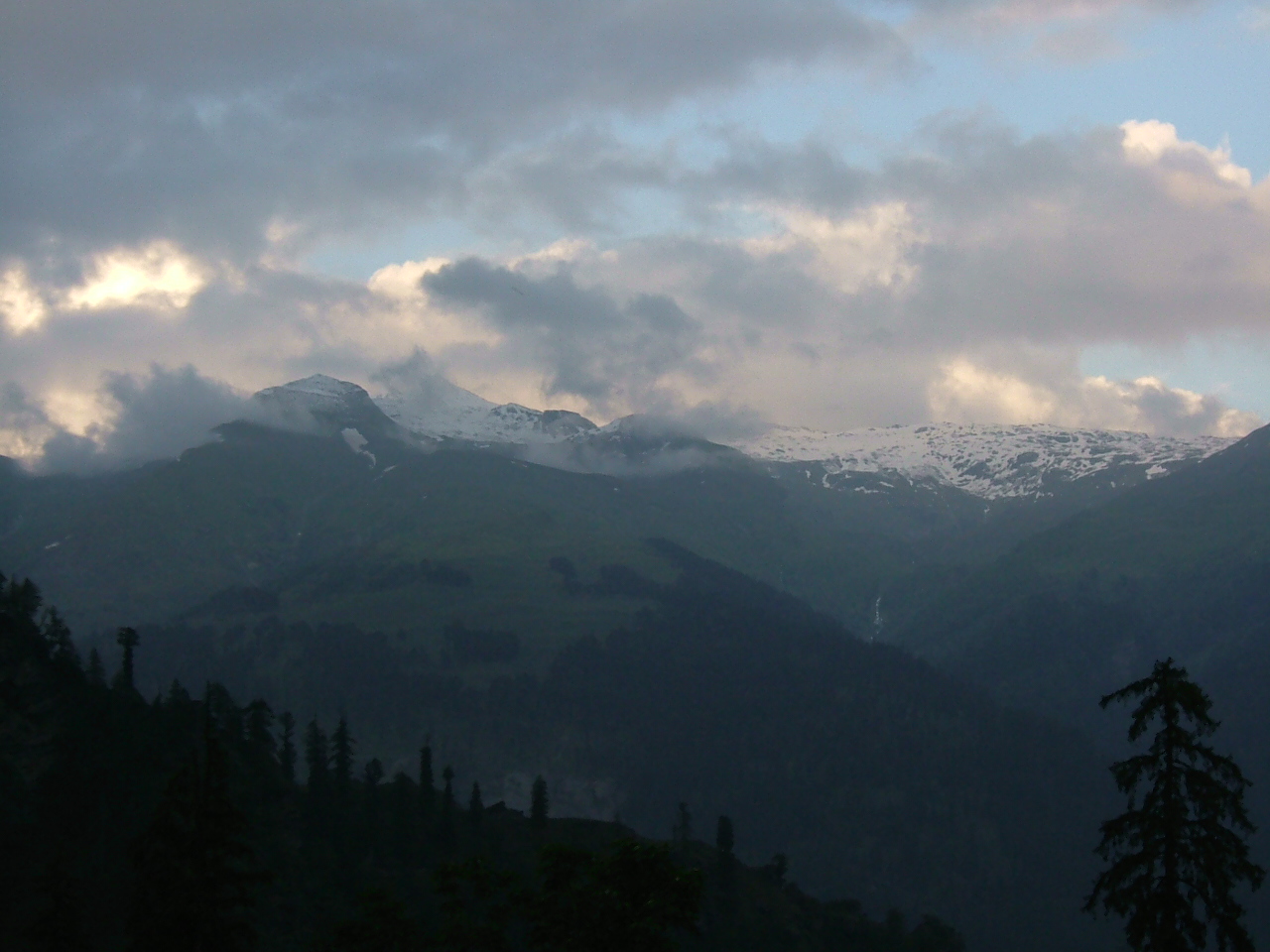
And I will leave you with another view of the hills/mountains – snow covered even in June:
A couple of years ago, I found my Grade 7 and 8 teacher on social media and have enjoyed his posts and sharing memories with him. He recently posted a meme of a man on a desert island writing his letter for the bottle and trying to decide whether to spell it desert or dessert. That brought up a memory I shared with him of his telling us that we might want a second helping of dessert but only one of desert. As I said to him, the time we spent in the desert of Jordan during four years there was the “best of times” and, to this day, leaves me longing for the desert.
The best piece of advice Sahib and I have ever had was given to us by the British husband of a Dutch diplomatic colleague at the first ever diplomatic reception we went to after arriving in Jordan. Mark told us “buy a 4-wheel drive vehicle and come out with the Jordan 4×4 club”. How right he was and how grateful we were, throughout our four years in Jordan, that we took his advice.
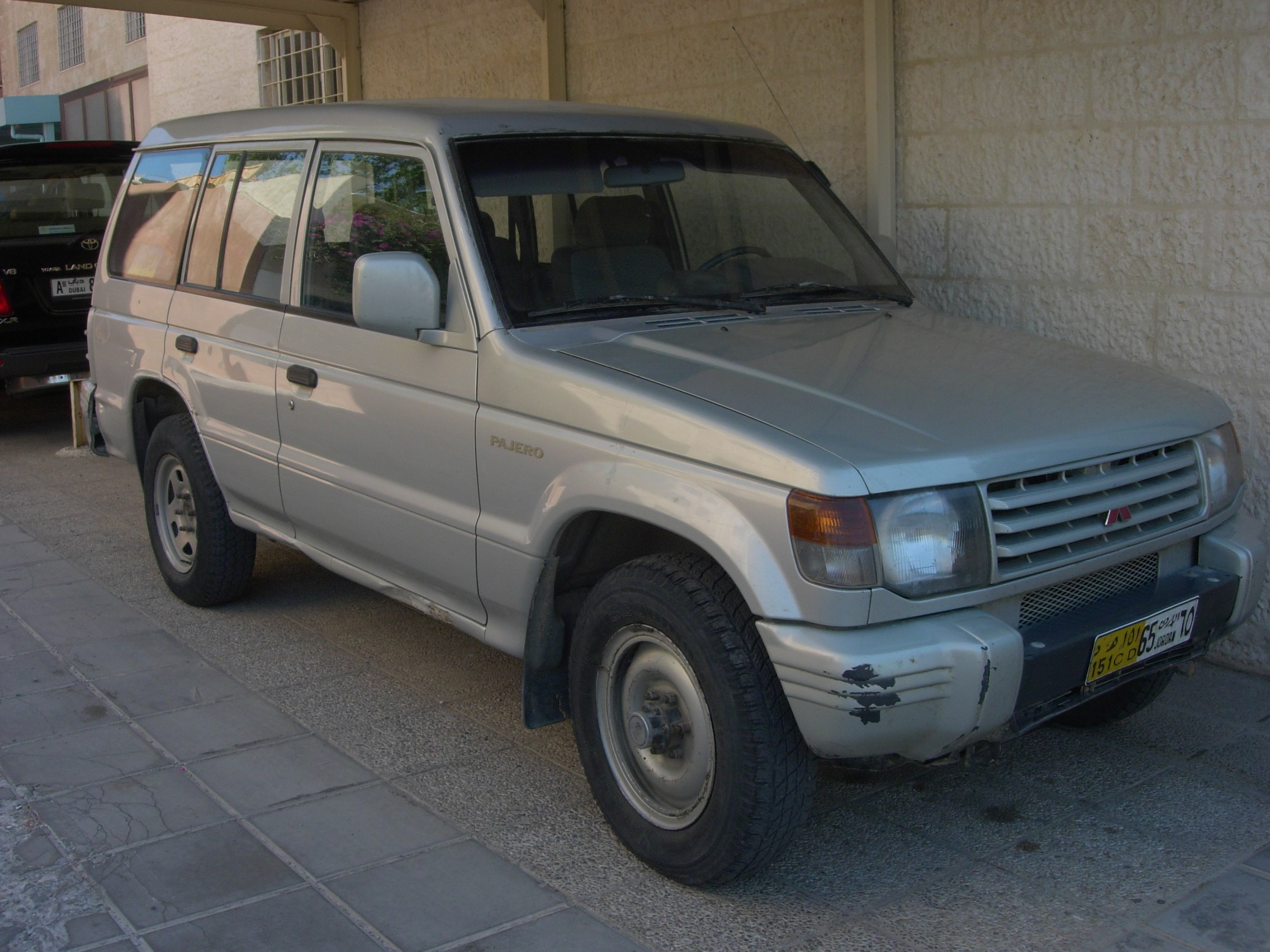
We had a modest car budget (for those wondering … our own personal funds – we were not “given” a car!) and were allowed to buy only one duty free vehicle by the Jordanian government. The transport manager at the embassy took us out to the “customs compound” on a hot day where we looked at many vehicles within our budget range. Most were pretty sad looking and many were far over our budget but we eventually selected a 7 year old Mitsubishi Pajero with a 4 cylinder engine with HI/LOW four wheel drive and wheel-lock. We were soon to call her Pajjie and came to love her dearly – she took us everywhere we wanted to go (okay, sometimes we needed a winch from the 6 cylinder vehicles to get to the top of a dune) with panache and verve.
This photo was taken just before we left Jordan 4 years later and shows some of her bumps and scrapes. We did get an injection carburetor as well as a second mounted spare tire – and used that second tire on more than one trip!
The Jordan 4×4 club met, in those days, at the Royal Automobile Club who also gave us meeting space in return for volunteer work on the Jordan International Rally and the Jordan National Rally – days that are still remembered as highlights of our four years in Jordan.
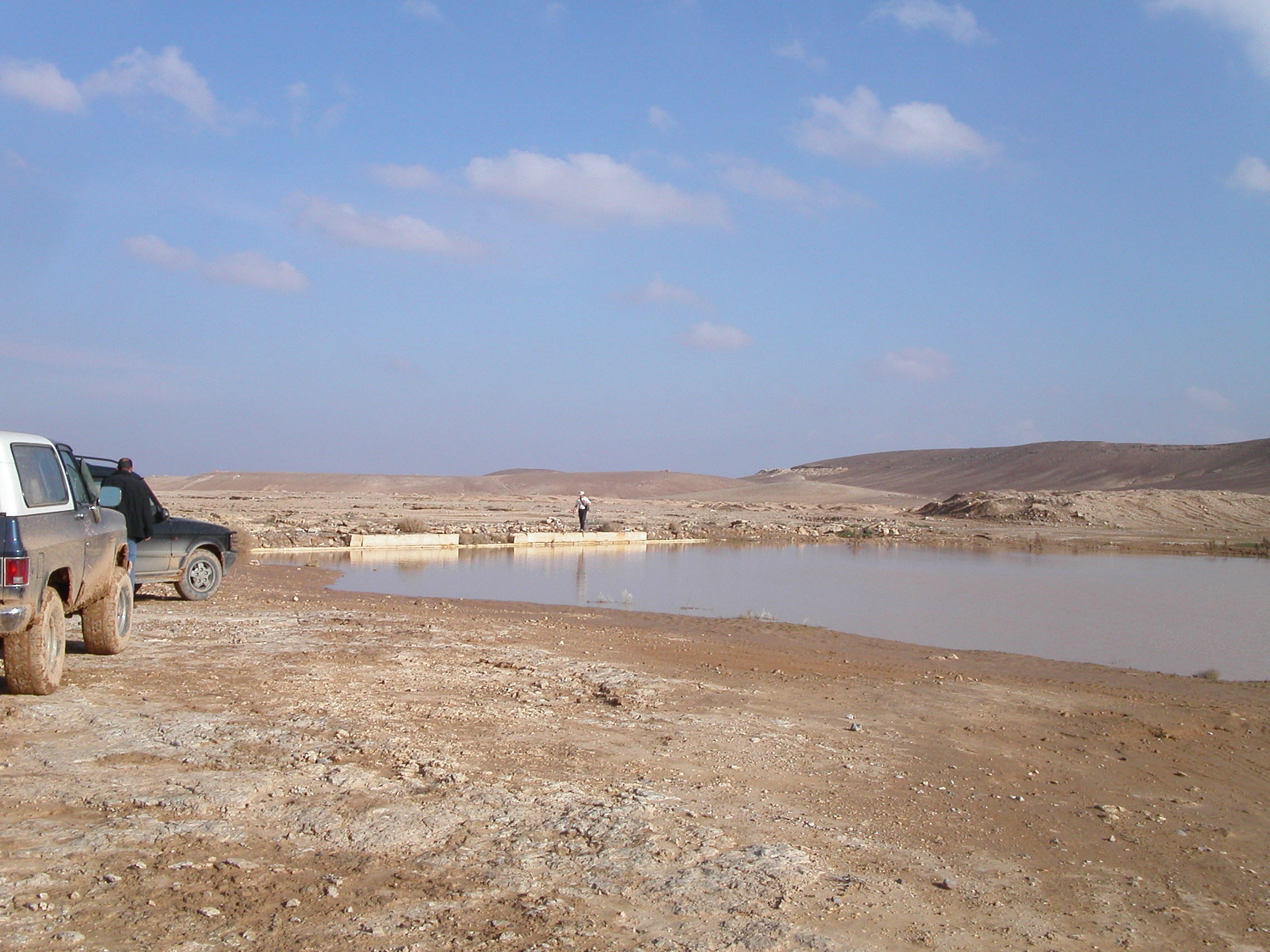
Our first trip with the Jordan 4×4 club followed soon – a dozen cars headed out early on a Friday morning (the weekend was Fri/Sat) to Qasr al-Jilat, a Roman Dam 70 km southeast of the airport in Amman that still held water! Learning to drive in formation both on the highway out of Amman and through the desert to the dam was challenging but between the day’s “group leader” at the front of the column and “tail end Charlie” at the back to ensure no one left behind it was always safety first – if someone had either mechanical issues or, more likely, a flat tire, we all stopped and worked together to get things done and on the road again.
The dam was made of huge stones and had a pond about 100 yards square behind it. It was obviously still in use because while we were there, one of the local Bedu farmers arrived with a water truck and hose and sucked up water to take back to his farm.
Qasr al-Jilat – still holding water 2000 years later – and a couple of our vehicles, quite dirty from the desert trip to get there.
Once a month the 4×4 Club went out and spent a day (or, about every other month, a weekend camping) in the desert. The “shebab” (not the terrorist organization but a group of (usually male) friends as the term is used in the Arab world generally) was a great group. The foreigners like us were few but the Jordanians were the friendliest, nicest group you could want to travel with.
The highlights of the year were the rallies at which we, and the club, volunteered doing the officiating. The International one was a two day affair. We would head out to our assigned spot on a Friday morning and spend the day doing “flying passage control” or “stage safety officer” duties and late afternoon would regroup and find ourselves a camping spot near the next day’s rally location and set up our tents (or sleeping bags in the back of the pick up trucks!) and make a campfire, cook our dinner and generally josh around. The companionship was wonderful.
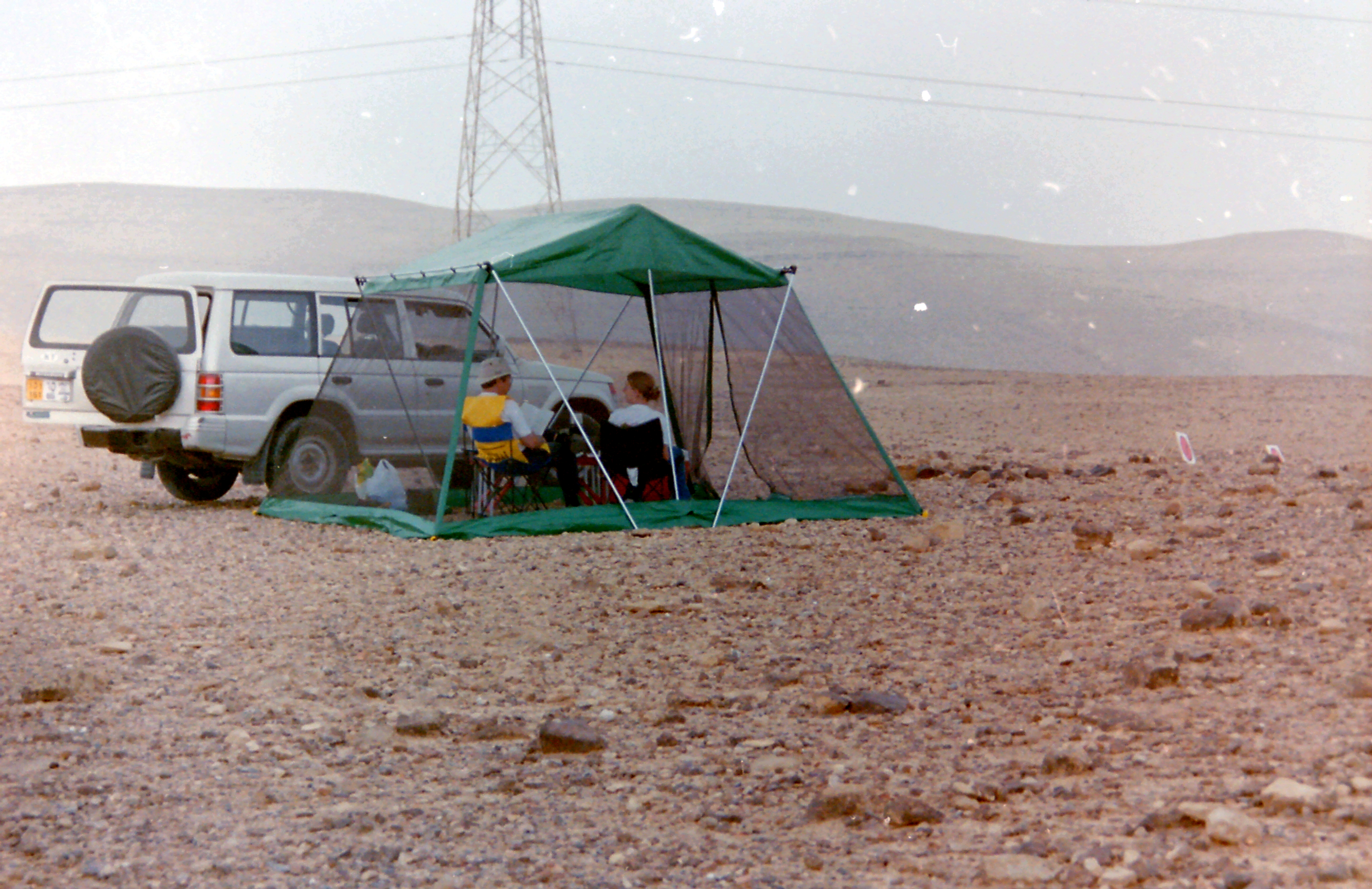
We took our dining shelter with us when officiating at the rallies for shade! This was one of our first rallies when we did “flying passage control” where we had to take note of each rally car passing us – after the first two years, the rallies got GPS units for each car and any variation from the route could be easily seen. We then switched to doing “stage safety officer” duties instead.
We got to so many places out in the desert and took so many photos that it is hard to choose a favourite photo or place – they were all wonderful. But here are a few:
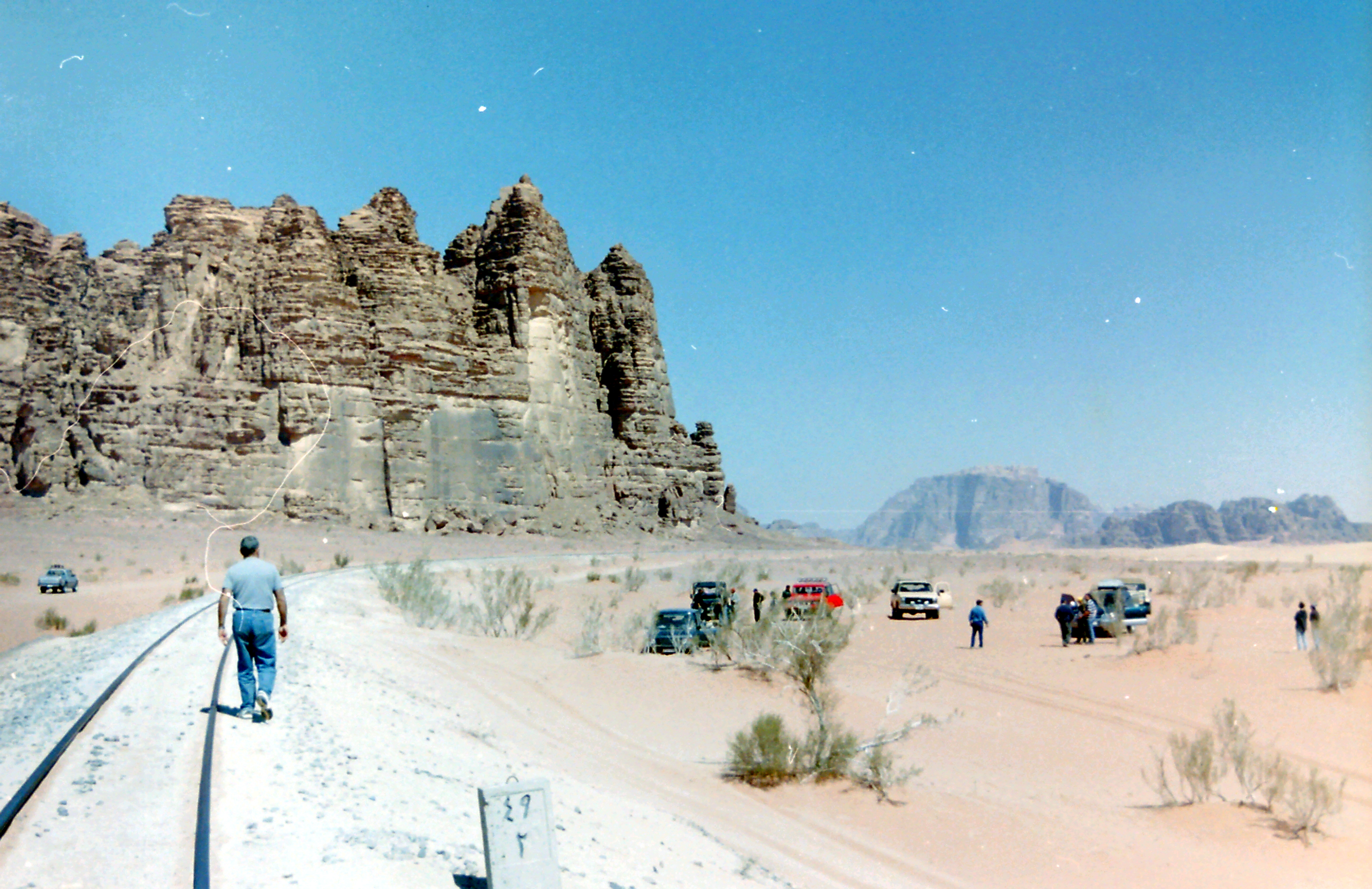
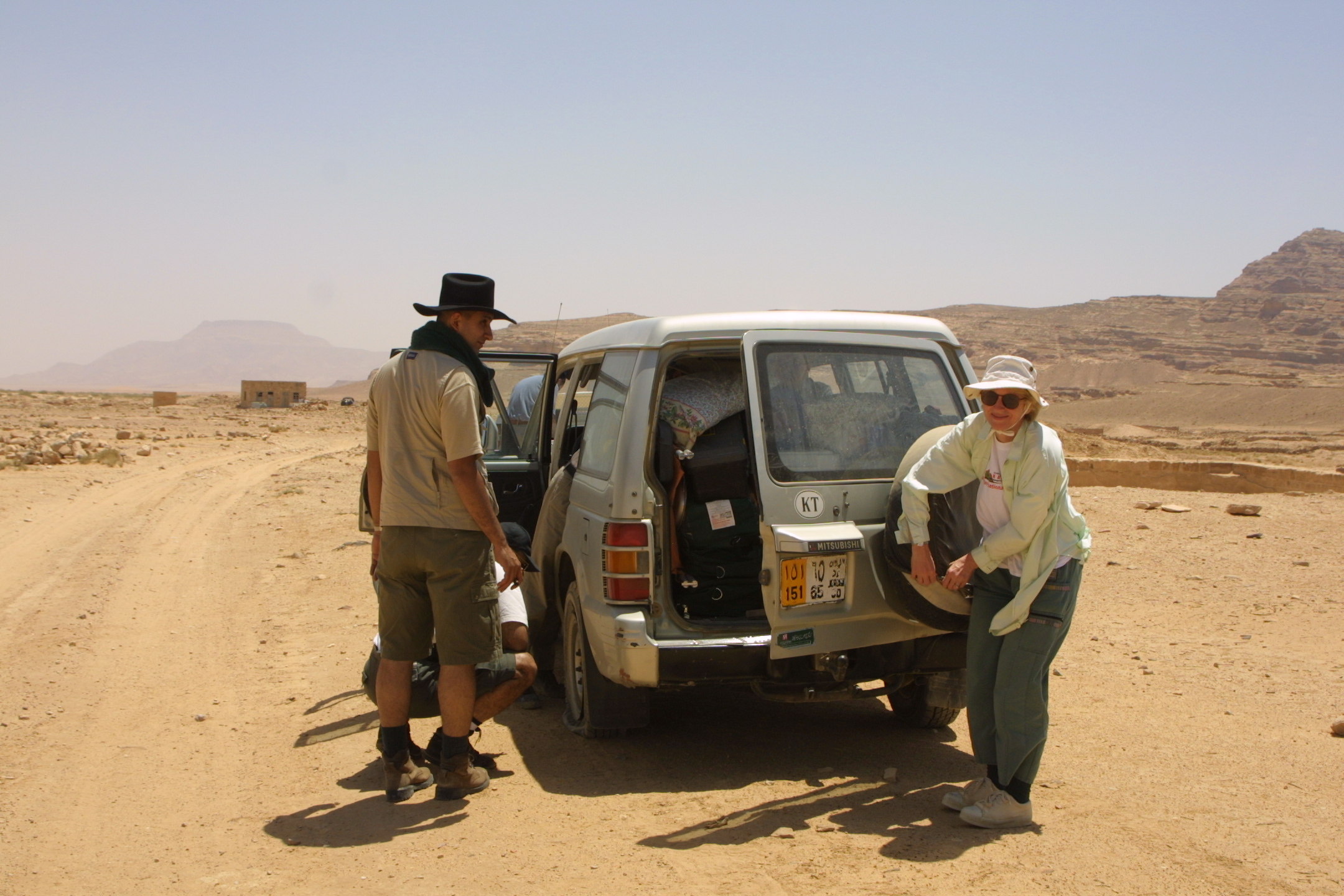
One of our favourite, and frequent, places to offroad was Wadi Rum. Here, the group is near the Hijaz railway (no longer working) under the 7 Pillars of Wisdom. Note the thorn bushes growing in the sand that were often lethal to tires – we had one day when a thorn bush branch threaded itself through one of our tires like a darning needle through cloth. There was a good reason to have two spare tires although I think we only used the second one on two occasions!
In addition to our second spare, we always went out loaded with equipment: our 20 litre bottle of water with pump top to ensure we had lots of water (the highest temp Pajjie told us about on her dash was 51 C one day!), food for the day or weekend if camping, ropes, jumper cables, car tool kit, toilet paper for those necessary trips into the distance to a toilet spot with the most beautiful scenery, tent, dining shelter, towels for soaking and removing the dust that caked our skin, a really good car lift jack. The club ended up purchasing sand ladders – that would be laid on the sand to give traction when somebody was stuck, shovels for digging out sand and mud for – again – traction, tire irons or crowbars for removing and sitting tires on wheels if worst came to worst or for moving rocks and boulders, a gas can to get gas in the desert where you looked for a gas can hung in a tree in front of a bedu tent or near a track in the desert which you followed until you found the local with gas to sell. Yup, fully loaded. We had a storage room attached to our apartment where we kept all of our off-roading equipment so that we could be sure we got it all since we were loading the car before the coffee had taken effect!
We soon got pretty good at changing Pajjie’s tires – I would remove the spare cover and work on the bolts while Sahib and some of the shebab would assess the damage and start to get the jack under and bolts on the wheel removed. Eventually it took us about 5 minutes or so to change a tire! This photo was on a camping trip and was near the planned campsite below the hill on the right at Hemeimeh (spelling optional!) – a place where we camped a couple of times.
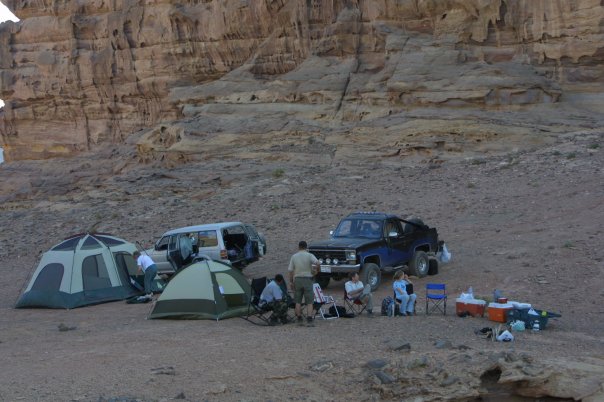
Our group spread out quite a bit but this was our campsite at Hemeimeh.
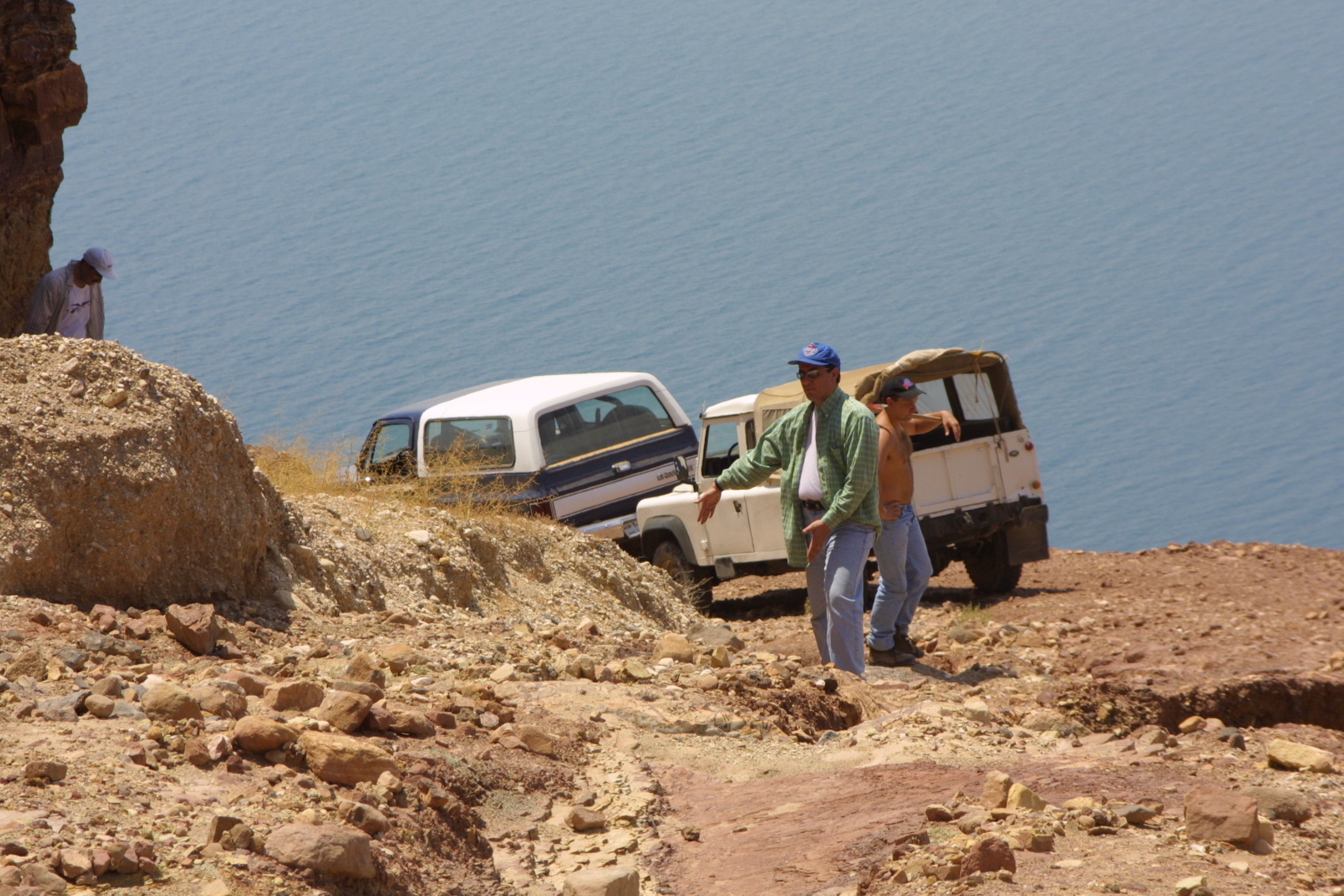
We often had views of the Dead Sea from the hills above the Rift Valley. Amman is at an elevation of 770 meters while the Dead Sea is 440 meters below sea level – and you can drive from one to the other in half an hour or so. That sea is kilometers away – and the group was moving along (at a very, very sedate pace) a cliff edge!
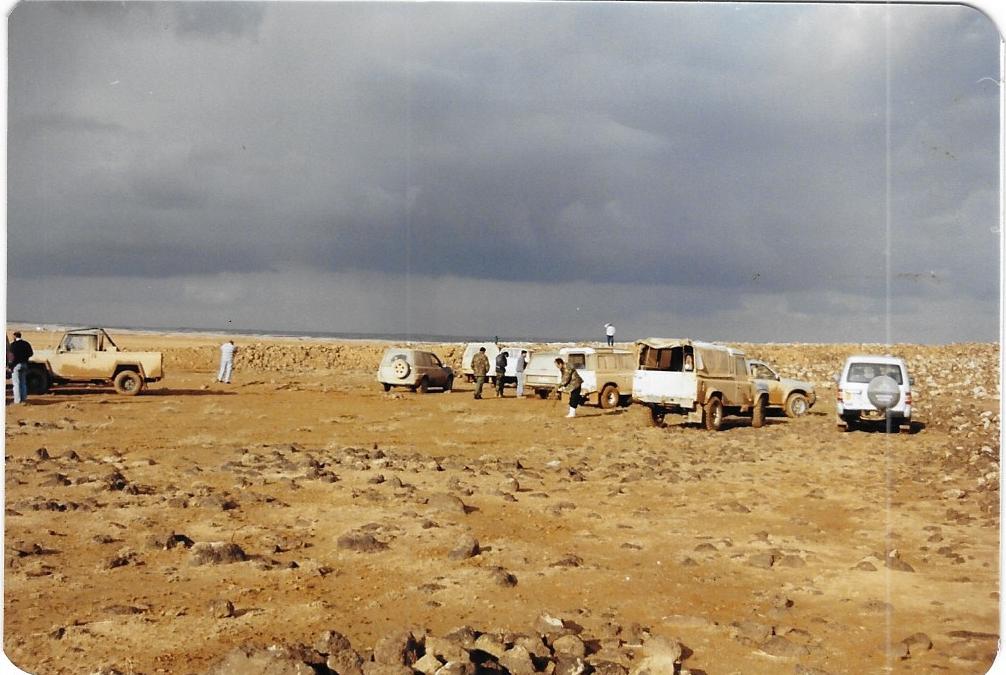
During the rainy season (from November to March) we often went off “mudding” in the eastern desert near Azraq. As you can see, the cars got more than a little muddy – in fact, there were often mud clots on the roof of poor Pajjie! My office building had an Egyptian caretaker who lived in quarters in the basement, spoke little English but was friendly and worked very hard. For 4 JD (not much at all) a month, he would wash our cars twice a week. When we had been off-roading, I gave him a couple extra JD for all his hard work. It also used to leave a mud puddle on the floor of the garage where we parked. My boss told me he knew about the mess that lasted a few days but considered it a part of good relations with our host country!
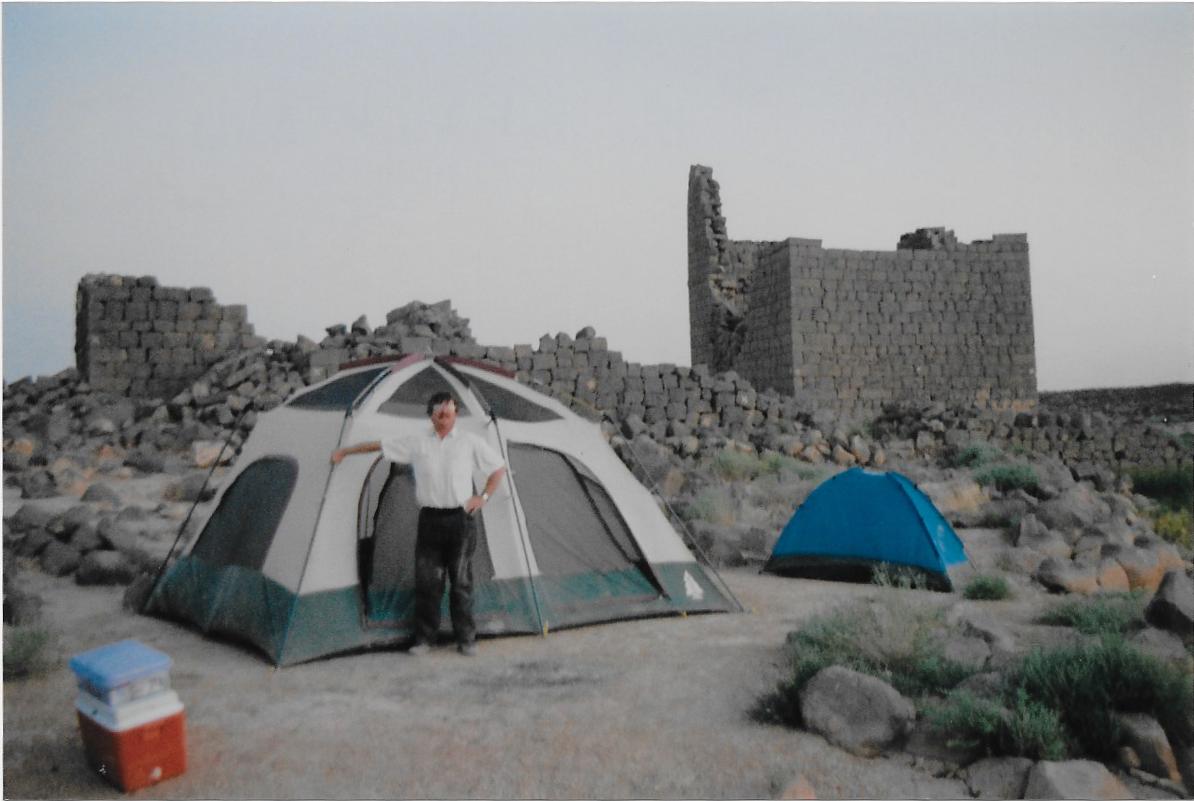
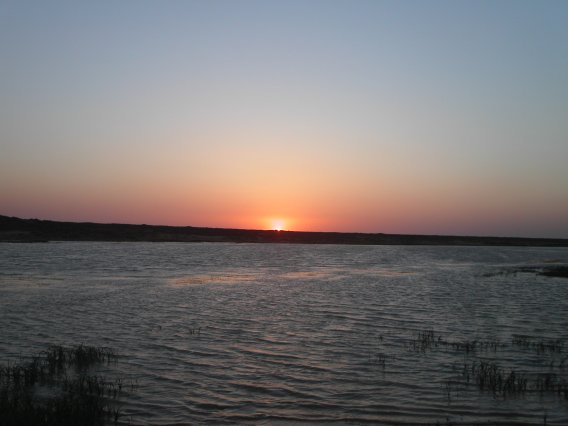
One of the places we got to camp twice was Lake Burqu – well north (off road!) of the Desert Highway – where there were the ruins of an old castle and the largest freshwater lake in Jordan.
Sunset over Lake Burqu from our campsite.
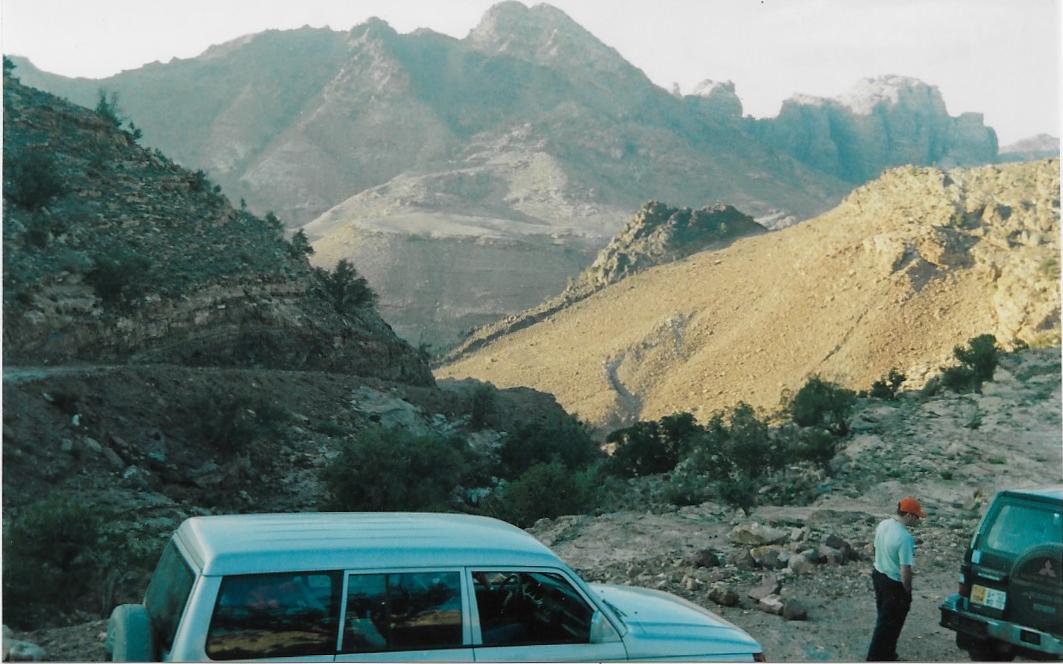
Another place we often off roaded was to Little Petra – in the hills between Petra itself and the Dead Sea were Nabatean settlements outlying Petra itself where houses were often built into (out of?) caves in the hills and the road was rocky and the views were spectacular. Late in our stay in Jordan, Sahib and I got pretty confident and often went out by ourselves to offroad and camp in the desert which was heavenly. We often said that Jordan was a “village of 5 million people” and proof came to us one day when we were camping by ourselves in a box canyon in Wadi Rum. A couple of local bedu, in a beat up pickup truck, stopped at our campsite and while our Arabic was as minimal as their English, while we were having tea (no matter what or where the first rule of hospitality in Jordan was offer water then tea) we soon understood their question asking us if we were the Canadians who recently had been out with a group at little Petra! We sure had to behave ourselves in Jordan…
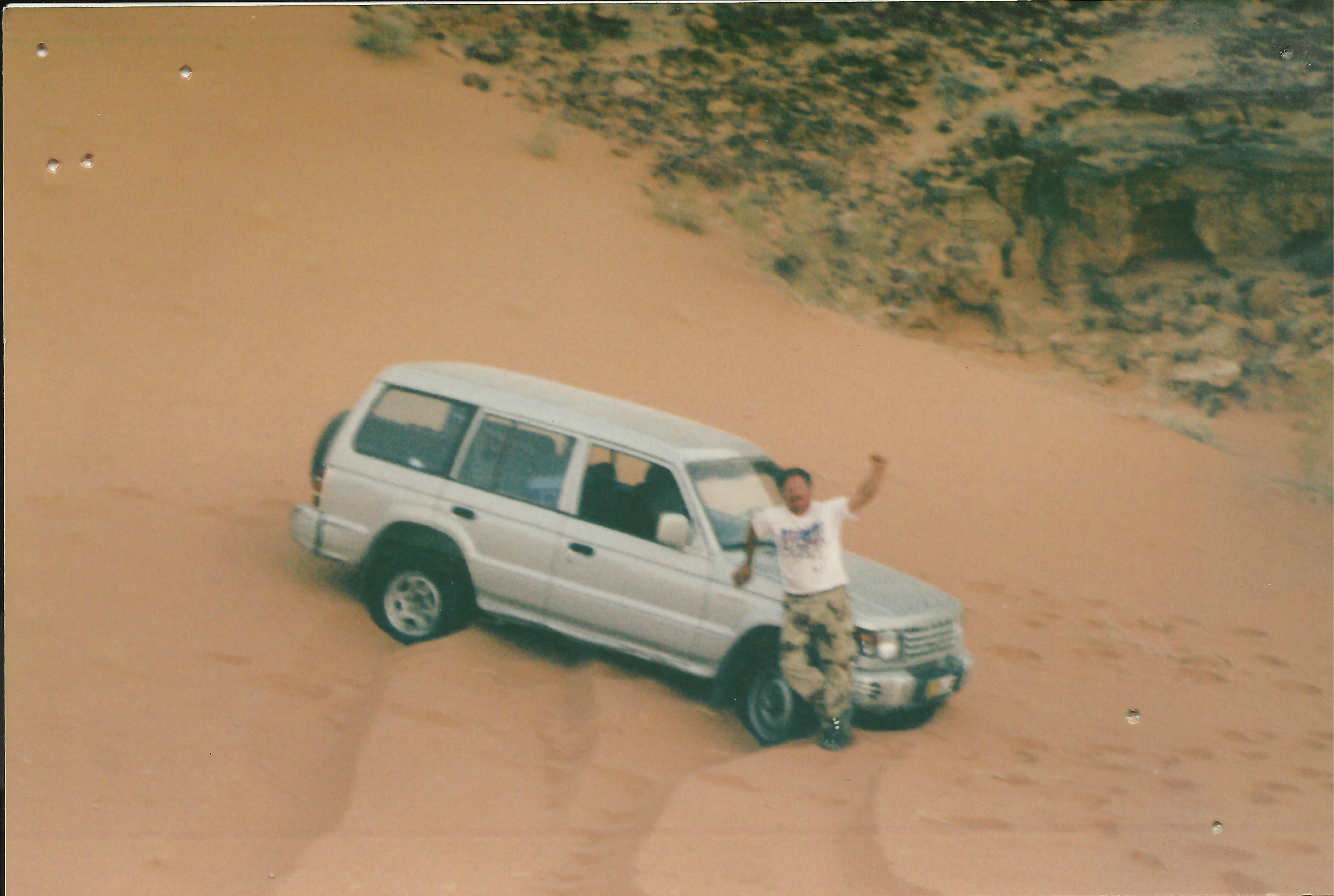
Needless to say, getting stuck in the sand was a frequent occurrence. In this case, sand ladders were not enough and one of the shebab used his winch to get us out!
Pajjie, a good companion who made all of our desert adventures in Jordan (and, in those days, Syria) possible.
My first experience with boats of any kind was at Pioneer Camps near Port Sydney, ON where I was a camper, dishwasher (at a cost of $10 for two weeks I got to do all the camp activities but also wash dishes after meals) and counsellor for 9 years growing up. As counsellor, after years of taking canoe and archery lessons, I got to teach those activities to campers. Canoes also escorted us during my 10 mile swim from Girls Camp to Junior Camp and back when I was 16 and they were the mode of transportation – and shelter – during “out-trips. Imagine sleeping under a canoe raised on rocks in the heaving down rain, if you will!
My next experience with boats was when I was an exchange student in the Netherlands and, during the summer break, we attended a sailing camp at Enkhuizen on the Zuider Zee. We stayed at the Dromedaire – a 14th Century jail that had been converted to a youth hostel providing sailing lessons. It is now De Drom – as centre of Art, Theatre and Culture (https://drom.nl/). The dorms were in the top floor, under the roofs and access was through a stone circular staircase with a 2″ thick rope handrail. Miss your footing and you do what I did – tumble down umpteen stairs and sprain your ankle until it looks like a black and blue grapefruit. Having done this our last night there, our team leader, Andy, who was part of the “trainer” team for his university’s football team, expertly wrapped it in football tape and I happily walked through the Rijksmuseum the next day – seeing, amongst many famous paintings, Rembrandt’s Night Watch.
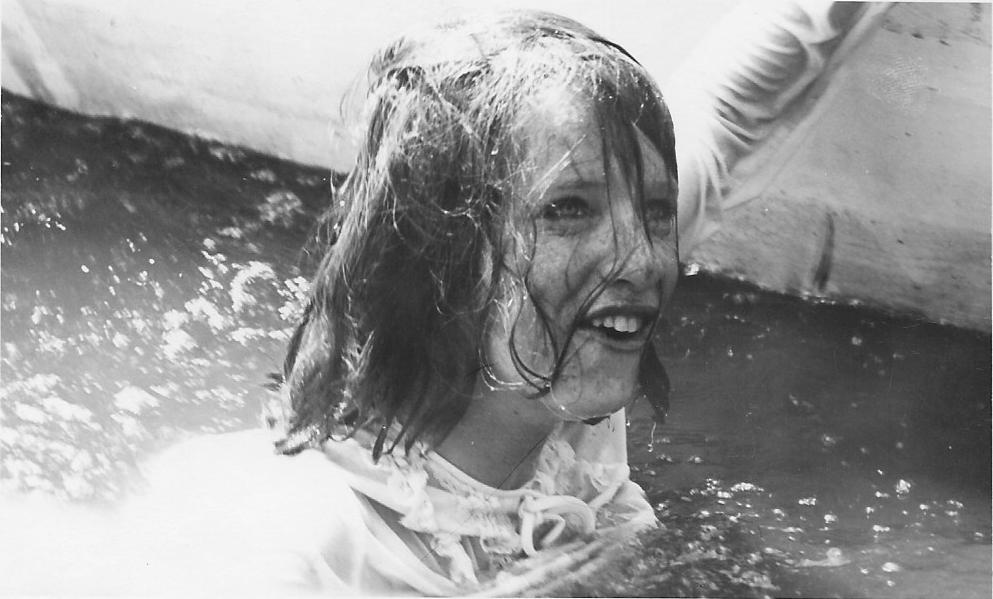
The final day of the sailing camp had a tradition – all the students got dumped in the water! Andy being an amateur photographer, caught a shot:
At one point, in about 1990, we borrowed my brother-law’s canoe for a camping holiday in Northern Ontario and had a near disaster on Windy Lake with our three daughters in the canoe with us. Having found the boat slip, we put the canoe in the water, then we all put on our life jackets and headed out on a calm lake under a sunny sky to take a look at the far shore. As we got there the sky turned black, the waves rose and the skies opened. Not being a large lake, we decided to stick close to the shore to paddle like mad around and back to the boat slip. Danger being a good motivator, we were making good progress through the reeds, the children were being quiet as mice and well behaved and we were half way back when we saw a motor boat headed our way! Someone had seen us from his cottage and, with better knowledge of the lake and seeing our struggle, come to our rescue. He pulled up beside us, took our bow line and pulled us slowly back to the slip. I don’t even remember, if I ever knew, the name of our Guardian Angel but we owe him a lot!
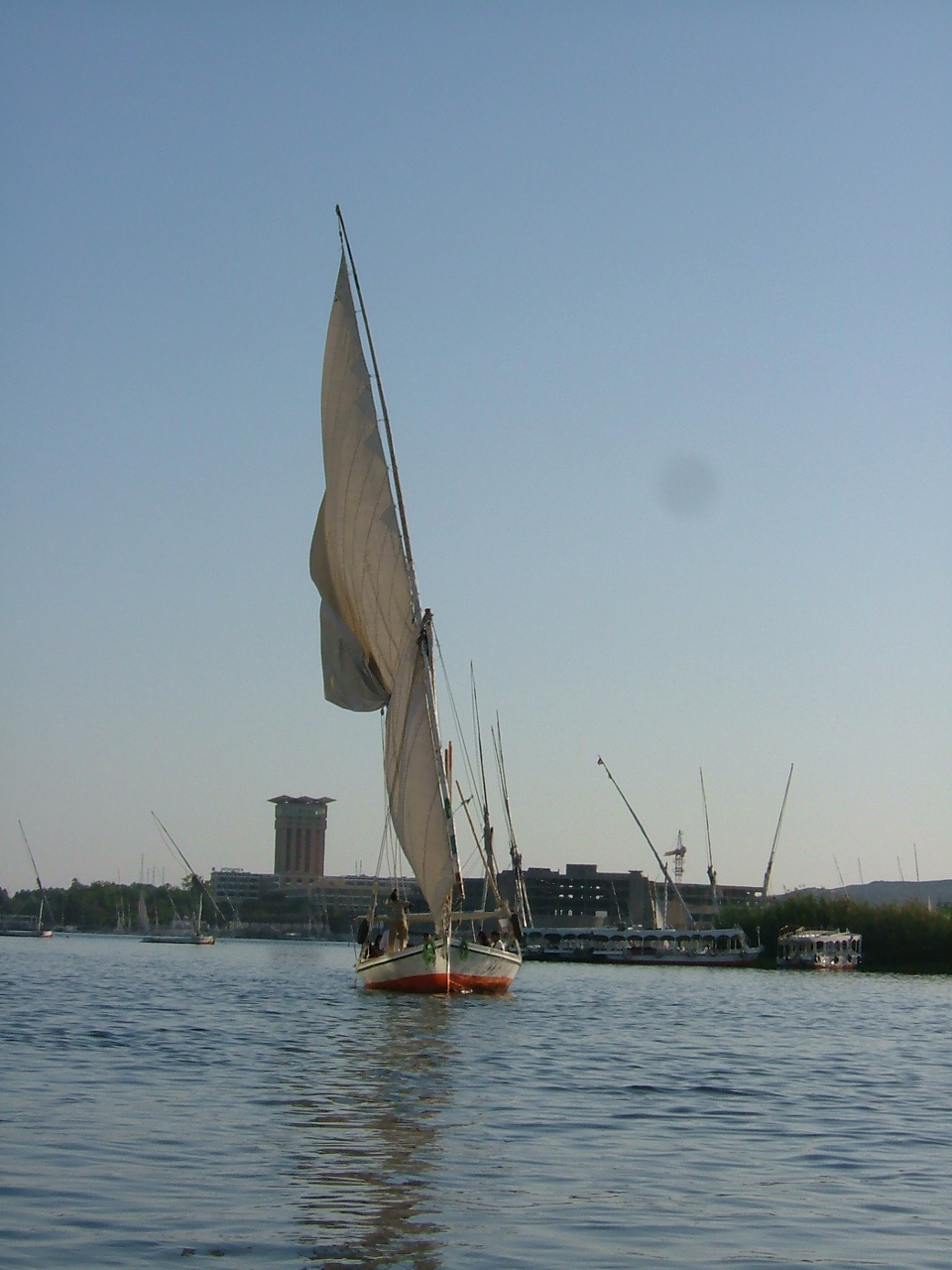
When Sahib and I started dating, I was actually saving money to go on a Caribbean cruise with a friend, Louise. That came to naught and probably just as well because I don’t really think I am a “cruiser” although I have been on one cruise that was spectacular – from Aswan to Luxor in Egypt with the friend I was visiting in Cairo. However, the boat was only about a quarter full – I arrived in Cairo shortly before the airspace over the North Atlantic and Europe closed due to a volcano eruption in Iceland – and most of the bookings had been cancelled. I was able to get back home as scheduled when things simmered down for a few days but then closed down with another eruption.
The cruise boat was like many one sees ads for in Europe – not huge, I think there were two decks plus a crew deck. En route we saw local falluccas on the water:
We got guided tours at Edfu, Karnak, Kom Ombo, Luxor and Valley of the Kings – an experience I would not have missed for anything!
My next real experience with boats was Jason’s Boat to Sabal Beach in 2014! Having shopped for groceries for two weeks in Placencia – I had a list and checked it twice! Jason picked us up at the dock to take us to everyone’s idea of a tropical paradise: Sabal Beach where it was completely off the grid – solar powered, not a grocery store in sight and no one on 7 miles of white sand beach! Travelling down, and back, that time the sea was calm as glass and unthreatening – later trips down and back on much rougher seas confirmed my first impression – Jason is a seafarer of high quality!
Photo Courtesy Wayne Church III
Although a small boat and open water, I have always felt safe with Jason – no matter how rough the sea – and have been back to Sabal Beach 5 more times! D, one of the owners of Sabal Beach, also had a boat and captain’s licence and on a couple trips to Placencia and Punta Gorda, from Sabal Beach, inspired the same confidence.
And now I am staying in a cabana on the canal on the way out of Placencia. When Jason left the main dock in Placencia (or, last year picked me up at the dock here) we went through the canal which is well posted with signs “NO WAKE” to keep traffic slow. He always slowed to a bare crawl to comply. Not so many of the boats I see travelling the canal from my deck. They go out to sea in the morning and back in the afternoon. Most are tour boats of just bigger than Jason’s boat but a number are huge – one a catamaran – and some are sailboats of varying sizes from small to large. Some go “dead slow” and pass quietly by. Others have a couple honkin’ big Evinrudes and you can hear them coming – slap, slap on the canal as they bounce through creating waves that jostle my tiny rowboat against the dock and throw waves up onto the shore. And then there are what I call the “party boats” coming through too fast with loud music blaring and drunken chatter no matter early morning or late evening. Quieter, though, are the few kayaks I see go past enjoying the canal.
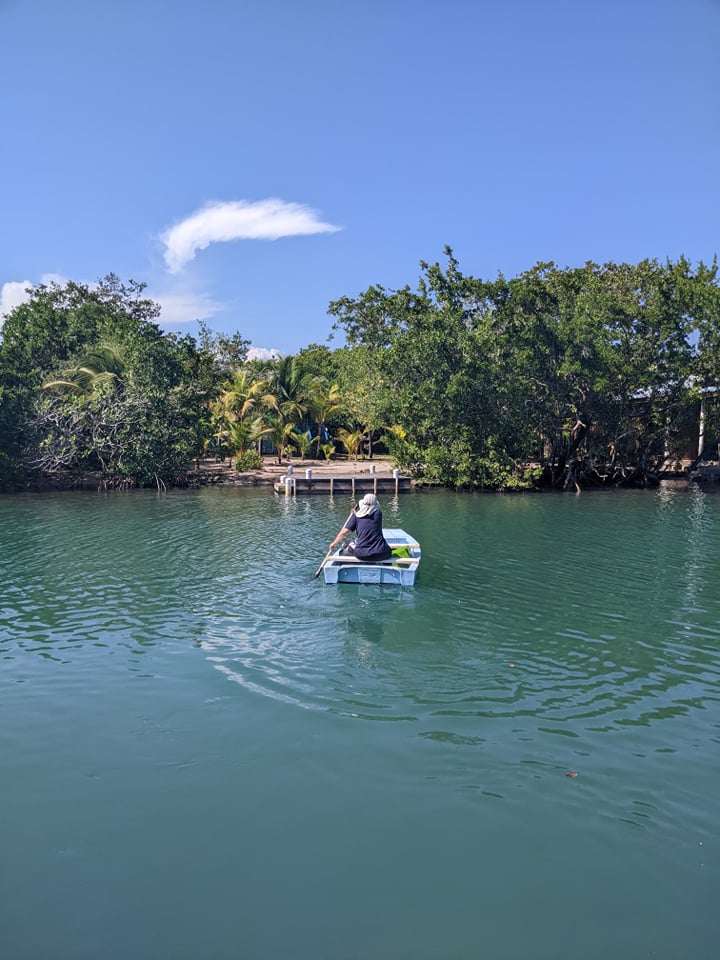
While I am sure most have seen a photo of the rowboat I have to bail after the previous day’s rain, here is “my” boat headed for “my” dock!
This is a “do nothing” day so I will return to a bit of travelogue … during Covid lockdowns, stay-at-home orders and the like, I often made Fb posts about “Travelling vicariously, Covid (day/month/now Year 3), and some of the photos I have taken over the years. For most of the years of travelling since retiring in 2007, I was living in the Maritimes and, like most Maritimers, I “worked away” – in my case, the commute was far farther than the many who worked in the oil patches of Alberta. I was so very, very fortunate. My current project is actually trying to organize the 100,000 or 200,000 photos I have in some manner. Wish me luck. A recent find was my pics of Swaziland.
One of the places I was fortunate to work in – I think 5 or 6 times – was Pretoria, South Africa. I may have had to work Mon-Fri but my weekends were my own and I made sure to get out and about and see all I could on the weekends! I started by booking through a travel agency but then they had difficulty drivers to get me to game lodges and started to get me to rent cars and drive myself. Given the lodges all had websites, I was soon making my own plans and renting a car to get where I would spend the weekend. Having driven on the wrong side of the road in India, that was not a problem in South Africa! The highways were good but speed limits rarely enforced and the traffic was everything from slow, old trucks, falling apart old cars, motorcycles and cars to big trucks with pup trailers – all going various speeds up to 160km/hr – caution advised.
One of the places that appealed was Swaziland (as it was then) now The Kingdom of Eswatini since 2018. Fortunately, my workday ended just after noon on a Friday, so I headed off for the weekend to Phophonyane Eco Lodge just north of Mbabane, Swaziland in a very small rented car. Luckily, there was a “dip line” at the border so I was able to avoid delay and easily got to the Lodge just before dusk and in time to put my order in for dinner. This was a bit non-plussing but made sense – order from the available menu so that little food gets wasted.
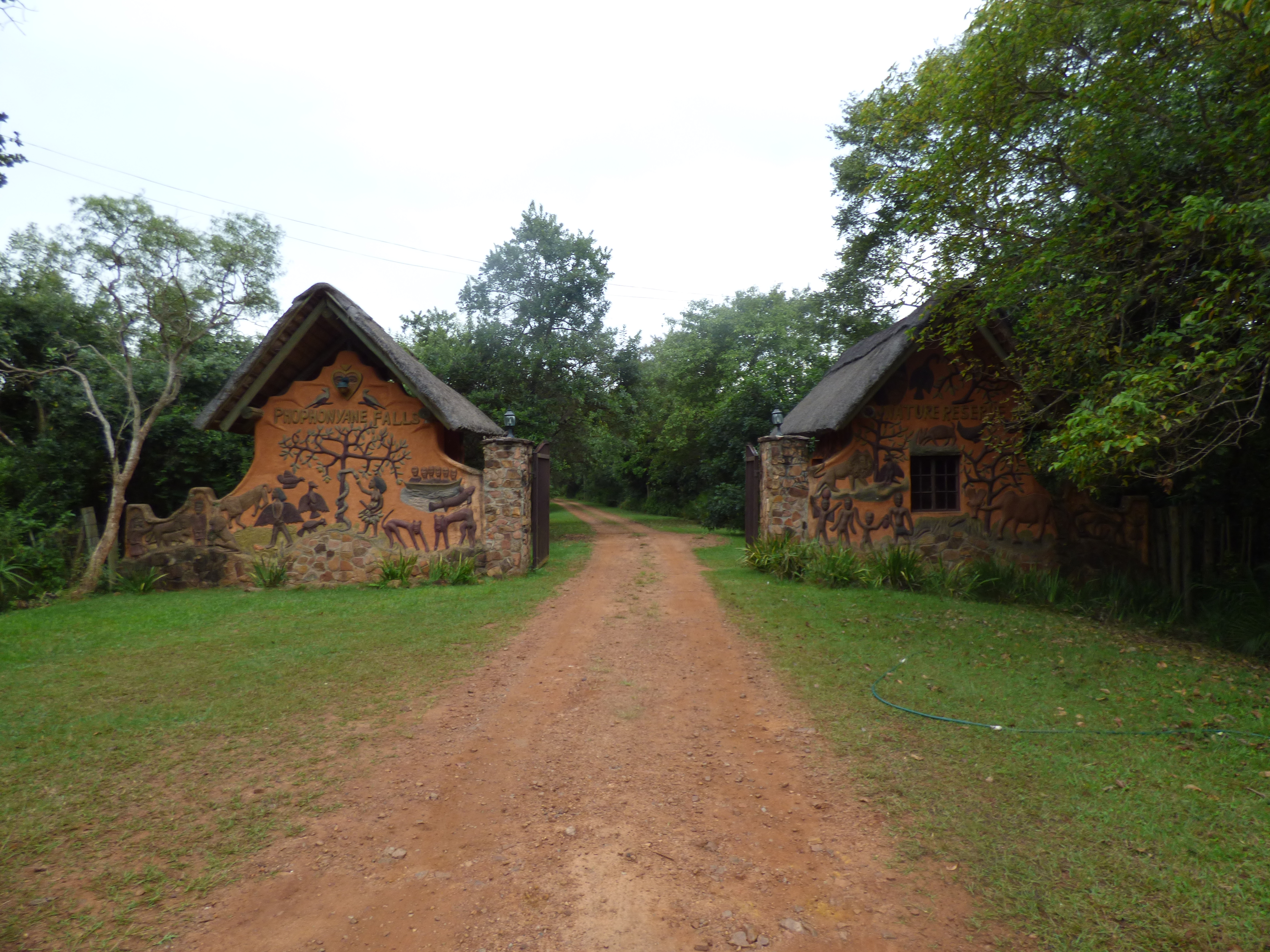
The entry gates to Phophonyane Eco Lodge
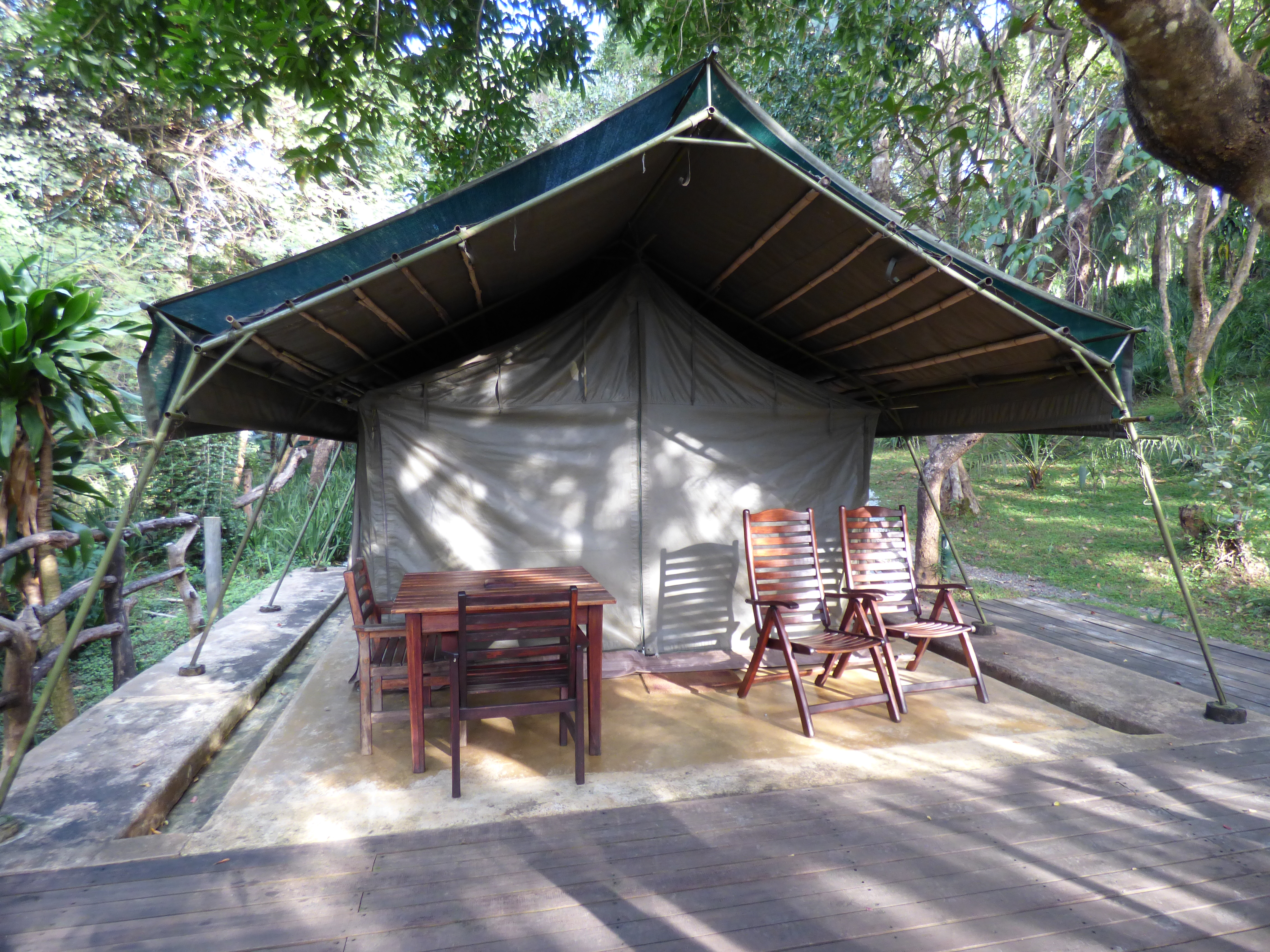
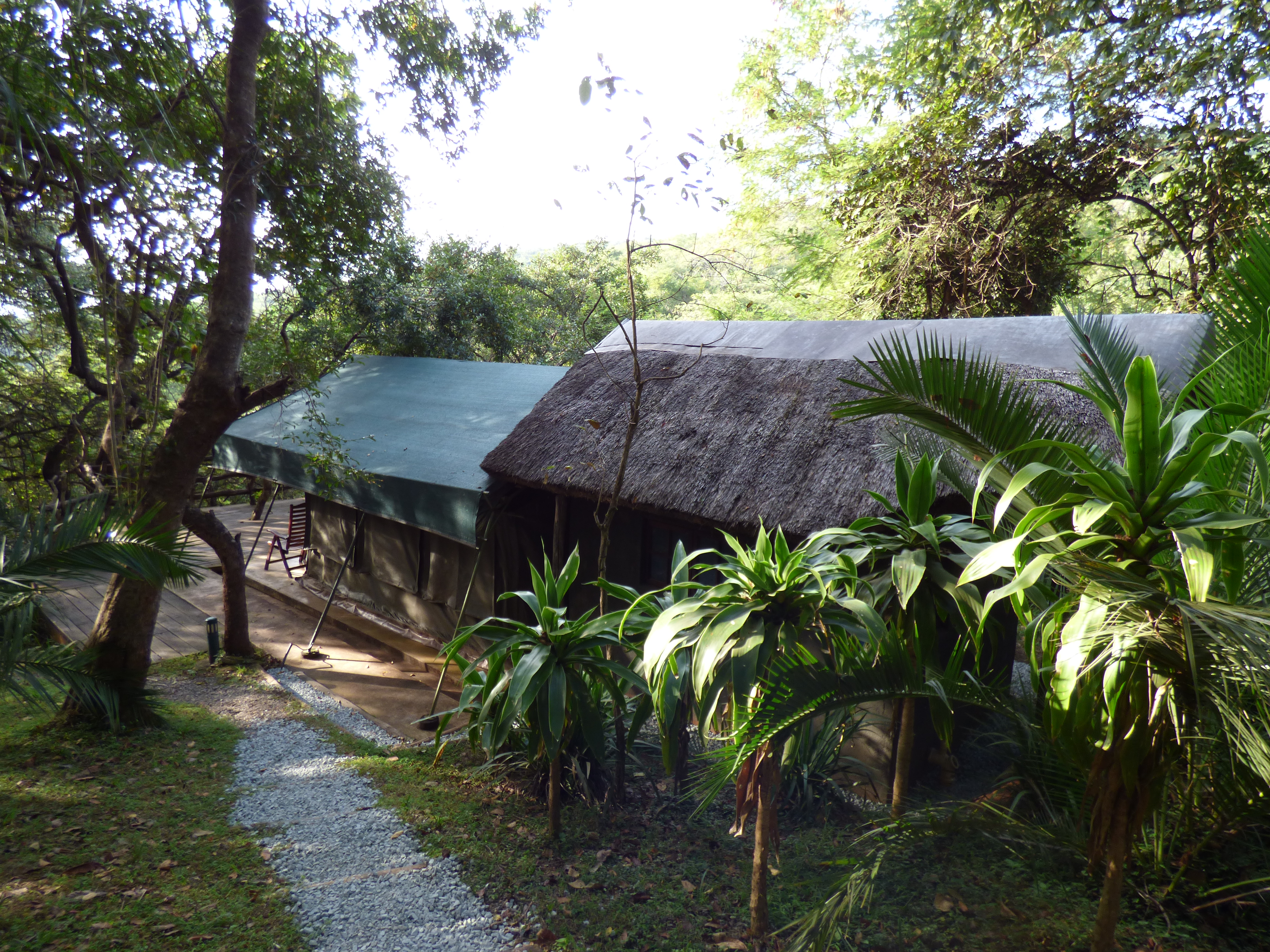
Rather than stay at the main lodge, I opted to stay in one of their tents – very much glamping!
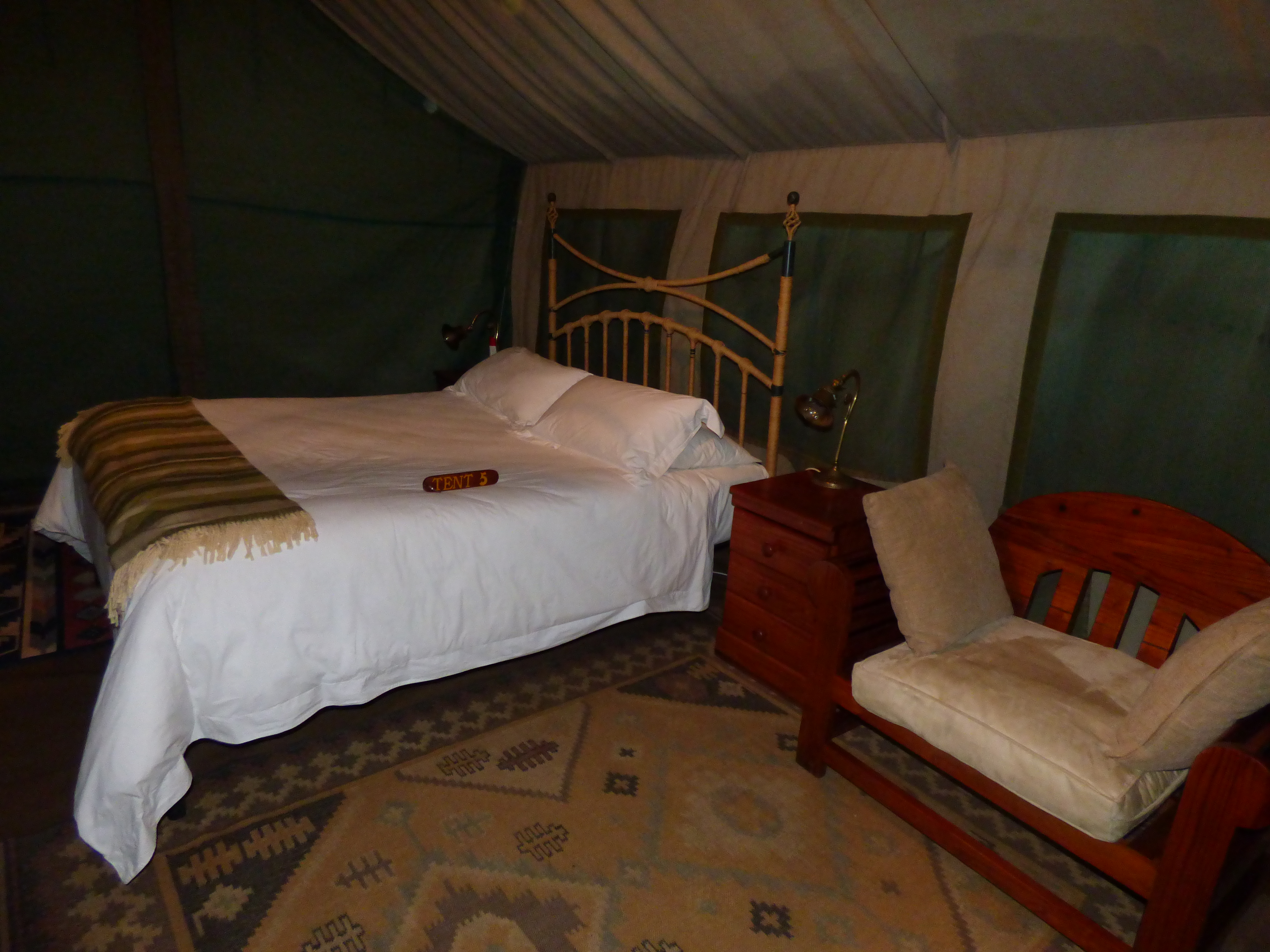
The tent was the sleeping quarters and was attached to a bathroom unit. The tent was airconditioned, carpeted and had a lovely deck and the monkeys made their way through the trees overhead!
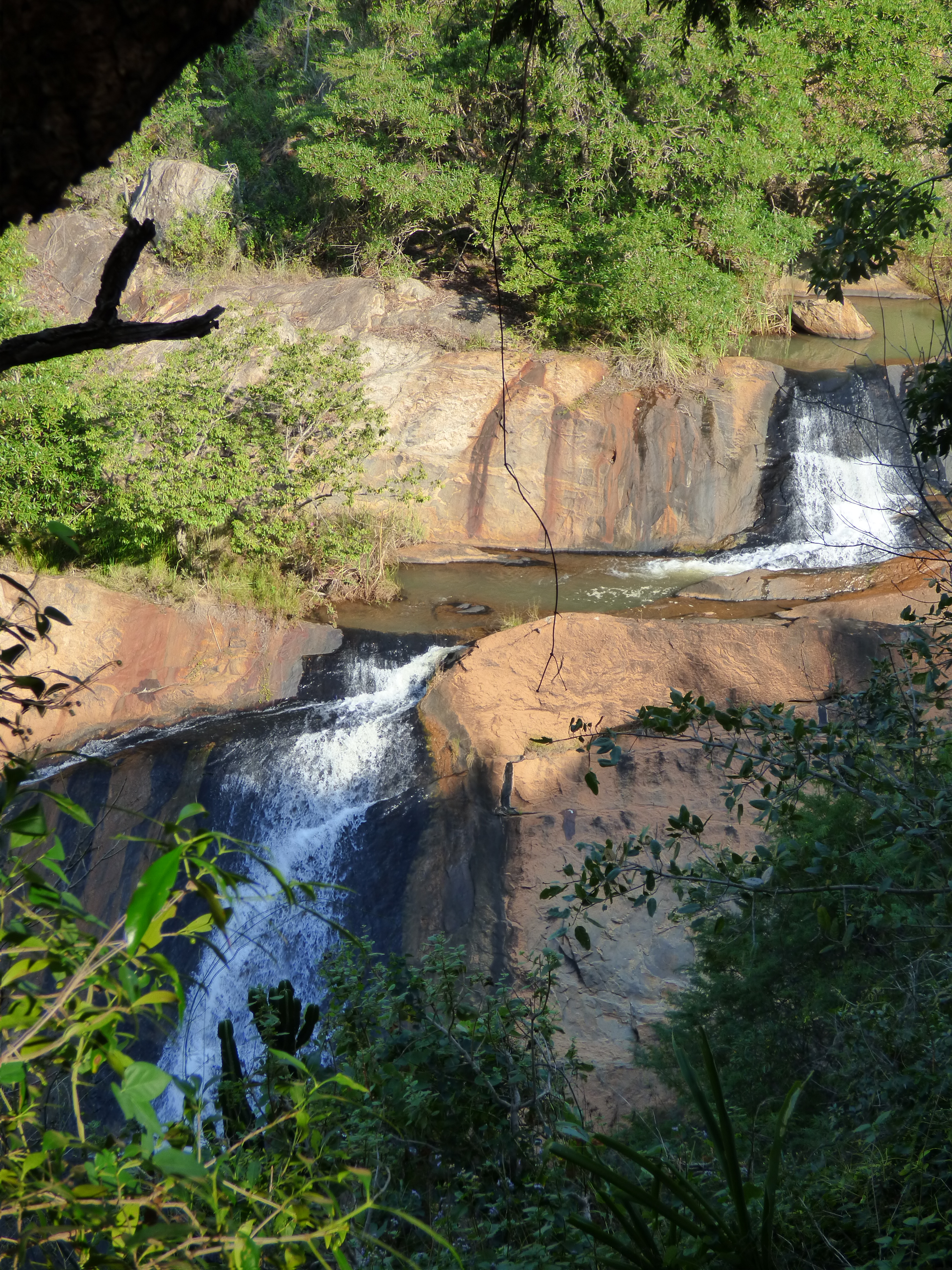
I spent most of Saturday hiking the local trails – one down to the edge of Phophonyane Falls.
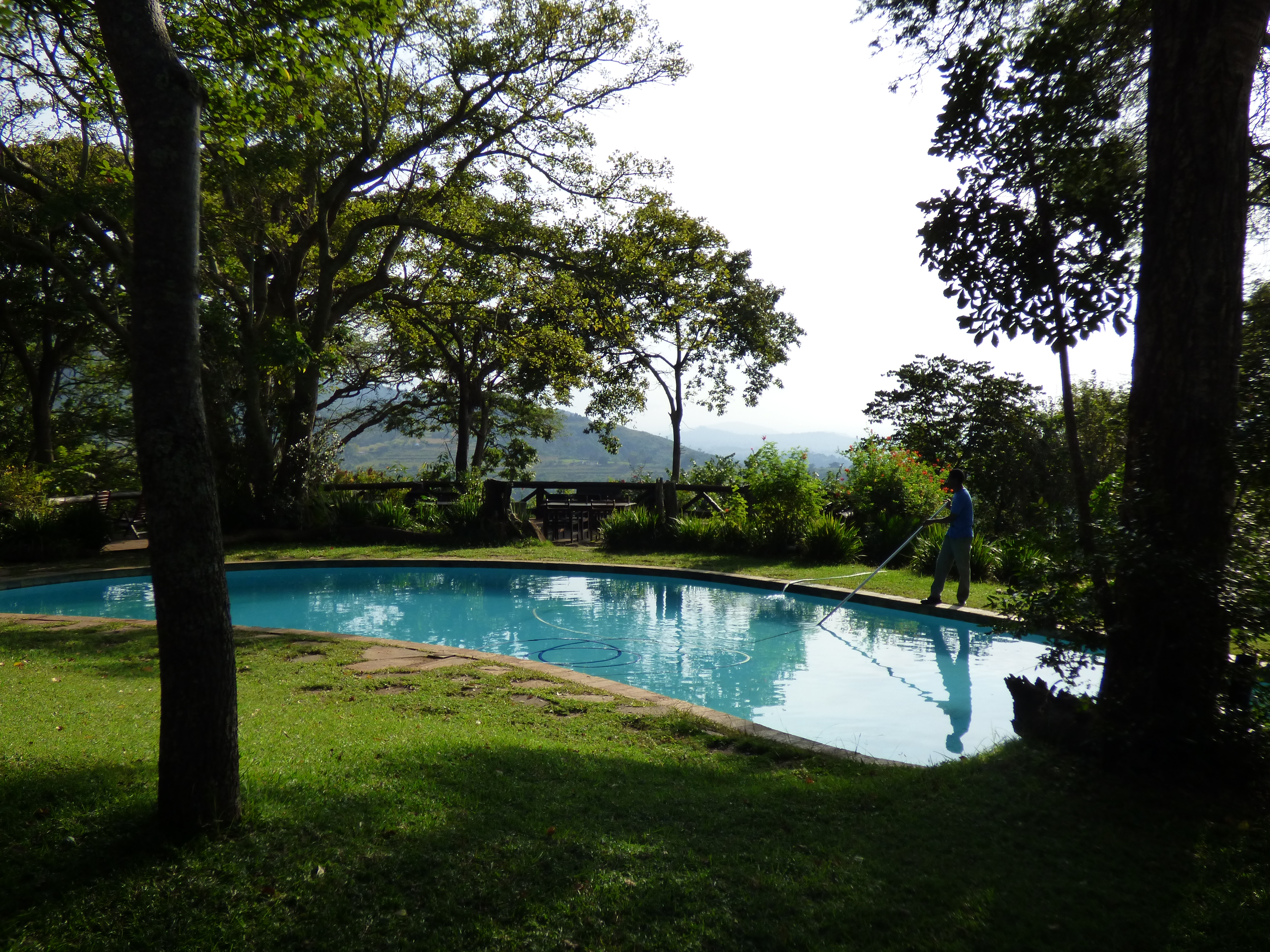
I also had the pool to myself and took a swim with the beautiful view.
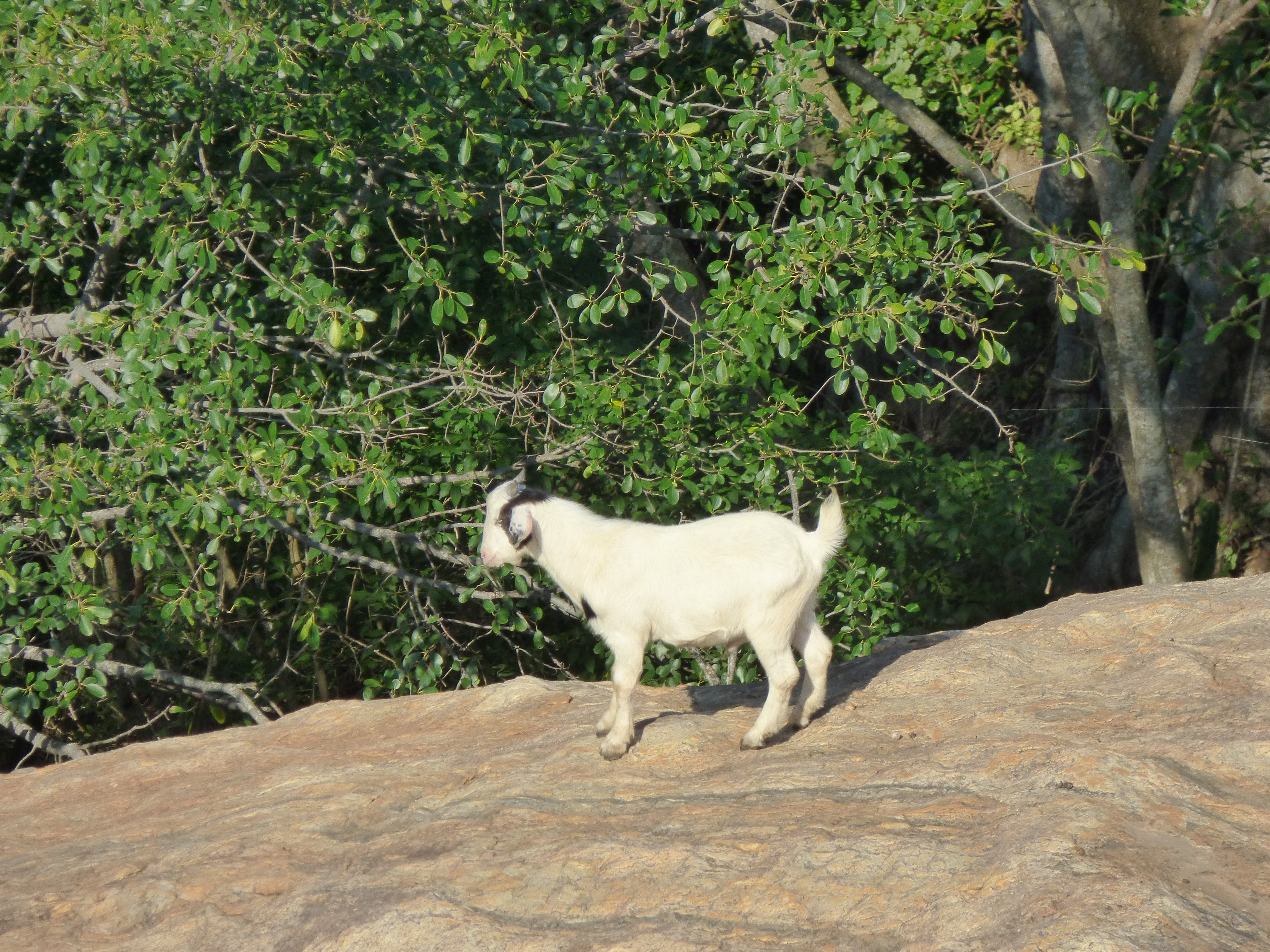
On my walk down to the falls, this goat kept me company.
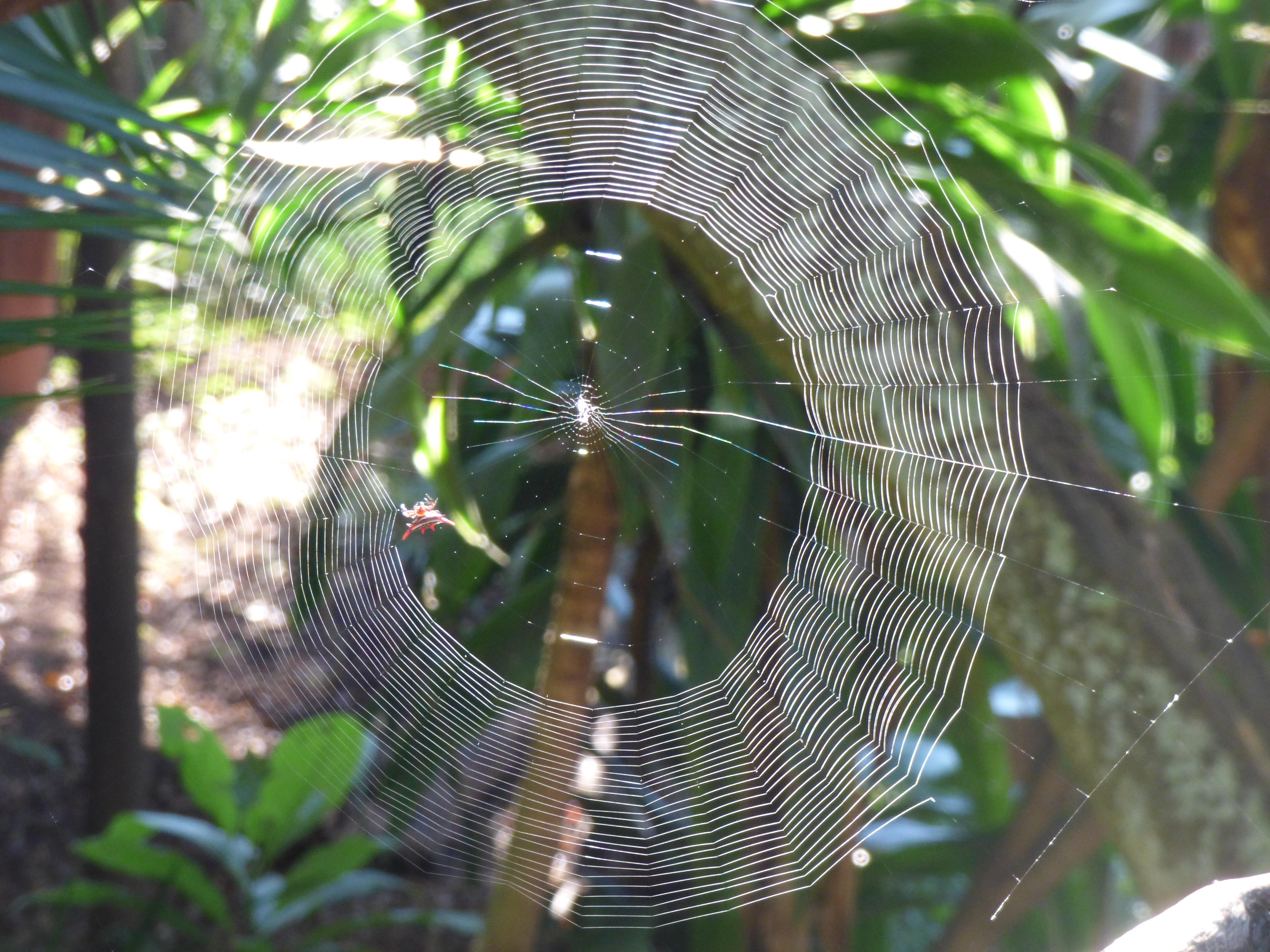
There was also a spider who made a lovely web that I was able to capture well.
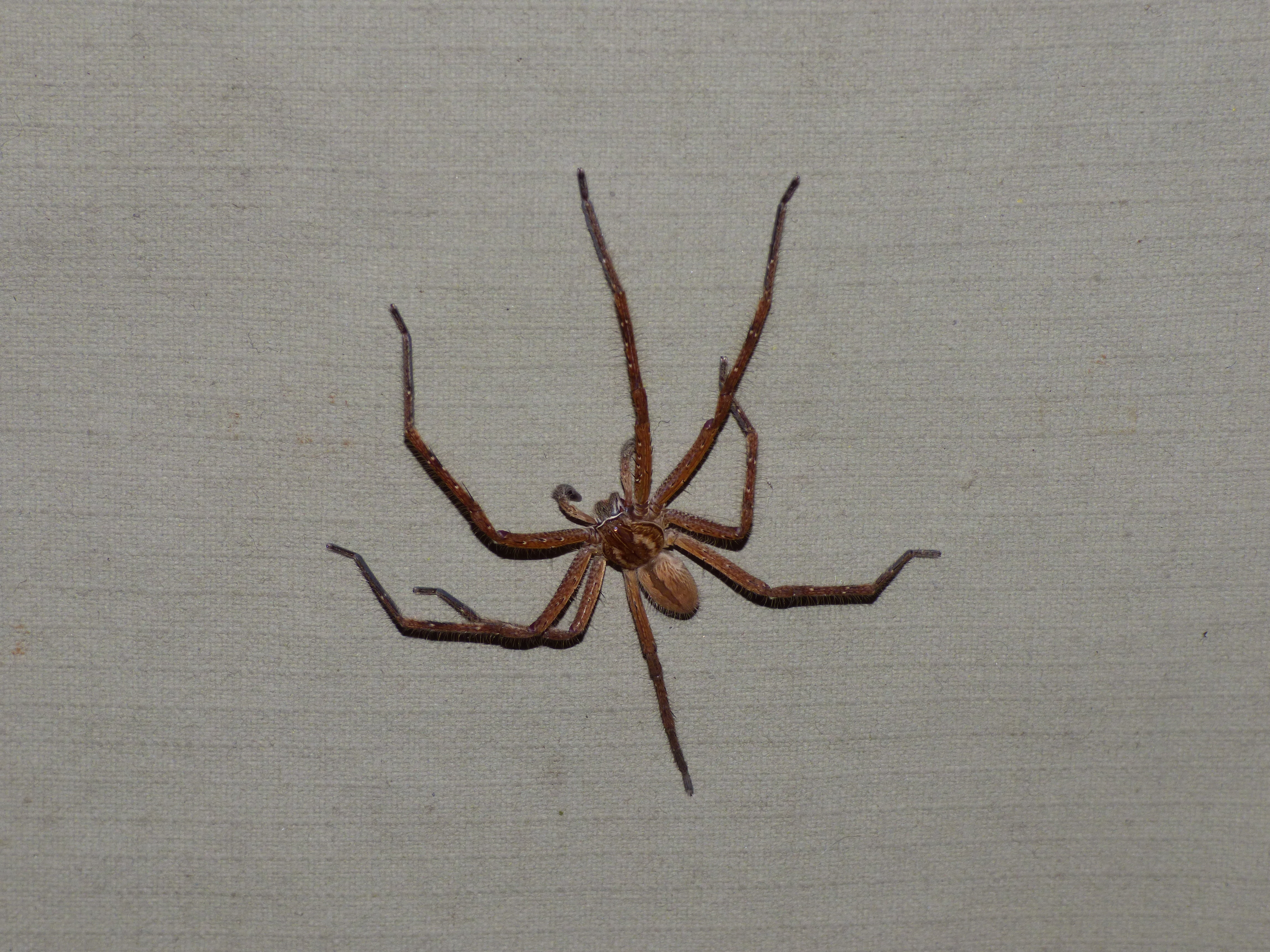
And a spider elsewhere that was about 3″ across – not sure if poisonous or not but he stayed still for a photo op.
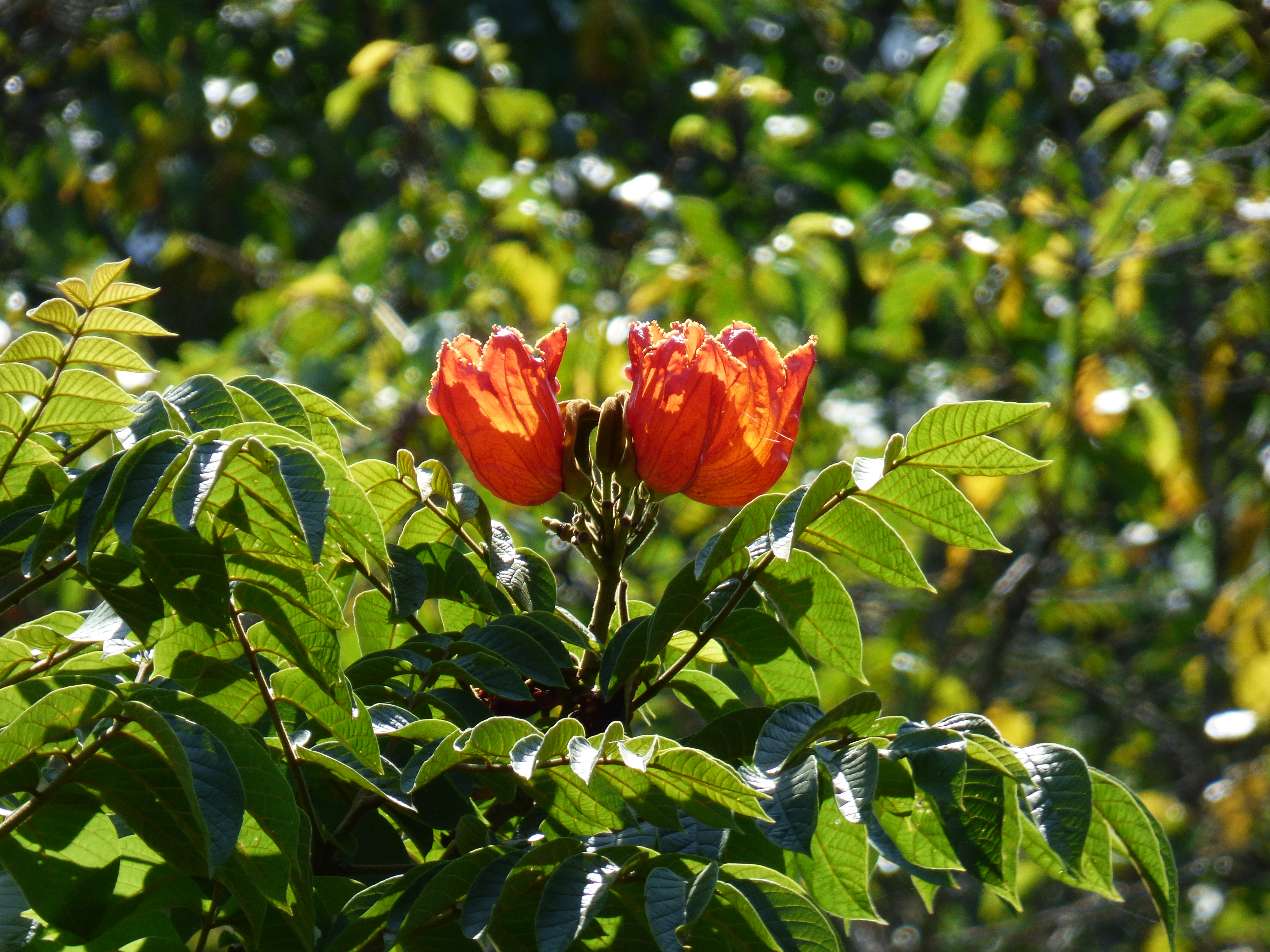
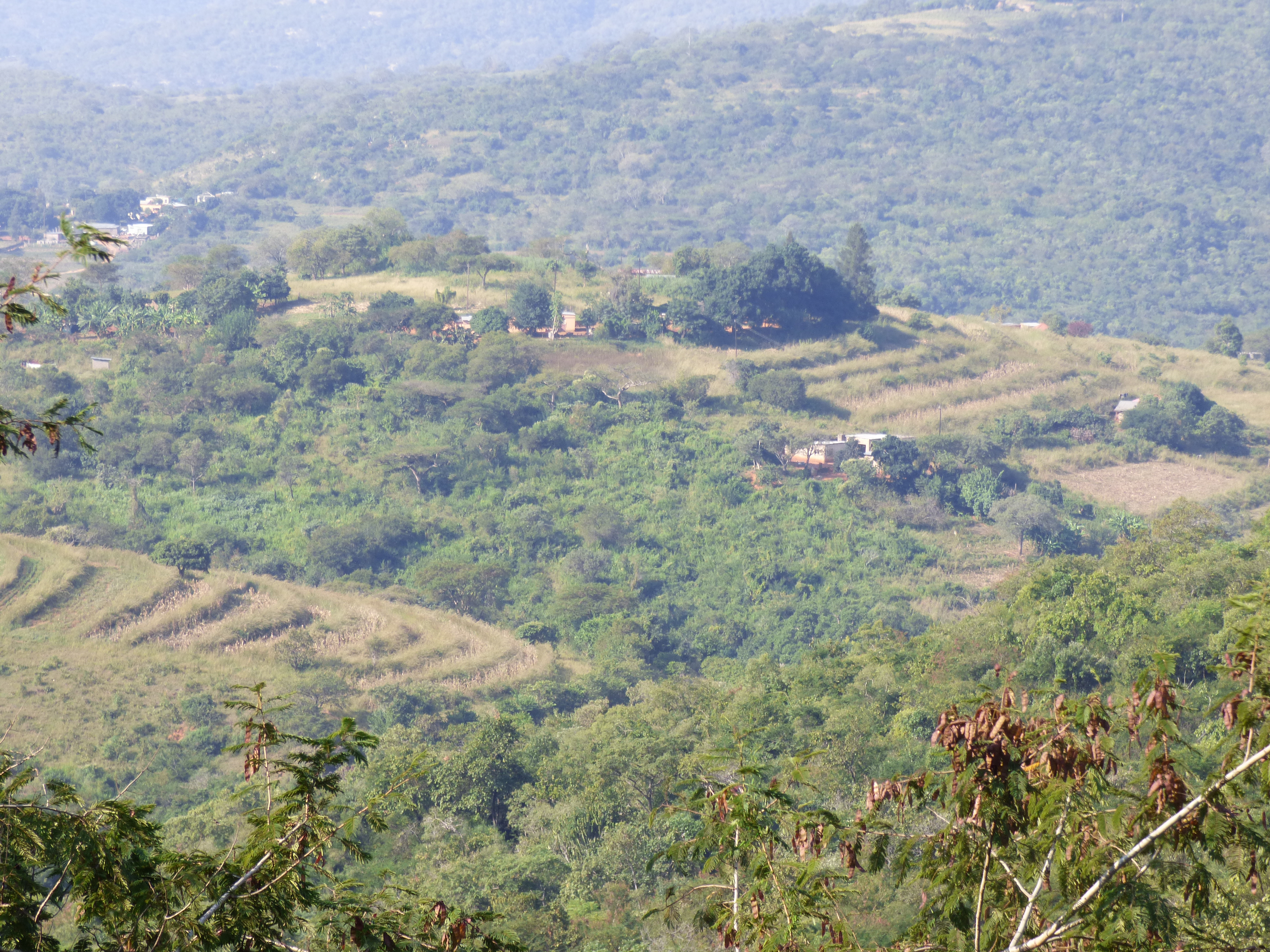
There were also pretty flowers and terraced farming to be seen.
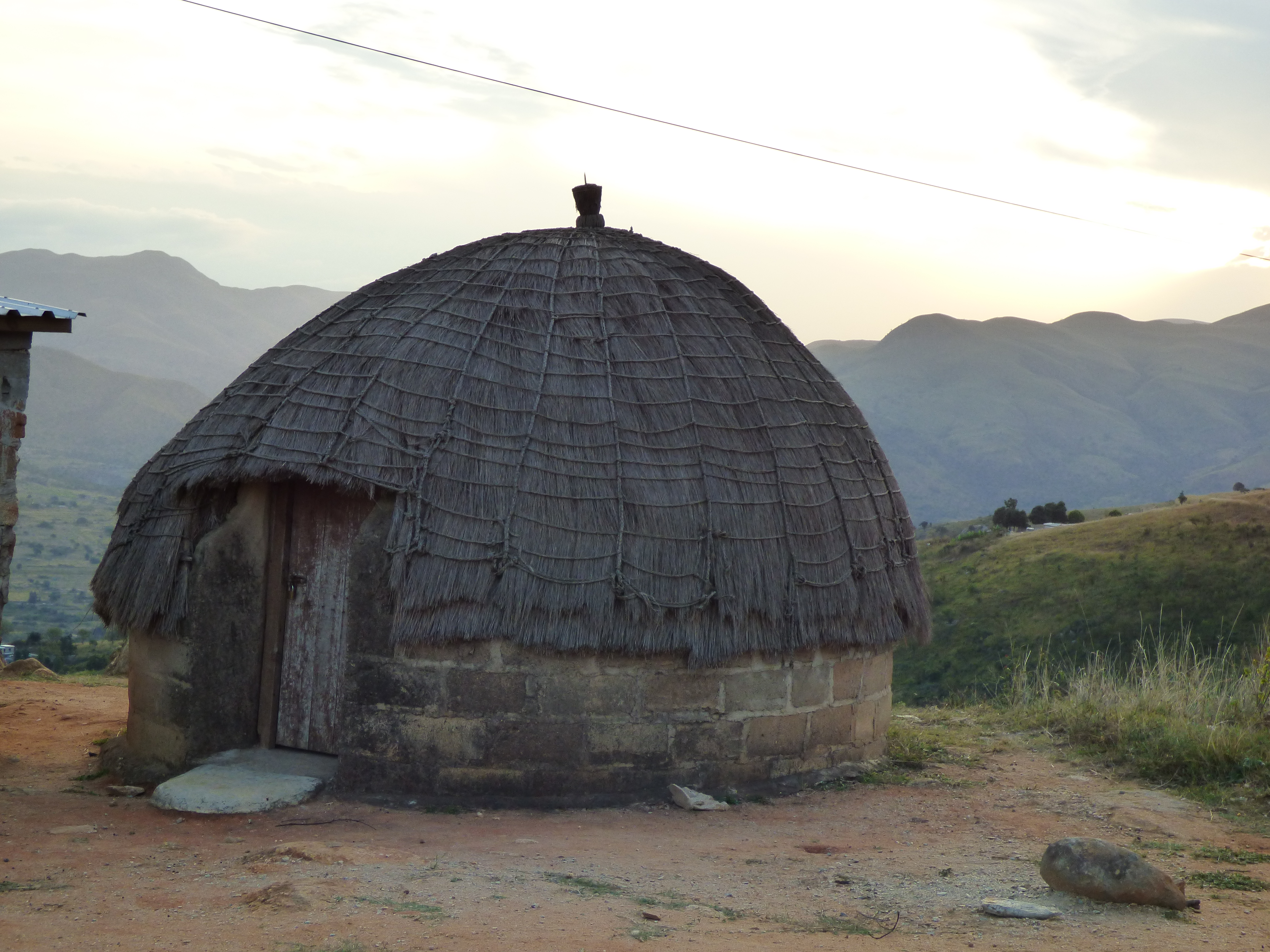
After another hike on Sunday morning, I headed back to South Africa and Pretoria and stopped near this roundavel where they were selling crafts – and bought 3 red straw angels for my Christmas tree that I still have and enjoy hanging every year.
And, of course, given my ticket in Dandriga the other day – there is a story of another manner of treating tourists – this time for South African tourists (my car had SA plates) heading home. Very shortly before the border, the excellent highway – with a speed limit of 100 kph – is suddenly posted, with no warning, 50 kph just before a roundabout. Never fear, the Swazi police were alert and waiting and I got pulled over for an on-the-spot fine. Since I only had 50 Rand visible in my wallet, they settled for 50 Rand!
An amazing weekend at a place that I will likely never get back to, much as I might want to.


 donnacapper